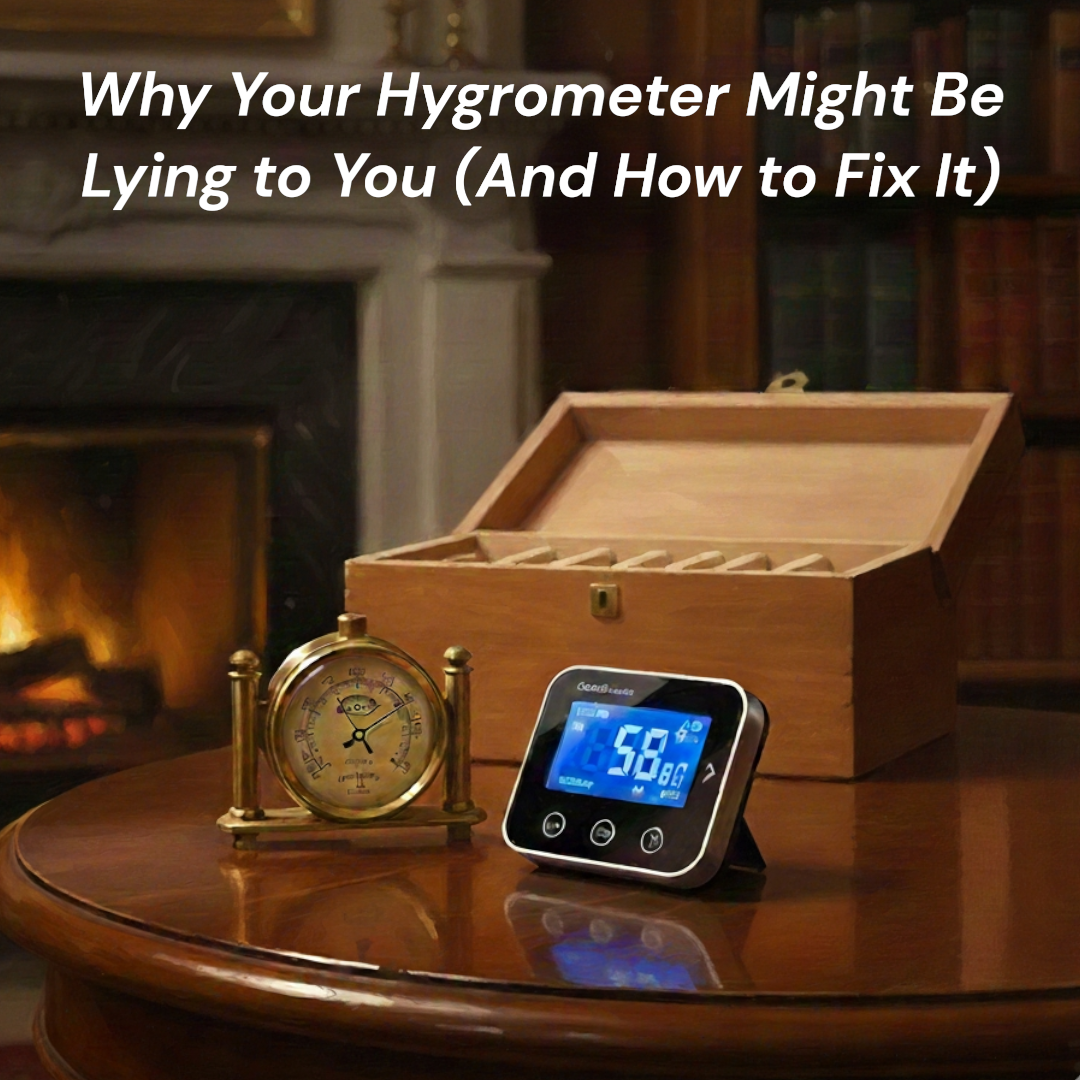
Picture this: a hygrometer reads 69% humidity—perfect conditions, right? But when someone pulls out a Padron that’s been resting for three weeks, the wrapper is cracking like desert clay. An inaccurate hygrometer. Way off.
If you’ve been storing cigars for any length of time, you already know that humidity control isn’t optional—it’s everything. Too dry, and cigars smoke harsh and burn hot. Too humid, and you’re inviting mold, beetles, and a spongy draw that’ll ruin a $20 stick in seconds.
But here’s what most people don’t realize: even brand-new hygrometers can be wildly inaccurate right out of the box. We’re talking 5%, 10%, sometimes 15% off. And if you’re making humidification decisions based on bad readings, you might as well be storing cigars in a kitchen drawer.
What Is the Salt Test for Hygrometers?
The salt test has been around forever, and there’s a reason it’s survived—it works. No fancy equipment needed, just basic household items and about 24 hours of patience.
Here’s what you need:
- A bottle cap or small dish
- Table salt (not sea salt or kosher salt)
- Water
- A ziplock bag or airtight container
- Your hygrometer
The science behind this is beautifully simple. When you create a saturated salt solution in an enclosed space, it naturally produces 75% relative humidity. Not 74%, not 76%—exactly 75%. It’s one of those reliable constants that makes calibration possible without spending money on expensive equipment.
Step-by-Step: How Do You Calibrate a Hygrometer with Salt
Mix a tablespoon of salt with just enough water to make it look like wet sand—think of the consistency you’d need to build a sandcastle. You don’t want soup; you want damp salt that holds its shape.
Spoon this mixture into your bottle cap or dish. Place it in the ziplock bag along with your hygrometer, making sure they’re not touching each other. Seal the bag completely. Now comes the hard part: waiting.
Let it sit undisturbed for at least 6 hours, though 24 hours gives you the most accurate reading. Don’t open the bag to check on it every hour (yes, the temptation is real). The environment needs that time to stabilize properly.
After the waiting period, check the hygrometer reading without opening the bag. If it reads 75%, congratulations—your hygrometer is accurate. But chances are, it won’t be spot-on.
How to Read and Adjust Your Salt Test Results
Most hygrometers will read somewhere between 68% and 78%. Let’s say yours reads 70%. That means it’s running 5% low. Every time it shows 65% in your humidor, the actual humidity is 70%. Write that offset down somewhere—on the back of the hygrometer, in a phone note, wherever it’ll be remembered.
If yours reads 80%, it’s running 5% high. When it shows 70% in your humidor, the actual humidity is 65%. That’s the difference between proper aging and dried-out cigars.
Some digital hygrometers have a calibration button that lets you adjust the reading directly. If yours has this feature, press it while the hygrometer is still in the bag showing its salt test reading. This resets the baseline to 75%, and you’re good to go.
For analog hygrometers, there’s usually a small screw on the back. Use a mini screwdriver to adjust the needle to 75% while it’s still in the sealed bag. Turn slowly—these adjustments are sensitive.
Why Did My Salt Test Fail? Common Problems and Solutions
Sometimes people get readings that seem impossible—like 55% or 90%. If this happens, the salt mixture is probably the culprit. Too much water dilutes the salt concentration and throws off the entire test. Too little water, and the salt doesn’t create enough humidity.
Temperature matters too. The salt test works best at room temperature, around 70-75°F. Testing in a cold basement or hot garage won’t yield reliable results.
And here’s something that trips people up constantly: don’t use fancy salts. Sea salt, Himalayan pink salt, kosher salt—they all have different crystal structures and mineral contents that affect humidity generation. Plain iodized table salt is what you need. The cheap stuff works perfectly.
How Often Should You Calibrate Your Humidor Hygrometer?
Digital hygrometers tend to drift over time. Test yours every six months, or any time something seems off with your humidor conditions. If cigars are smoking differently than usual—harsh, plugged, or just not right—that’s your cue to run a salt test.
Analog hygrometers are less stable and need checking every three months. They’re also more prone to damage from being bumped or dropped. Any time an analog hygrometer takes a hit, test it before trusting it again.
Which Hygrometers Are Worth Calibrating? (Digital vs Analog)
Not every hygrometer is worth the effort of calibration. Those cheap round analog hygrometers that come free with budget humidors? They’re often so poorly made that they can’t hold calibration for more than a few weeks. Save yourself the frustration.
Digital hygrometers with actual brand names behind them—Boveda, Caliber IV, Xikar—these are built to be calibrated and will hold that calibration. The salt test actually means something with quality instruments.
If you’re still using the freebie that came with your humidor and it’s consistently off by more than 5%, just replace it. A decent digital hygrometer costs $20-30 and will save you hundreds in ruined cigars over its lifetime.
What Happens If You Don’t Calibrate Your Hygrometer?
Here’s the math nobody talks about. Let’s say there’s 50 cigars in a humidor, averaging $10 each. That’s $500 worth of tobacco. If the hygrometer is reading 5% high and cigars are actually being stored at 60% humidity instead of 65%, the entire collection is slowly desiccating.
Those cigars won’t mold or show obvious damage. They’ll just smoke terribly. Harsh, hot, lacking the complexity and smoothness they should have. You might think you got a bad batch or that the online reviews were wrong. Meanwhile, the real problem is sitting right there on the humidor wall, displaying a comfortable lie.
Beyond Basic Calibration: Maintaining Ideal Humidor Conditions
Once you’ve got an accurate hygrometer, the real work of humidity management begins. Different cigars prefer slightly different conditions. Connecticut shade wrappers can handle 65% beautifully, while thick Maduros often do better at 68-70%. Knowing your actual humidity—not what an uncalibrated hygrometer claims—gives you the control to dial in perfect conditions for your collection.
Some cigar enthusiasts keep multiple hygrometers in larger humidors to monitor different zones. Humidity can vary by several percentage points from top to bottom in a tall cabinet humidor. But this only works if those hygrometers are actually calibrated. Three inaccurate readings don’t somehow average out to accuracy—they just give you three different wrong numbers.
The salt test isn’t glamorous. It doesn’t involve expensive gadgets or complicated procedures. It’s just salt, water, and patience. But it’s the foundation of everything else in cigar storage. Get this right, and suddenly humidor management becomes predictable instead of mysterious.
Your cigars deserve better than guesswork. They deserve accurate information. And accurate information starts with a properly calibrated hygrometer sitting in a ziplock bag with some wet salt for 24 hours.
It’s that simple. And that important.
Related Topics
- The Right Temperature for Storing Cigars: Your Complete humidor Guide
- How to choose the right humidor
- How to Store Cigars Without a Humidor: Practical Storage Solutions That Work
FAQ
The minimum is 6 hours, but 24 hours is ideal. Some people get impatient and check after 2-3 hours, but the humidity inside the bag needs time to fully stabilize. Overnight works perfectly—set it up before bed, check it the next evening.
The hygrometer might be accurate, but there could be other issues going on. Check for air leaks in your humidor seal, verify your humidification device is working properly, or consider whether your cigars need more resting time. Sometimes what seems like a humidity problem is actually a matter of cigars needing to acclimate after shipping.
No, Boveda packs are self-regulating and produce their stated humidity level (65%, 69%, 72%, etc.). However, your hygrometer still needs calibration to accurately monitor what the Boveda is doing. The pack works fine—you just need to make sure you’re reading the environment correctly. Kind of like how your oven temperature is what it is, but your thermometer still needs to be accurate to verify it.
It’ll tell you how far off they are, but cheap hygrometers often can’t be calibrated or won’t hold calibration for long. Think of the salt test as a diagnostic tool. If a cheap hygrometer is 10% off and has no calibration screw or button, you’ve just confirmed it’s time to buy a better one. At least you know where you stand.
The test is ruined. Water droplets will give false readings, possibly way off. This is why the salt should be damp (like wet sand), not soupy. And keep the dish and hygrometer separated in the bag so they’re not touching each other.
For digital hygrometers, every 6 months is the standard recommendation. For analog hygrometers, bump that up to every 3 months since they drift more quickly. However, there are situations that call for immediate testing regardless of schedule: if you drop or bump your hygrometer, if your cigars suddenly start smoking differently, if you notice the reading seems stuck or unresponsive, after extreme temperature changes in your storage area, or any time you just have a gut feeling something’s off. Better to spend 24 hours on a salt test than to discover months later that your entire collection has been sitting at the wrong humidity.
Subscribe to our newsletter and find out about all new posts
Check out our latest posts
- The 20 Best Cigars for the Money
 The best cigars for the money are not the lowest-priced cigars on the shelf. They’re the ones where the price and the quality don’t match.… Read more: The 20 Best Cigars for the Money
 - How to Put Out a Cigar Properly: The Complete Guide
 Most guides online skip this entirely. They’ll walk you through cutting, lighting, draw technique — then nothing. The session just ends and you’re left staring… Read more: How to Put Out a Cigar Properly: The Complete Guide
 - Interview Escobar Cigars: Two Markets, One Brand, Zero Compromises
 Escobar Cigars has been carving out its place in some of the world’s most demanding markets — navigating strict European regulations, building a brand without… Read more: Interview Escobar Cigars: Two Markets, One Brand, Zero Compromises
 - Swecigars: Premium Cigar Distribution in Sweden Explained
 Most people pick up a premium cigar and never think twice about what it took to get there. Behind every cigar on a Swedish shelf… Read more: Swecigars: Premium Cigar Distribution in Sweden Explained
 - Do you inhale cigar smoke?
 Do you inhale cigar smoke? No. The smoke stays in your mouth, you taste it, then blow it out. Cigarettes get inhaled into the lungs.… Read more: Do you inhale cigar smoke?
 - El Septimo Cigars: The Complete Guide — cigar Reviews, Interviews & the Story Behind the Brand
 El Septimo cigars are a Swiss-founded luxury cigar brand owned by Zaya Younan. Tobacco is grown without pesticides at high altitude, fermented for 12 months… Read more: El Septimo Cigars: The Complete Guide — cigar Reviews, Interviews & the Story Behind the Brand
 - Cigars vs Cigarettes: What’s the Difference?
 Cigars and cigarettes both involve tobacco, but that’s about where the similarities end. The difference between smoking a premium cigar and grabbing a quick cigarette?… Read more: Cigars vs Cigarettes: What’s the Difference?
 - Sex and Cigars Trigger the Same Parts of Your Brain
 It’s that hour. The one you’ve been quietly looking forward to all day. You settle into your chair — the leather cool for just a… Read more: Sex and Cigars Trigger the Same Parts of Your Brain