
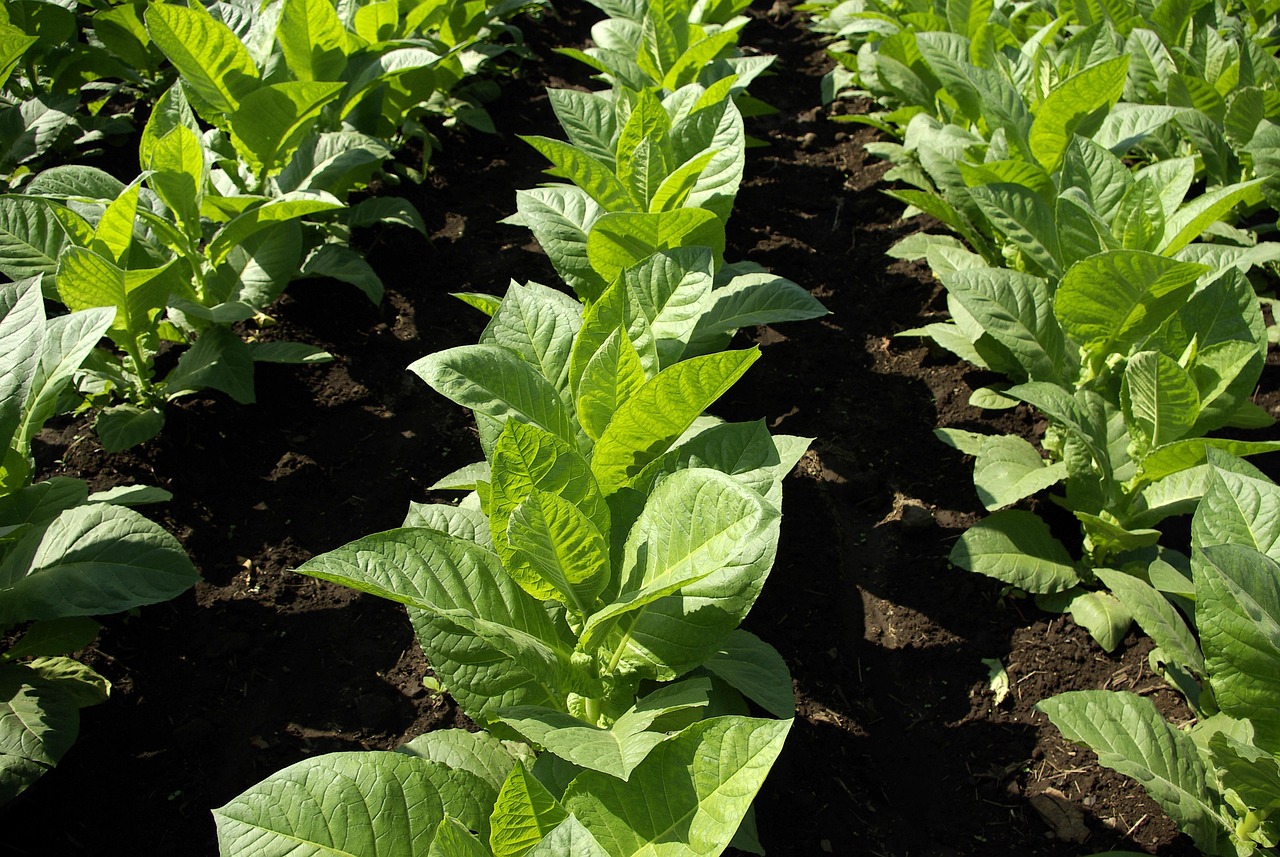
Behind every cigar lies a craft that begins long before the tobacco reaches the table for rolling. In the fertile soil of the fields, seedlings are planted with care, and through months of care, the leaves grow – shaped by climate, soil and human experience. Every step in the cultivation requires precision, patience and respect for the process. The harvest is done by hand, with an eye for detail and the right ripeness.
Many times we are met with the perfect picture, the plants are seen in the greenhouse, the leaves grow, the tobacco is fermented, the cigars are rolled and put into storage. The truth is that the road to the cigar you just smoked or are holding in your hand right now began its journey long before the greenhouse. A hard and laborious work with an incredible number of working hours before the move from greenhouse to field is even possible.
The field where the magic begins and is rarely seen. The soil will determine the flavors
Have you ever smoked a few cigars from a brand that you love only to find a few years later that they don’t taste the same at all? At first you think that your taste buds have changed so mutch that the cigar tastes different. But the fact is that the nutrients in the soil have changed so to a level that the same tobacco variety from exactly the same place has acquired a different flavor character. Even if the blend is exactly the same, the taste is completely different.
Poorly cultivated soil means that the harvest is reduced, given that the tobacco does not have the same opportunities to take root and absorb nutrients. Which means that it may even become unusable.
We will use Nicaragua’s soil as an example. Why Nicaragua is because an incredible number of cigars come from there and the soil in Nicaragua is the most difficult to cultivate. The soil is mineral rich and incredibly moist, which means that it clumps to a point where the roots have difficulty gaining a foothold if the soil is cultivated incorrectly. The changing climate with rain means that the nutritional value in the soil can change slightly from year to year, which also means that you have to think twice about how the soil should be cultivated. Too much rain during the rainy season can cause nutritional values to drop and with it a poorer harvest if you are not careful with what you do.
This is the story behind the soil. A laborious and precision-conscious work that gives plants the opportunity to grow
Tobacco is grown in warm climates and during dry periods for the reasons of being able to control the firmness, nutritional value and irrigation of the soil. Tobacco grows best in a soil that is almost as porous as sand. If the soil is more lumpy, the roots have difficulty gaining a foothold and getting nutrients to grow.
But how do you do it and how much work is required to get the soil in the ultimate density to get a good harvest? If you let the soil dry out, the outer crust will become a little more porous while the soil underneath is a little more lumpy. To get the right density on the soil, it is necessary to plow the field several times to let the soil slowly dry out. A laborious job that must be done time and time again and takes days to perform by skilled farmers. If the farmer makes a mistake, he can risk the upcoming harvest he has ahead of him. Although turning the soil with a tractor may not sound particularly difficult and laborious, it takes time and is incredibly important that it is done correctly. If you don’t get the right consistency in the soil, neither the roots will take hold nor the nutrients will be absorbed properly.
Before the farmer start to continue working the soil, samples are often sent for analysis. By sending them for analysis, they find out which values are low and high and then you get recommendations on what type of fertilizer to use to recreate the perfect environment for the tobacco. The reason is that the soil changes throughout the year and you do this to increase the chances of a good harvest and tobacco that has the same qualities as the years before. If the nutritional value changes, it will affect the flavors of the tobacco and the quality of the harvest.
Now comes another thing that is incredibly interesting in my opinion. Not even the fertilization of the soil is usually done by machine.
There are two methods used.
1. Everything is done by hand. The plantations are large and the work is time and energy consuming. Fertilizer is spread over the entire field by hand so that tractors do not destroy the soil and reduce the possibilities for the harvest.
2. Special hoses are laid out along the entire field with holes where the plants will be and the fertilizer is sprayed that way. The hoses are pulled by hand.
What I find incredibly interesting about this part is that by reducing the use of machinery, you increase the space for more harvests and reduce climate impact. Call me crazy if you want, but have you looked at today’s food industries where tractors go up and down with fertilizer to increase speed and reduce labor? If more industries were to do the same thing as tobacco planting, more people would have opportunities for work, climate impact would be reduced and the land could be used more productively.
Meanwhile Green house
While the work is going on with the soil, the plants that will later become the cigars we get to enjoy are prepared. The small dust-sized seeds are placed on trays with cells filled with seed soil. Unlike many other crops, the seeds are not covered with soil and are allowed to lie on top of the soil. The trays are placed in greenhouses that are temperature and humidity controlled. The optimal climate is 25-30 degrees with a humidity of about 90%. “It is also not uncommon to use plant lighting.After about 2-3 weeks, the small seeds have taken root and begun to develop leaves. When the plants start to get leaves, everything goes much faster. The plants are watered gently with nitrogen-rich nutrition with a mist of water to reduce the risk of damaging the plants and optimize growth. When the plants reach a size of about 5-7 centimeters, they are transplanted into larger pots with nutrient-rich soil and allowed to grow strong to about 20-30 centimeters. During this period, the plants are exposed to more and more sunlight and a drier, airier climate to slowly get used to growing outdoors. During growth, the plants are checked regularly. Height and leaf size are checked, as are the strength of the stems. Diseased and weak plants are thinned out. This entire process takes about 1.5 – 2 months. The process is very delicate and requires careful work to get the best possible result.
A new part of the craft is taking off: the move from the greenhouse to the field
I am impressed by the commitment of all the people in the process of getting the perfect cigar. Unlike other tobacco varieties, Black Tobacco is handled with a little more care, caution and passion.
Each plant is replanted by hand, spaced at about 50-60 centimeters from each other. The distance gives the roots more space to grow; water and nutrition they receive are not something they compete for. Irrigation pipes are pulled by hand along the fields. The tobacco grows between 60 – 100 days up to 120-180 cm depending on the type and during this period if it does not rain, it is watered about 5 times carefully. A little trick used to make the roots grow faster is to water a little extra on one of the irrigation days; this makes them hungry for more, and the roots grow stronger in search of water. Tobacco is sensitive and requires nitrogen; overwatering poses the risk of destroying the harvest. Meanwhile, the growth is carefully and passionately monitored, you look over the leaves and quickly notice how they are doing. Like flowers, the color changes and the leaves become droopy when the nutrition is too low. Imagine when you have received too little nutrition for a while, your body collapses, you may become a little pale and you are generally tired, the same goes for the plants. The color changes easily and they start to droop. To increase the nutrition of the tobacco, the leaves under the volado are removed at the bottom of the plant to increase the nutrition of the remaining plant.
I can’t help but be impressed by all the dedication, passion, knowledge and hard work that goes into it before the cigar even gets to the curing barn. Unlike many other goods that are grown and consumed such as vegetables, fruits and some spices that do not need to be fermented, the tobacco is far from finished. Tomatoes are picked, washed and sorted, potatoes, lettuce and many fruits the same, everything is done quickly to get to the consumer before they go bad, the tobacco has just begun its journey.


During my journey through the world of cigars, I came across Tony Barrios and Stallone cigars, whom I interviewed and wrote an article about. Tony is a big part of why I am writing this particular series. During our interview, he spoke wholeheartedly about agriculture and the importance of the soil. We rarely read about all the hard work that goes into the field before the tobacco is planted and the importance behind the work. In order to give you the opportunity to read about parts that are rarely seen, I asked Tony for help. Tony welcomed my request for help by opening his arms to share his knowledge. A wholehearted kindness and time that I will never forget.

Subscribe to our newsletter and find out about all new posts
Check out our latest posts
- Robusto vs Toro: Real Smoke Times, Flavor and Which One to Choose
 Robusto vs toro. Stand in front of any walk-in humidor long enough and you will face that choice. Two shelves. Two sizes. Often the same… Read more: Robusto vs Toro: Real Smoke Times, Flavor and Which One to Choose
 - Macanudo Maduro Diplomat Review: A Smooth, Fruity Maduro in a Short Figurado
 The Macanudo Maduro Diplomat is a mild-to-medium figurado that offers more brightness than most maduros. Over 60 minutes it works through sweet cashew, remarkably ripe… Read more: Macanudo Maduro Diplomat Review: A Smooth, Fruity Maduro in a Short Figurado
 - Brun del Ré Cigars and Carlo Corazza: The Costa Rican Puro That Ferments for Over a Year

By Peter Stefanic, VDG Cigars There is something magical about cigars and their ability to bring people together. When my interview with Carlo Corazza of Brun del Ré began, I had pictured us starting at the beginning, with the story of the cigars. Instead we spent the first thirty minutes talking about everything from politics […]
- The story of Karina Owen Part 1 of 3: At the End of the Night

A Instagram notification. A new follower. @staynclassyowen. We had been circling each other for the better part of a year by then, the way people in this business do. Two people working in cigars, on two different continents, exchanging messages about a collaboration that never quite got scheduled. Friendly. Professional. Going nowhere in particular, that […]
- The Leaf That Changes Everything: Why La Flor de Zaida and Medio Tiempo Belong in the Same Sentence

You buy a watch. A good one. You expect a reliable movement. But when you open the case, sitting inside is a hand-finished Swiss caliber. Every gear, every spring, every component touched by human hands. The same one that drives a Rolex Daytona. In every piece. As standard. That is what Antonio Piredda built with […]
- La Flor de Zaida Brings the Diamond Collection and Ralf Moeller to InterTabac 2026

Some brands go to Dortmund to take orders. La Flor de Zaida goes to make a statement. InterTabac opens at Messe Dortmund on Tuesday, September 15. Three days, more than 800 exhibitors, around 14,500 trade visitors. In Hall 4, something unique is about to happen. Antonino Piredda and La Flor de Zaida are at booth […]
- Casa Magna Colorado Torito Review: A Rich, Approachable Everyday Full-Bodied
 The Casa Magna Colorado Torito packs a lot of cigar into a short, thick format. Over an impressive 105 minutes this Nicaraguan puro works through… Read more: Casa Magna Colorado Torito Review: A Rich, Approachable Everyday Full-Bodied
 - Aroma de Nicaragua Connecticut Toro Review: A Long, Gentle Nicaraguan With Unusual flavors
 The Aroma de Nicaragua Connecticut Toro is a mild-to-medium cigar that quietly overachieves. Over an extraordinary 100 minutes it works through cedar, nutmeg, vanilla bean,… Read more: Aroma de Nicaragua Connecticut Toro Review: A Long, Gentle Nicaraguan With Unusual flavors
