
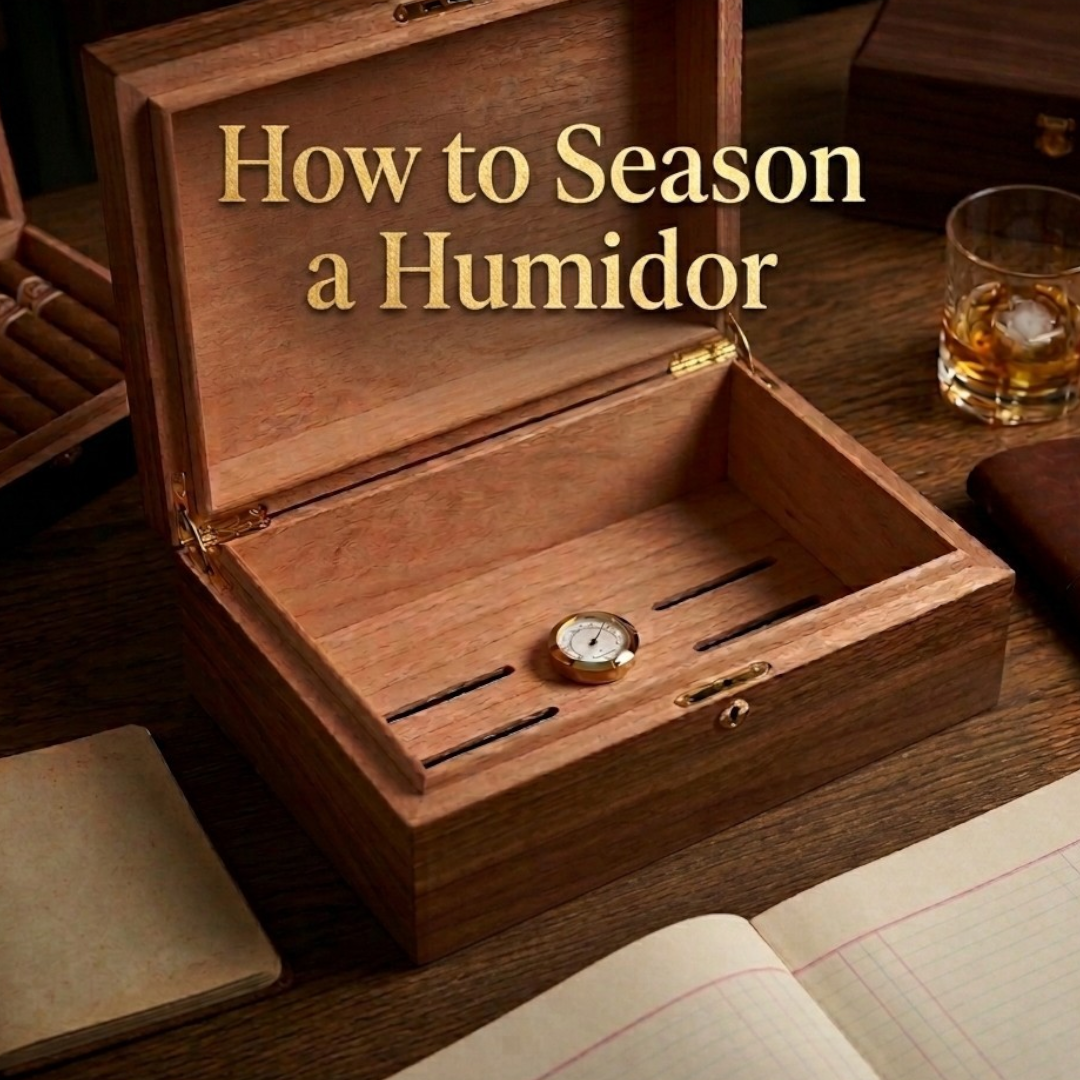
How to season a humidor is one of the first things every new cigar smoker has to figure out — usually right after they’ve already made the mistake of skipping it. A brand-new humidor looks ready to use. It isn’t. The dry Spanish cedar lining will pull moisture straight out of your cigars until it reaches equilibrium, and by the time you notice something’s wrong, the damage is done.
Seasoning fixes this. It saturates the cedar before your cigars go in, so the wood is already in equilibrium when you load up the humidor. Takes 3–14 days depending on the method. Do it once, do it right, and you won’t think about it again for years.
This guide covers the two main methods — distilled water and Boveda — plus when re-seasoning becomes necessary, what actually goes wrong, and why tupperdors and coolerdors don’t need it at all.
Choosing a humidor first? How to Choose the Right Humidor
Why Seasoning a Humidor Matters
Spanish cedar is hygroscopic — it absorbs moisture until it matches the humidity of whatever environment it’s sitting in. Factory-fresh cedar is bone dry. Put cigars into an unseasoned humidor and the wood immediately starts pulling moisture from the nearest source, which happens to be your tobacco.
No humidification device can keep up with that. The cedar wins. Wrappers lose their pliability and crack. The filler dries, compresses, and burns hot. Flavors that took years to develop get incinerated before they reach your palate. In a very dry environment, you can go from a fresh premium cigar to something unsmokable in under a week.
Once the cedar is properly seasoned, it stops competing with your cigars and starts working with them. It absorbs slight humidity spikes and releases moisture during dry periods — a buffer that makes the whole system more stable. That’s the point of the wood. It just needs to be conditioned first.
Before You Start: Two Things You Actually Need
Most seasoning guides list five things you need. It’s really two.
A digital hygrometer you’ve calibrated. The analog dial hygrometer that ships with most entry-level humidors can read 10–15% off straight out of the box. If you’re relying on a hygrometer that says 70% when the real number is 58%, you’ll think the seasoning worked when it hasn’t. Calibrate before you start — the salt test takes one evening. How to Calibrate a Hygrometer: Salt Test Guide
Distilled water. Not tap water. Tap water carries dissolved minerals — calcium, magnesium, whatever your local supply contains — that deposit on cedar over time and can introduce contaminants. Distilled water costs next to nothing and removes the variable entirely. There’s no reason to use anything else.
Method 1: Distilled Water (3–7 Days)
The method that’s been working for decades. Faster than Boveda when done correctly, and it costs almost nothing. The only real risk is using too much water — more on that below.
Step 1: Wipe the Cedar
Dampen a clean cloth with distilled water — damp, not wet. Wipe every interior cedar surface: bottom, sides, lid lining, trays, dividers. The wood should look slightly darkened and feel cool to the touch, not dripping. If water is beading up or running off, you’ve used too much. Pooled water on cedar causes warping, especially on thin tray bottoms.
Step 2: The Sponge Setup
Soak a sponge in distilled water and wring it until it’s heavy but not dripping. Lay a zip-lock bag flat on the humidor floor and place the sponge on top of it. The plastic is a barrier — a saturated sponge sitting directly on cedar over several days can cause uneven absorption and bowing. Small detail, worth getting right.
Step 3: Charge the Humidification Device
If you’re using foam, gel beads, or a crystal humidifier, saturate it with distilled water, then shake or drain the excess over a sink. It should be full but not leaking. Place it in its normal position inside the humidor.
Step 4: Close the Lid and Leave It
Set the hygrometer inside, close the lid, and don’t open it for at least 3 days. Every time you lift the lid you dump the accumulated humidity and slow the process. The hardest part of seasoning a humidor is leaving it alone.
Step 5: Read the Numbers and Decide
After 3 days, check the hygrometer. Readings of 80% or above are completely normal at this stage — the sponge is releasing a lot of moisture and the cedar is absorbing heavily. This isn’t a problem. Don’t remove the sponge yet.
By day 5, pull the sponge out. Close the lid again and leave it for 2–3 more days. When the reading holds steady between 68–72% without any extra moisture source, the humidor is ready. If it’s still swinging or sitting low after 7 days, do another wipe-down and give it more time. Larger humidors and very dry climates can need the full 14 days.
Method 2: Boveda 84% (14 Days)
Slower, but almost impossible to get wrong. No wiping, no sponges, no risk of warping the cedar with too much water. For anyone who wants to set it up and forget it for two weeks, this is the right method.
What You Need
Boveda 84% RH seasoning packs — not the 69% or 72% maintenance packs. The 84% version is designed specifically for conditioning dry cedar. Sizing: one Size 60 pack for every 25 cigars your humidor is rated to hold. A 100-count humidor needs four packs.
The Process
Remove the outer plastic overwrap from each pack and place them inside the empty humidor. Close the lid. Leave it for 14 days. Don’t open it to check readings — the 84% packs are doing their job whether your hygrometer says 75% or 92%. The moisture releases slowly and evenly throughout the two weeks.
After 14 days, remove and discard the seasoning packs. They’re single-use and can’t be recharged. Add your cigars and switch to your regular maintenance packs at whatever RH you’ve chosen.
The Boveda method is the better choice for beginners specifically because removing the decision-making removes the failure points. There’s nothing to adjust, nothing to monitor, no judgment calls about whether the cedar looks damp enough.
After Seasoning: Loading the Humidor
Seasoning complete — now the common mistake is filling the humidor too fast. Start at 50–60% capacity, let the humidity stabilize for a day or two, then add the rest of your cigars. A well-conditioned humidor with a decent seal should reach its target RH and hold it within 24–48 hours of being loaded.
If you’re using Boveda for ongoing maintenance, 69% is the right starting point for most cigars and most humidors. It sits in the middle of the safe range and works for virtually all premium handmade tobacco. Once you have a sense of how your specific humidor performs, you can adjust from there.
Full humidity management guide: How to Store Cigars: The Complete Humidity Guide for Your Humidor
Five Mistakes That Cause Seasoning to Fail
Using Tap Water
Minerals in tap water deposit on cedar over time and can eventually affect how the wood manages moisture. It’s an easy variable to eliminate — distilled water is cheap and widely available. Use it every time.
Soaking the Cedar Instead of Wiping It
More moisture is not better. Cedar absorbs what it can absorb — beyond that, water just sits on the surface and causes warping. The wipe should leave the wood slightly darker and cool to the touch. If it looks wet, you’ve overdone it.
Opening the Lid Repeatedly
Checking the humidor every day during seasoning is counterproductive. Each opening drops the internal humidity, makes your hygrometer reading meaningless, and extends the total time needed. Set it up once and leave it for the full 3–5 days minimum before the first check.
Trusting the Analog Hygrometer That Came With It
Entry-level analog hygrometers are notoriously unreliable. A reading of 70% on an uncalibrated analog dial could mean the actual humidity is anywhere from 58% to 82%. Calibrate with a salt test before you start, and use a digital hygrometer if at all possible.
Adding Cigars Before the Readings Stabilize
An underseasoned humidor doesn’t just fail to protect your cigars — it actively dries them out as the cedar continues absorbing moisture. Stable means steady: the reading holds at your target RH for at least 24 hours with no extra moisture source present. If it’s still swinging by several percentage points between checks, it’s not done.
When to Re-Season
A correctly maintained humidor that stays loaded and humid doesn’t need re-seasoning. The cedar holds its conditioning as long as the environment inside stays consistent. Re-seasoning becomes necessary in specific situations only:
The humidor sat empty for months. Dry cedar dries out. If the humidor has been unused and closed for a long period, treat it like new before adding cigars again.
The humidity crashed hard. If internal RH dropped to 60% or below for an extended stretch — humidification device ran dry, humidor was left open, whatever the cause — the cedar has likely lost significant conditioning. Re-season before trying to recover the humidity through normal maintenance.
You cleaned the interior after a mold problem. Wiping cedar down with distilled water and letting it fully dry strips the conditioning. Start fresh.
Very dry climates. Boveda specifically recommends re-seasoning once or twice a year in desert environments or homes with heavy winter heating, where the cedar loses conditioning faster than average.
Does a Tupperdor or Coolerdor Need Seasoning?
No. Seasoning is about wood — specifically, conditioning dry cedar so it stops competing with your cigars for moisture. Plastic, acrylic, and metal containers don’t absorb humidity. A tupperdor is ready to use the moment you add a Boveda pack and a hygrometer.
This is a genuine practical advantage of non-wooden storage for beginners. No waiting period, no risk of warping, no seasoning mistakes. Just seal, add packs, add cigars.
Budget storage options that skip this step entirely: How to Store Cigars Without a Humidor
Frequently Asked Questions
The distilled water method takes 3–7 days for most standard desktop humidors. Large humidors and very dry environments can push that to 14 days. The Boveda 84% method always takes 14 days with no shortcuts — the packs release moisture gradually over the full two weeks.
No. The cedar is actively pulling moisture from its environment during seasoning — that includes any cigars inside. Keep them in a sealed zip-lock bag with a small Boveda 69% pack while the humidor conditions. A few days in temporary storage won’t hurt them.
Not at all. High readings during the distilled water method are normal. The wet sponge is releasing a lot of moisture and the dry cedar is absorbing it aggressively. The reading will settle once the cedar approaches equilibrium and the sponge is removed. Don’t adjust anything — just wait.
Yes. The 69% and 72% maintenance packs are not designed to condition dry cedar — they’re calibrated to maintain a specific RH in an already-stable environment. Put a 69% maintenance pack into an unseasoned humidor and the dry cedar will exhaust it in days. Season with the 84% packs first, then switch to maintenance packs.
With the Boveda method, no — the 84% packs are self-limiting and stop releasing once the cedar reaches equilibrium. With distilled water, leaving a soaking sponge in direct wood contact for extended periods can cause uneven absorption and warping. That’s why the zip-lock bag barrier matters and why wiping damp rather than wet is important.
Only if it has wood trays or shelves inside. The wooden components need conditioning even if the cabinet itself is not wood. Boveda recommends placing 84% packs in an empty, unplugged wineador for 7 days — shorter than the standard desktop humidor seasoning because wineador cedar components are typically thinner.
Read more about cigar storage
How to store cigars long-term: How to Store Cigars: The Complete Humidity Guide
Choosing the right humidor: How to Choose the Right Humidor
Budget storage that skips seasoning: Making a Cheap Homemade Humidor
New to cigars: How to Smoke a Cigar: The Complete Beginner’s Guide
If this post answered one question, there are dozens more worth exploring. Over the years on VDG Cigars, every major topic in the premium cigar world has been covered — beginner guides, storage, palate training, troubleshooting, pairing, brand deep-dives, and original interviews with founders. It is all collected in one place: The Complete Cigar Guide: Everything You Need to Know About Premium Cigars.
Subscribe to our newsletter and find out about all new posts
Check out our latest posts
- What Is a Connecticut Cigar? The Wrapper Explained
 A Connecticut cigar is named after its wrapper. Not the country it was made in, not the filler inside it. The tobacco in the middle… Read more: What Is a Connecticut Cigar? The Wrapper Explained
 - How a Cigar Is Made, From Seed to Shop
 The cigar in your hand took longer to make than most people think, and almost none of that time was spent rolling it. Rolling is… Read more: How a Cigar Is Made, From Seed to Shop
 - Top 30 Best Winter Cigars (2026): Reviewed by Flavor, Body and Smoke Time
 Winter changes the whole cigar. The evenings start at four. The smoking chair moves closer to the fire, or the cigar moves out to the… Read more: Top 30 Best Winter Cigars (2026): Reviewed by Flavor, Body and Smoke Time
 - Cigar Ring Gauge in mm: Every Size, and What Thickness Actually Changes
 Ring gauge is how thick a cigar is. The second number in a 5 x 50 is the ring gauge, and it counts in sixty… Read more: Cigar Ring Gauge in mm: Every Size, and What Thickness Actually Changes
 - Horacio 8 Classic Review: A Small, Nutty Costa Rican Everyday Smoke
 The Horacio 8 is a short, medium-bodied cigar that packs plenty of flavor into a compact format. Over 50 minutes it works through sweet almond… Read more: Horacio 8 Classic Review: A Small, Nutty Costa Rican Everyday Smoke
 - Karina Owen: The Woman Who Built Her Own Name (Part 3 of 3)
 Something personal before any of this begins. I have been working on Karina Owen’s story for a few months now. Sitting here writing the last… Read more: Karina Owen: The Woman Who Built Her Own Name (Part 3 of 3)
 - Horacio Heritage 6 Review: A Full-Bodied Costa Rican With a Perfumed Floral Edge
 The Horacio Heritage 6 is a short, full-bodied cigar with an unusual, perfume-like floral character that sets it apart. Over 45 minutes it works through… Read more: Horacio Heritage 6 Review: A Full-Bodied Costa Rican With a Perfumed Floral Edge
 - Karina Owen: The Years That Taught Her People (Part 2 of 3)
 Part 1 of this interview ended with a door Karina Owen left unlocked. She had changed her degree, kept her credits, and told herself that… Read more: Karina Owen: The Years That Taught Her People (Part 2 of 3)
