
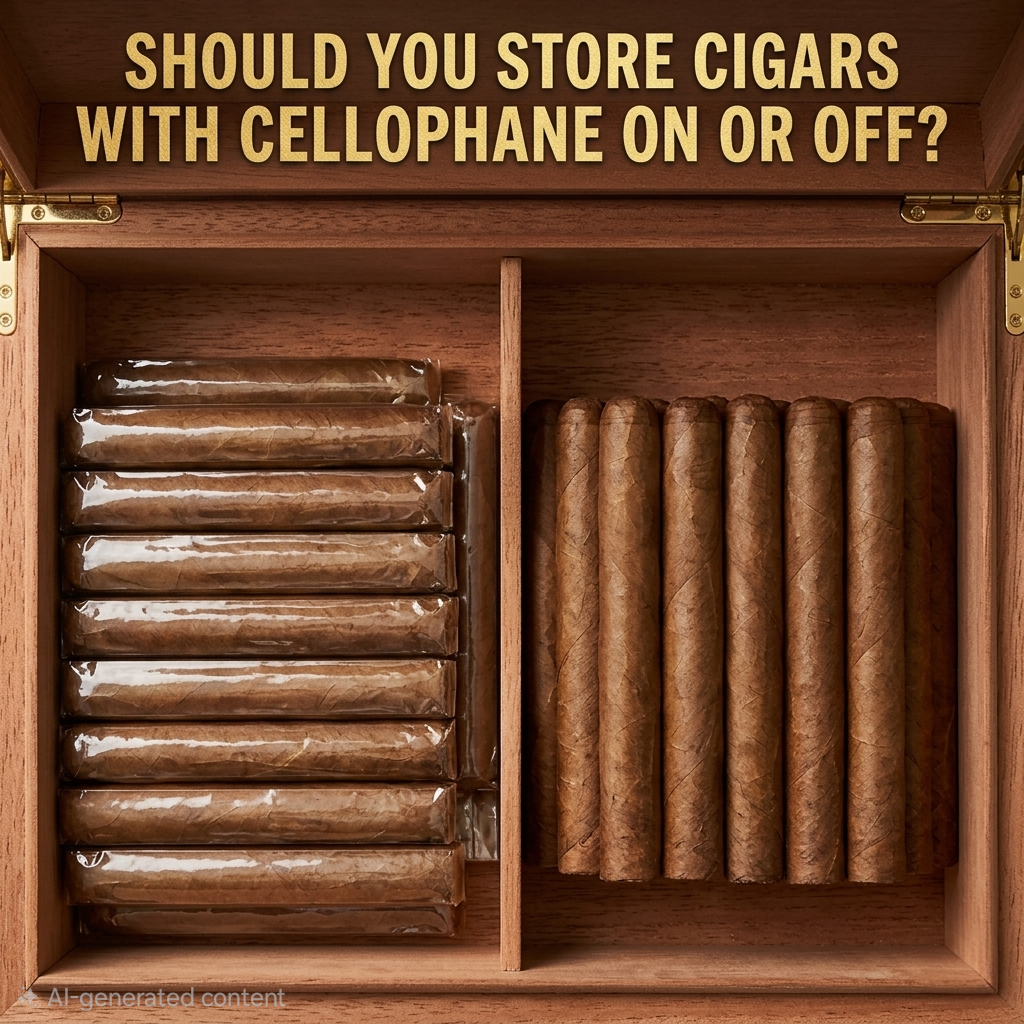
Should you store cigars with the cellophane on or take it off? It is one of the most asked questions in the hobby, and the answers floating around the forums contradict each other constantly. Some swear by naked storage. Others never touch the wrapper. Most articles end with a shrug and the words “personal preference,” which helps no one.
Here is the honest, complete answer, built on more than a decade of storing and aging cigars across four continents and hundreds of reviewed sticks.
Quick Answer
Keep the cellophane on if you store a mixed collection, smoke through your cigars within six months, travel with them, or run a humidor that swings in humidity. Take it off if you are aging cigars long term, box-aging a single blend, or running a stable, dialed-in humidor where you want the fastest, fullest flavor development. The right choice depends entirely on what you are trying to achieve, not on a universal rule.
Now the detail, because the “why” is what separates a guess from a decision.
What Is Cellophane, Actually?
Most of the bad advice about cellophane comes from one mistake: people treat it like plastic wrap. It is not.
Cellophane is a thin film made from regenerated cellulose, a plant-based material drawn from sources such as cotton, wood pulp, or hemp. The name blends cellulose with diaphane, an old word for transparent. A Swiss chemist named Jacques E. Brandenberger developed it in the early 1900s after watching wine spill across a restaurant tablecloth and deciding the world needed a waterproof film.
The detail that matters for storage is this: cellophane is semi-permeable. Water vapor passes through it slowly. It is not a seal and it is not airtight. The wrapper breathes, just at a reduced pace compared to a naked cigar sitting in open humidor air. Every other answer in this guide flows from that single fact.
What Cellophane Actually Does to Your Cigar
Strip away the opinions and four real effects remain.
It slows humidity exchange. A wrapped cigar absorbs and releases moisture more gradually. In a stable humidor that barely matters. In a humidor that fluctuates, the cellophane works as a buffer and softens the blow of a sudden swing.
It slows flavor development. Less air moves across the wrapper, so the slow oxidation that drives aging is moderated. Over a few months the difference is hard to detect. Over years it becomes real.
It limits flavor marriage. Cigars stored naked together slowly trade oils and aromas through the shared humidor air, a process smokers call marrying. In a box of fifty identical cigars that is a benefit. In a mixed humidor holding a bold maduro next to a delicate shade-grown wrapper, it can flatten the distinct character you paid for.
It protects the wrapper. Wrappers crack, split, and peel. Cellophane adds a layer of defense during shipping, handling on the shop shelf, and the daily shuffle of pulling cigars in and out of your humidor.
The Case for Keeping Cellophane On
There are clear situations where leaving it on is the smarter move.
You keep a mixed collection. Different brands, regions, and strengths in one space means the cellophane is your flavor barrier. A heavy Nicaraguan ligero has no business bleeding its oils into a mild Connecticut. Wrap them and each cigar keeps its own voice.
You smoke through cigars within six months. At that pace the flavor gap between wrapped and naked is something even a trained palate struggles to pick out in a real-world smoke. Do not overthink it.
Your humidor is not perfectly stable. Passive humidification, frequent lid-opening, or seasonal climate swings all create risk. The cellophane gives you a second line of defense. It will not rescue a neglected humidor, but it narrows the damage window.
You travel with your cigars. Travel cases, travel humidors, a jacket pocket for the evening, the cellophane stays on. The physical protection alone earns its place. You can always strip it later.
You store flavored cigars near your premiums. Infused cigars off-gas aggressively. Cellophane alone will not fully contain them, and they really belong in a separate space, but if they must share a humidor, keep them wrapped.
The Case for Taking Cellophane Off
Equally strong reasons run the other way.
You are aging for the long haul. This is the one scenario where the difference is substantial. Laying cigars down for two, five, or ten years means coaxing out secondary and tertiary notes, letting the pepper settle and the cedar bloom. The cigar needs to breathe and marry with the cedar of the humidor. Take the wrapper off and let it work.
You are box-aging a single blend. Cabinet-style aging of twenty-five or fifty identical sticks exists for exactly this. The point is marriage, cigars of the same pedigree harmonizing over time. Cellophane works against the goal.
You want faster equilibration. Fresh cigars often need to rest before they smoke their best. Without cellophane that rest period shortens, because the cigar settles into your humidor environment more quickly. Useful if your patience runs thin or your cigars traveled a long way to reach you.
You run a stable, dialed-in humidor. If your Spanish cedar box holds a steady relative humidity year-round with a calibrated hygrometer, the cellophane is doing a job your humidor already handles. Lose it.
You care about the look. This counts more than people admit. Opening a humidor to rows of naked wrappers, the oily sheen, the clean bands, the pressed seams, is part of the ritual. Cigar smoking is partly a visual pleasure. If the humidor is part of yours, dress it properly.
How Long Do Cigars Stay Fresh in Cellophane Outside a Humidor?
This is where a lot of new smokers get burned, so be clear-eyed about it.
Cellophane does not preserve cigars on its own. Because the film is porous, a wrapped cigar left out of a humidor will still dry out, just a little slower than a naked one. Expect roughly a few weeks before the cigar starts losing condition in a normal room, and far less in a dry climate. The cellophane buys you time, not immunity.
If you need to hold cigars without a humidor for more than a few days, add a humidity pack to a sealed container or a zip-top bag. The cellophane is a helper, never the whole system. Anyone who tells you a cellophane sleeve keeps a cigar fresh “indefinitely” outside a humidor is selling you a myth.
Does Cellophane Trap Ammonia?
A fair question, especially with younger tobacco that has not finished its fermentation cycle.
The short version: not in any meaningful way, because the film is semi-permeable. A cigar that still needs to off-gas will do so straight through the cellophane, only more slowly. If a fresh cigar tastes harsh or chemical, the fix is rest time in the humidor, not pulling the wrapper. Time does the work.
The exception is genuinely green cigars released with minimal aging, which a few boutique brands do push to market early. If you suspect that, remove the cellophane and give the cigar more open air to breathe through its rest.
Does Cellophane Change Over Time?
Yes, and almost nobody mentions it.
Cellophane is a natural material, so older sleeves turn a yellow-amber color, grow brittle, or get tacky. That amber tint is actually a rough age indicator, a small clue to how long a cigar has been resting. The downside is that decade-old sleeves can stick to the wrapper. Forcing one off a vintage stick risks tearing the wrapper along with it, so soften it first in a slightly humid environment and work slowly.
If you are buying aged cigars from an estate lot or auction, inspect the cellophane before you decide anything. If it has already degraded, whatever protection it offered is gone, and leaving it on simply postpones a tricky removal to the moment you most want a clean smoke.
The Scenario Decision Matrix
Rather than a single rule, this is how the decision actually breaks down.
| Your Situation | Recommendation |
|---|---|
| Mixed humidor, multiple brands | Keep cellophane on |
| Aging 12+ months, single blend | Off for faster development, on works but ages slower |
| Aging 12+ months, mixed collection | Keep cellophane on |
| Travel and transport | Keep cellophane on |
| Smoking within 6 months | Either works, your preference |
| Unstable or fluctuating humidor | Keep cellophane on |
| Delicate wrappers (Cameroon, shade-grown) | Lean toward keeping on for protection |
| Flavored cigars | Store separately, keep on if forced to share |
| Box-aging identical sticks | Off is ideal for marriage, on still ages slowly |
My Personal Approach
In my own humidor I run a hybrid system, and it has held up for years.
Cigars I plan to smoke within six months stay wrapped. It keeps the rotation simple, protects the wrappers from handling, and at that timeline I genuinely cannot pick out a flavor difference in a real smoke.
Cigars I am laying down for a year or more come out of the cellophane, but only when they sit in their own section organized by blend. I never let naked cigars mingle with the everyday rotation.
Flavored cigars live in a dedicated space and never share air with my premiums, wrapped or not.
Once you stop hunting for a universal rule and start matching the choice to the purpose, the whole question gets simple.
The Bottom Line
Cellophane on works best for mixed humidors, shorter rotation under twelve months, unstable storage, travel, and protecting fragile wrappers.
Cellophane off works best for long-term aging, box-aging a single blend, and well-tuned humidors where you want maximum development.
The real question was never cellophane versus no cellophane. It is what you want your storage to accomplish. Answer that, and the wrapper decision answers itself.
Peter Stefanic is a certified cigar sommelier with over a decade of experience and the founder of VDG Cigars, a premium English-language publication for those who take the leaf seriously.
Frequently Asked Questions
Not always. It depends on your goal. For a mixed collection or short-term storage, leaving it on is perfectly fine. For long-term aging of a single blend, removing it lets the cigars develop and marry more freely.
It slows moisture loss but does not replace a humidor. A wrapped cigar left in open air still dries out, just a little slower. For a few hours of transport it is fine. For days or weeks you need a humidor, a sealed container, or a zip-top bag with a humidity pack.
Only a matter of weeks in a normal room, and less in a dry climate, before the cigar begins losing condition. The cellophane buys time, not permanent freshness. Treat any claim of indefinite freshness without humidity as a myth.
No. It looks like cling film but it is made from regenerated cellulose, a plant-based material. It is biodegradable and semi-permeable to water vapor, which is exactly why it suits cigar packaging.
Yes, modestly. With the wrapper off, air moves more freely around the cigar, which speeds the oxidation behind flavor development. Over aging periods of twelve months or longer the effect becomes noticeable.
Marginally in the short term and more clearly over long aging. The film creates a small microclimate that limits how much a cigar trades oils and aromas with its neighbors, so wrapped cigars hold their original profile while naked cigars blend more with the humidor.
Yes. If you unwrap cigars to age them, keep the sleeves. They are handy for protecting individual cigars when you travel or slip one into a pocket.
For maximum, fullest development over long periods, off is generally better because the cigar breathes and marries more. For slow, controlled aging that preserves a single blend’s original character, on can be preferable. The choice follows your aging goal.
Yes. A wrapped cigar takes on humidity more slowly, so reviving a dried-out cigar stored in cellophane takes longer. If you are rescuing a neglected cigar, removing the sleeve helps it rehydrate.
Largely yes. The semi-permeable film slows the exchange of oils and aromas between cigars, which helps keep distinct blends from blending together. It is the main reason to keep cellophane on in a varied collection.
Naked storage favors flavor development, marrying, and the look of an open humidor, and it suits stable setups and long-term aging. Wrapped storage favors protection, flavor separation, and travel. Neither is universally better, which is the entire point of this guide.
Subscribe to our newsletter and find out about all new posts
Check out our latest posts
- Macanudo Maduro Diplomat Review: A Smooth, Fruity Maduro in a Short Figurado

- Brun del Ré Cigars and Carlo Corazza: The Costa Rican Puro That Ferments for Over a Year

- The story of Karina Owen Part 1 of 3: At the End of the Night

- The Leaf That Changes Everything: Why La Flor de Zaida and Medio Tiempo Belong in the Same Sentence

- La Flor de Zaida Brings the Diamond Collection and Ralf Moeller to InterTabac 2026

- Casa Magna Colorado Torito Review: A Rich, Approachable Everyday Full-Bodied

- Aroma de Nicaragua Connecticut Toro Review: A Long, Gentle Nicaraguan With Unusual flavors

- Aroma de Nicaragua Ecuador Robusto Review: A Long-Burning Nicaraguan Value

- Valentino Siesto at InterTabac 2026: Orange Black Arrives and Velero Sets Sail

- El Septimo at InterTabac 2026: Mi Familia and Queen Sheba Series II Come to Europe

- Top 20 Best Robusto Cigars 2026: Reviewed by Flavor, Body and Smoke Time

- The Children Nobody Reaches

- The 100 Best Cigars: Reviewed by Flavor, Body and Smoke Time

- A Life Without Limits: Angela Brown of Black Label Trading Company

- Karen Berger Cigars Compared: Eight cigars, by Body, Flavor and Smoke Time

- K by Karen Berger Connecticut Toro Review: A Smooth, Approachable Everyday Smoke

- Top 24 Best Toro Cigars: Reviewed by Flavor, Body and Smoke Time

- Top 50 Best Fall Cigars (2026): Reviewed by Flavor, Body and Smoke Time

- Cuban Cigars Explained for Beginners

- Interview: Alexandra Younan & El Septimo

