
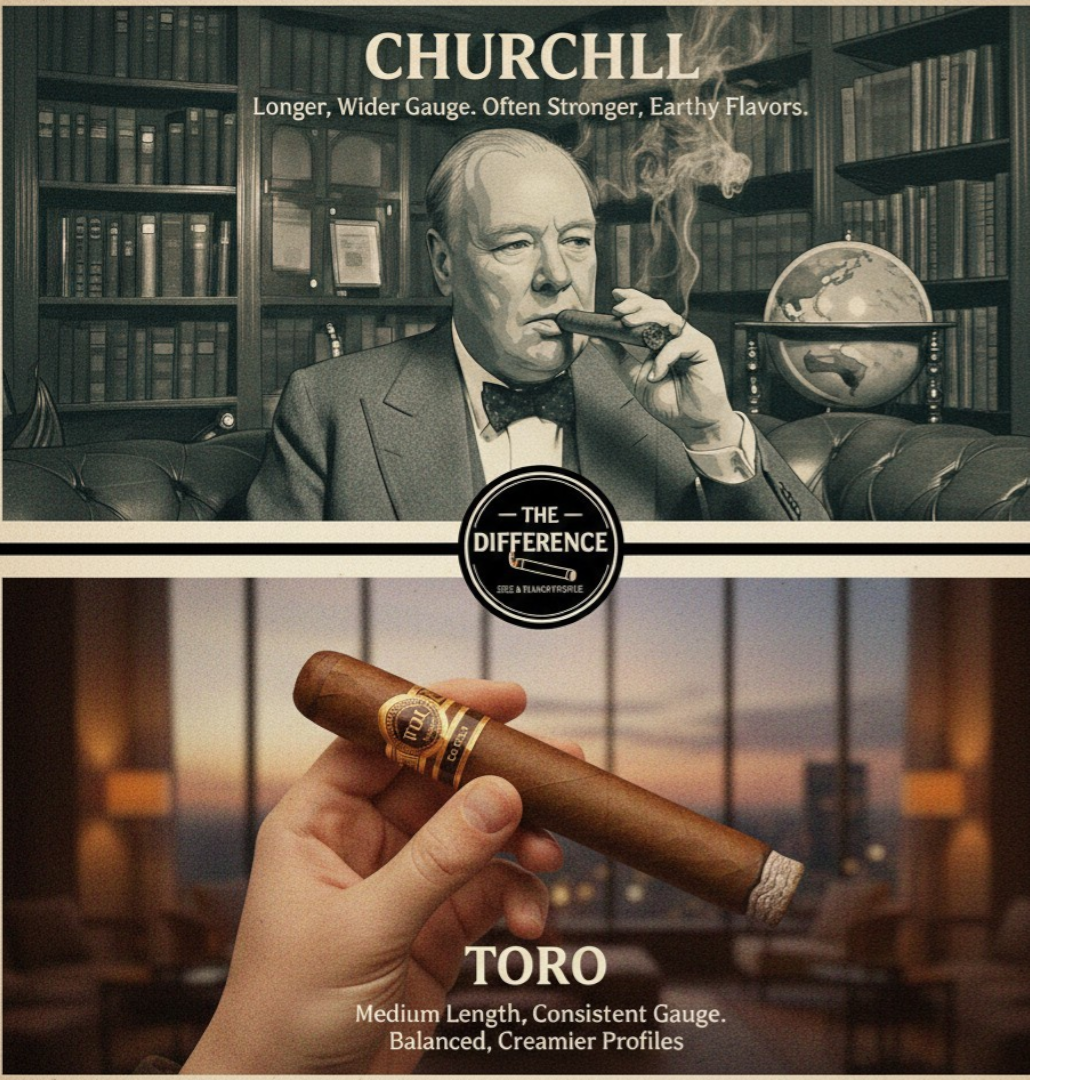
Churchill and Toro are two of the most popular vitola formats in premium cigar culture. They look similar on the surface, but they smoke completely differently. The gap between them isn’t just about length—it’s about how size shapes flavor, time, and the overall experience.
The Dimensions
Churchill cigars measure 7 inches long with ring gauges between 47 and 50. Named after Winston Churchill, who was rarely photographed without one, the format carries a ceremonial weight that matches its physical scale. Expect 80 to 100 minutes of smoking time, sometimes longer.
Toro cigars run 6 to 6.5 inches with ring gauges between 50 and 54. The name comes from the Spanish word for bull—stocky, powerful, direct. Smoking time lands between 60 and 80 minutes. It’s the more practical format, and not by accident.
How Size Shapes Flavor
This is where most smokers get surprised. The difference in ring gauge fundamentally changes what you taste.
Churchill: Wrapper-Forward, Slow to Develop
A narrower ring gauge means the wrapper leaf covers proportionally more of the cigar’s surface relative to the filler inside. In a Churchill, the wrapper drives the flavor conversation. Maduro wrappers in Churchill format can become intense in the final third—all that accumulated heat amplifying the dark, fermented character of the leaf. Connecticut-wrapped Churchills stay more even throughout.
The long length also creates what smokers call linear progression. Flavor unfolds in chapters—first third opens, middle third develops, final third intensifies. The experience rewards patience.
Toro: Filler-Forward, Immediately Complex
A thicker ring gauge shifts the balance toward filler tobacco. Blenders can work with more leaf varieties in the blend, and you taste that diversity right away. The shorter length means the cherry stays closer to your palate throughout—flavors arrive directly rather than being filtered through extended tobacco.
Toros tend to deliver simultaneous complexity: multiple notes at once rather than a slow reveal. For anyone building their palate, this makes them excellent learning cigars. Our guide on how to identify cigar flavors goes deeper on exactly this.
Time and Occasion
Churchill cigars belong to unhurried moments. Anything under 90 minutes risks rushing it. When you accelerate your pace, the temperature climbs and the flavors turn harsh. These cigars suit weekend afternoons, long dinners, or any occasion that deserves the full ceremony—not because of status, but because the format genuinely needs that time to express itself.
Toro cigars are the everyday format. A 60 to 80 minute window fits after-dinner smoking, social occasions, or outdoor time without dominating the night. Enthusiasts who smoke regularly find Toro more sustainable—and more honest about how most smoking sessions actually unfold.
See also: How Long Does It Take to Smoke a Cigar?
Construction
Seven inches is demanding to roll well. Filler distribution has to stay consistent across a longer column—any loose pocket or tight spot becomes a burn problem. Premium Churchill construction is genuinely impressive when done right. Budget versions, however, reveal flaws more readily than shorter formats do.
Cutting matters more too. At a 47–48 ring gauge, over-cutting the cap risks the wrapper. Be precise.
Toros are more forgiving by nature. The thicker ring gauge holds temperature more evenly, reducing hot spots and relighting needs. Draw tends to be slightly more open. Smoke production is higher—which suits most smokers, though it’s worth considering in confined spaces.
Wrapper Performance by Format
The same wrapper behaves differently depending on which format it’s on:
Maduro — Better balanced throughout in a Toro. In a Churchill, intensity can peak sharply in the final third.
Connecticut — Thrives in Churchill. The subtle, creamy character needs the wrapper emphasis that a narrower ring gauge provides. In Toro, filler can overpower it.
Habano / Corojo — Works in both, but differently. Churchill delivers refined, progressive spice. Toro hits with immediate pepper and earth.
Broadleaf / Oscuro — The most intense wrappers perform better in Toro, where the filler provides balance. In Churchill, they can become overwhelming.
A full breakdown of wrapper types is available here: The Essential Guide to Cigar Wrappers
Strength and Body
Format doesn’t determine nicotine strength—the tobacco blend does. But format affects how that strength lands.
Churchill spreads nicotine delivery across a longer session. The gradual build can feel more manageable, especially in medium to full blends. Toro concentrates that delivery into a shorter window. Combined with higher smoke volume, identical blends often feel fuller-bodied in Toro format than they do in Churchill.
Understanding the difference between body and strength matters here: Mild vs Medium vs Full-Bodied Cigars
Storage
Churchill cigars don’t fit in standard humidors without diagonal placement—7 inches exceeds the capacity of most desktop units. Travel humidors rarely accommodate them at all. If Churchill smoking is a regular habit, storage planning matters more than it does with shorter formats.
Toros fit without issue in nearly every standard humidor, desktop unit, and travel case. Their more frequent use also keeps humidor rotation healthy. Dead stock in a humidor ages unevenly.
Regardless of format: How to Store Cigars Properly
Pairing
Churchill’s extended session suits beverages with depth and staying power—aged spirits, full-bodied red wines, port, or a strong French press coffee. The slow pace lets the drink evolve alongside the cigar.
Toro pairs with a wider range precisely because you’re not committing two hours to it. Bourbon, Irish whiskey, dark rum, stouts, and bold espresso all work well. Ice stays viable through the shorter session.
Further reading: 10 Cigars That Pair Perfectly with Coffee — How to Pair Cigars with Whiskey
Which One Is Right for You?
Choose Churchill when you have 90-plus minutes, want the wrapper to lead, and are marking an occasion that deserves a longer ceremony.
Choose Toro when you have an hour, want full-spectrum complexity delivered more directly, or smoke often enough that practicality matters.
Most experienced smokers keep both. Toros fill the rotation. Churchills wait for the right afternoon. That’s not a compromise—it’s how the formats are supposed to be used.
If you’re newer to premium cigars and unsure where to start, Toro is the better entry point. The flavor arrives more clearly, the time commitment is manageable, and the forgiving construction means fewer frustrations while you’re still developing technique. Our Beginner’s Guide to Cigars covers exactly where to go from there.
Related Articles
Cigar Sizes & Formats
- Understanding Cigar Vitolas: How Size Shapes Your Smoking Experience
- Cigar Sizes Explained: Ring Gauge vs. Length (And Why It Matters)
- Box Pressed Cigars: A Beginner’s Guide to the Square-Shaped Smoke
Flavor & Wrappers
- Maduro vs Connecticut Wrapper: Key Differences Every Cigar Smoker Should Know
- The Essential Guide to Cigar Wrappers
- How to Taste Notes in Cigars: The Complete Beginner’s Training Guide
- Mild vs Medium vs Full-Bodied Cigars: What’s the Real Difference?
Getting Started
- Cigar 101: Everything You Need to Know About Smoking Cigars
- Best Cigars for Beginners: Top 30 Picks to Start Your Journey
- How to Smoke a Cigar Properly: The Right Way for Beginners
Pairing & Storage
- How to Pair Cigars with Whiskey: Beginner’s Guide
- 10 Cigars That Pair Perfectly with Coffee
- How to Store Cigars: The Complete Humidity Guide for Your Humidor
- How Long Does It Take to Smoke a Cigar?
If this post answered one question, there are dozens more worth exploring. Over the years on VDG Cigars, every major topic in the premium cigar world has been covered — beginner guides, storage, palate training, troubleshooting, pairing, brand deep-dives, and original interviews with founders. It is all collected in one place: The Complete Cigar Guide: Everything You Need to Know About Premium Cigars.
Subscribe to our newsletter and find out about all new posts
Check out our latest posts
- How a Cigar Is Made, From Seed to Shop
 The cigar in your hand took longer to make than most people think, and almost none of that time was spent rolling it. Rolling is… Read more: How a Cigar Is Made, From Seed to Shop
 - Top 30 Best Winter Cigars (2026): Reviewed by Flavor, Body and Smoke Time
 Winter changes the whole cigar. The evenings start at four. The smoking chair moves closer to the fire, or the cigar moves out to the… Read more: Top 30 Best Winter Cigars (2026): Reviewed by Flavor, Body and Smoke Time
 - Cigar Ring Gauge in mm: Every Size, and What Thickness Actually Changes
 Ring gauge is how thick a cigar is. The second number in a 5 x 50 is the ring gauge, and it counts in sixty… Read more: Cigar Ring Gauge in mm: Every Size, and What Thickness Actually Changes
 - Horacio 8 Classic Review: A Small, Nutty Costa Rican Everyday Smoke
 The Horacio 8 is a short, medium-bodied cigar that packs plenty of flavor into a compact format. Over 50 minutes it works through sweet almond… Read more: Horacio 8 Classic Review: A Small, Nutty Costa Rican Everyday Smoke
 - Karina Owen: The Woman Who Built Her Own Name (Part 3 of 3)
 Something personal before any of this begins. I have been working on Karina Owen’s story for a few months now. Sitting here writing the last… Read more: Karina Owen: The Woman Who Built Her Own Name (Part 3 of 3)
 - Horacio Heritage 6 Review: A Full-Bodied Costa Rican With a Perfumed Floral Edge
 The Horacio Heritage 6 is a short, full-bodied cigar with an unusual, perfume-like floral character that sets it apart. Over 45 minutes it works through… Read more: Horacio Heritage 6 Review: A Full-Bodied Costa Rican With a Perfumed Floral Edge
 - Karina Owen: The Years That Taught Her People (Part 2 of 3)
 Part 1 of this interview ended with a door Karina Owen left unlocked. She had changed her degree, kept her credits, and told herself that… Read more: Karina Owen: The Years That Taught Her People (Part 2 of 3)
 - Brun del Ré Privado Gran Toro Review: A Two-Hour Costa Rican Puro
 The Brun del Ré Privado is a cigar built to be savored slowly. A 100% Costa Rican puro aged three years, it was blended by… Read more: Brun del Ré Privado Gran Toro Review: A Two-Hour Costa Rican Puro
