
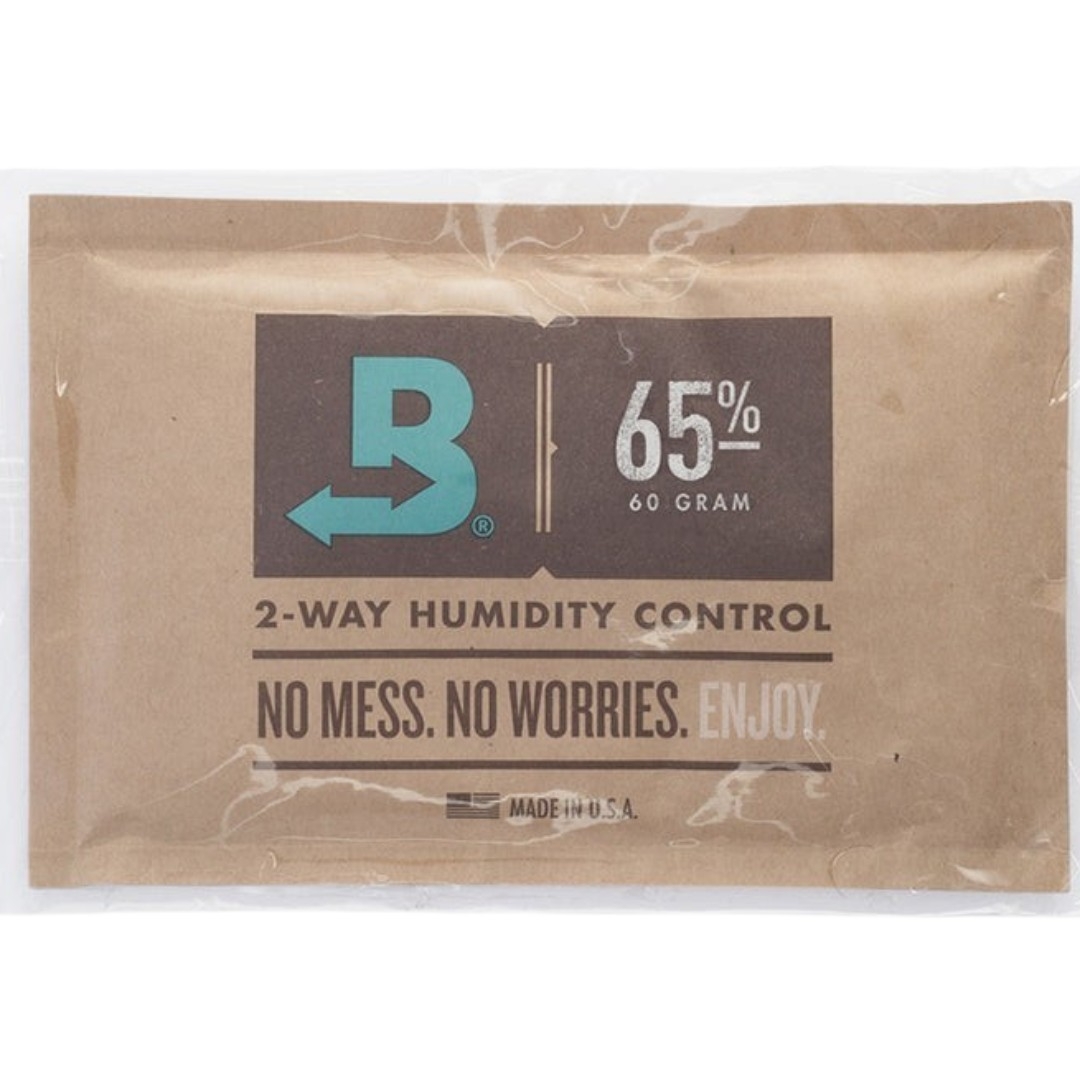
Quick answer: An opened Boveda pack lasts 2 to 6 months in a wood humidor, and 6 to 9 months in an airtight container like a tupperdor or acrylic case. Unopened, sealed in original packaging, Boveda is rated for a 2-year shelf life by the manufacturer. The exact number depends on your seal quality, climate, and how often you open the lid.
That’s the number everyone quotes. What nobody tells you is how to actually know when your pack is done, why the “2 to 6 months” range is so wide, and what changes if you’re storing cigars in Sweden through a dry heating season versus a humid US summer. Here’s the breakdown most guides skip past.
Wood Humidor vs Airtight Container: The Number Nobody Separates Out
This is the part most articles skip past. A Boveda pack doesn’t behave the same way in every container, and lumping all storage types into one “2 to 6 months” range hides the real story.
In a standard wood humidor, even a good one, the wood itself breathes a little. Spanish cedar absorbs and releases moisture constantly, which means your Boveda pack is never just maintaining a sealed environment, it’s also managing the wood’s own moisture exchange. That’s why wood humidors land on the shorter end, typically 2 to 4 months.
In an airtight setup, a Tupperdor, acrylic case, or sealed cooler, there’s almost no exchange happening except when you open the lid. Less work for the pack means more time before it’s exhausted, which is why airtight containers consistently land on the higher end of the lifespan range. If you’re considering the switch, I cover the tradeoffs of tupperdors versus traditional wood humidors in my cigar storage guide.
Don’t even own a humidor yet? Boveda still works. A resealable freezer bag with a pack inside holds humidity surprisingly well for short-term storage, travel, or just getting started before you invest in proper equipment. It’s not a long-term solution for a serious collection, but it beats leaving cigars exposed to open air.
If you’re trying to stretch your Boveda budget, switching from a leaky wood box to an airtight container does more for pack longevity than almost anything else you can do.
What Drains a Pack Faster
Three things matter more than anything else once you’ve picked your container.
Seal quality. A cheap humidor with a warped lid or a worn gasket forces constant air exchange. A poor seal can drain a pack in a matter of weeks, while a properly sealed cabinet stretches that out toward the higher end of the range.
Climate. I’m based in Sweden, and our indoor air swings hard between a humid late summer and a bone-dry heating season. A pack working against radiator heat in February exhausts faster than one sitting in a stable, naturally humid room. If your climate shifts seasonally, expect your Boveda lifespan to shift with it.
Lid frequency. Every time you open your humidor, conditioned air escapes and the pack has to rebuild equilibrium. I check my humidor twice a week instead of daily, and that single habit change noticeably extended pack life compared to when I was in and out constantly.
60g vs 320g: Which Size Actually Lasts Longer Per Dollar
60g packs: best for small humidors and travel cases, lasting 2 to 4 months and covering roughly 1 pack per 25 cigars.
320g packs: best for cabinet humidors and wineadors, lasting 4 to 8 months, with one pack covering roughly the same ground as five 60g packs.
Don’t undersize a large humidor to save a few dollars upfront. Small packs in a big space exhaust faster because they’re outmatched by the volume of air and wood they’re regulating. I run larger packs in my main storage, and the actual cost per month of humidity control comes out lower than constantly restocking smaller ones.
How Many Packs Does Your Humidor Actually Need
Pack lifespan and pack count are connected. Underpack a humidor and every pack works overtime, which shortens its life on top of risking unstable RH. Here’s how I size it out:
Up to 25 cigars: 1 pack (60g) 25 to 50 cigars: 2 packs (60g) or 1 pack (320g) 50 to 100 cigars: 3 to 4 packs (60g) or 1 to 2 packs (320g) 100 to 150 cigars: 5 to 6 packs (60g) or 2 packs (320g) 150+ cigars or full cabinet: 6+ packs (60g) or 3+ packs (320g)
These are starting points, not hard rules. A leaky humidor or a dry climate pushes you toward the higher end of each range. I’d rather slightly overpack than chase a struggling single pack across a half-empty cabinet. Adding more packs than the minimum doesn’t over-humidify your cigars either, since Boveda is calibrated to a fixed RH no matter how many packs you use. If anything, going a bit heavier on packs can work in your favor: more total buffering capacity means each individual pack works less hard, which means longer life per pack and a more stable RH overall, especially in a leaky humidor or during seasonal swings. There’s no real downside to rounding up.
Inspect Your Humidor Periodically, Not Just The Pack
Most guides only tell you to check the Boveda pack itself. I check the humidor too, every time I’m in there. A pack that’s dying unusually fast, say in three or four weeks instead of months, is rarely a defective pack. It’s almost always a leaking humidor.
Things I look for during a quick inspection:
- Lid seal. Run a finger or a thin strip of paper around the seam. If you feel airflow or the paper slides out easily, the seal has weakened.
- Hinges and latch. Wood warps over time, especially with seasonal humidity swings. A latch that used to click firmly and now feels loose is a sign the lid isn’t closing flush anymore.
- Hygrometer drift. If your readings swing more than they used to between pack checks, that’s often the humidor losing its grip on stable RH, not the pack failing early. If you haven’t checked your hygrometer’s accuracy in a while, my hygrometer calibration guide walks through the salt test in a few minutes.
- Wood condition. Cracking, gaps at the joints, or a finish that’s started to separate from the case all let air through.
Catching a leak early saves you money on packs and protects the cigars themselves. I’d rather spend five minutes checking the box than keep buying Boveda to compensate for a humidor that’s quietly failing.
How To Tell A Pack Is Actually Done
Forget the calendar. The real test is touch.
A working pack feels soft, almost like a small gel cushion, with give when you squeeze it. An exhausted pack goes stiff and you can feel the crystallized salt shift inside, sometimes with a faint crackling sound. That’s your signal, not a date you wrote down three months ago.
I squeeze-test every pack each time I’m in the humidor anyway, since it takes two seconds. A hygrometer reading drifting away from your target RH backs up what your hands are already telling you. I go deeper into calibration and accuracy in my full guide on cigar storage and humidity control.
Does RH Level Affect How Long a Pack Lasts?
Yes, indirectly. A 65% RH pack and a 72% RH pack placed side by side will fight each other, since each is trying to pull the environment toward a different target. That conflict burns through both packs faster than using a single matched RH level throughout your humidor. Stick to one RH level per container. If you want a more humid storage strategy for aging, use all 72% or all 75%, not a mix. This same logic applies when you’re seasoning a new humidor with 84% RH packs, that’s a separate, short-term process and those packs should never stay in once seasoning is done.
Temperature vs RH: Picking The Right Boveda Level For Your Climate
This is the part that actually affects mold and tobacco beetle risk, and it’s tied directly to how long your packs last too, since the wrong RH choice for your climate just means the pack works harder and burns out faster while putting your cigars at risk. I go much deeper into the beetle side of this in my tobacco beetle prevention guide, since temperature actually matters more than RH alone for stopping an infestation before it starts.
Humidity and temperature work together, not separately. Mold and tobacco beetle eggs both thrive in the same conditions: high humidity combined with warm temperature. Beetle eggs hatch reliably once you’re above 68-70°F (20-21°C) with RH in the 65-70% range, and the risk climbs fast past 70°F. That combination is what causes the classic “bloom that’s actually mold” scare, or worse, an active beetle hatch.
Here’s how I match RH to climate and season:
Warm climate or summer heat (above 75°F / 24°C indoors): Go with a 65% RH Boveda pack instead of the usual 69% or 72%. Lowering the RH target gives you a buffer against the temperature pushing you into mold and beetle territory, while still keeping cigars from drying out.
Average room temperature (68-72°F / 20-22°C): A 69% RH pack is the safe, all-purpose choice most of the year for stable indoor climates like Sweden outside of peak summer.
Cooler climate or air-conditioned room (below 68°F / 20°C): Stick with 69% RH here, since the lower temperature offsets the humidity and keeps you well clear of the danger zone. I personally never go above the 69% pack regardless of temperature, since it leaves no buffer if the room warms up unexpectedly, and Boveda doesn’t even sell anything at 70% anyway, their lineup jumps straight from 69% to 72%.
Hot and humid climate combined (think Florida or Southeast Asia summers): Stick with 65% RH and consider air conditioning your storage space if at all possible. Temperature control matters as much as the Boveda pack itself in this scenario, no humidity pack can fully compensate for a room that’s consistently hot.
The mistake I see most often is people defaulting to 72% RH year-round because it’s marketed as the “aging” level, without adjusting for the fact that their room runs warm in summer. If your storage space heats up seasonally, your RH target should drop with it. Pair this with keeping your storage area out of direct sunlight and away from exterior walls that swing in temperature, both covered in my cigar storage guide.
My Personal Replacement Routine
I keep an eye on the hygrometer and check the packs by hand every now and then. Soft and pliable, they stay in. Starting to firm up, they get swapped right away. No guessing, no wasted packs, no dry cigars from trusting a generic timeline that ignores my actual setup.
If you’re building your storage routine from scratch, my beginner’s guide to cigar storage covers where Boveda fits next to traditional humidification systems, and my guide to cigar aging is a useful next read if proper humidity has you thinking about long-term storage rather than just keeping cigars fresh week to week.
Frequently Asked Questions
Two years, as long as it stays sealed in its original cellophane wrapper or master bag, stored in a cool, dry place. This is confirmed directly by Boveda, so if you stock up in bulk, the unopened packs in your closet aren’t losing potency anytime soon.
No. Once the gel crystallizes and goes rigid, it’s finished. Soaking it in water won’t restore it properly and isn’t worth the risk to your cigars.
Not actively harmful, but it does nothing for you. It’s just taking up space that could hold a working pack.
A general rule is one 60g pack per 25 cigars, or one 320g pack for roughly every 100 to 125 cigars of capacity. I’d rather slightly overpack a large humidor than risk underpacking it.
They’ll still regulate humidity on their own, but you’re guessing on confirmation. I always pair Boveda with a calibrated hygrometer.
Use 65% RH instead of the standard 69% or 72%. Warm temperature combined with high humidity is what drives mold and tobacco beetle risk, so dropping the RH target gives you a safety buffer when the room runs hot.
No. Mixing humidification methods gives Boveda inconsistent conditions to react to and can actually shorten pack life while making your readings less reliable.
Written by Peter Stefanic, Certified Cigar Sommelier (IACS) and editor of VDG Cigars.
Subscribe to our newsletter and find out about all new posts
Check out our latest posts
- How a Cigar Is Made, From Seed to Shop

- Top 30 Best Winter Cigars (2026): Reviewed by Flavor, Body and Smoke Time

- Cigar Ring Gauge in mm: Every Size, and What Thickness Actually Changes

- Horacio 8 Classic Review: A Small, Nutty Costa Rican Everyday Smoke

- Karina Owen: The Woman Who Built Her Own Name (Part 3 of 3)

- Horacio Heritage 6 Review: A Full-Bodied Costa Rican With a Perfumed Floral Edge

- Karina Owen: The Years That Taught Her People (Part 2 of 3)

- Brun del Ré Privado Gran Toro Review: A Two-Hour Costa Rican Puro

- Aroma de Nicaragua and Hernan Lopez: Up to a Year in the Pilón, and the Nicaraguan Cigar Built Without the Pepper

- Interview with Karen Berger

- The $1 Challenge: Helping Philadelphia Youth With the Roberto Martinez Foundation

- Robusto vs Toro: Real Smoke Times, Flavor and Which One to Choose

- Macanudo Maduro Diplomat Review: A Smooth, Fruity Maduro in a Short Figurado

- Brun del Ré Cigars and Carlo Corazza: The Costa Rican Puro That Ferments for Over a Year

- The story of Karina Owen Part 1 of 3: At the End of the Night

- The Leaf That Changes Everything: Why La Flor de Zaida and Medio Tiempo Belong in the Same Sentence

- La Flor de Zaida Brings the Diamond Collection and Ralf Moeller to InterTabac 2026

- Casa Magna Colorado Torito Review: A Rich, Approachable Everyday Full-Bodied

- Aroma de Nicaragua Connecticut Toro Review: A Long, Gentle Nicaraguan With Unusual flavors

- Aroma de Nicaragua Ecuador Robusto Review: A Long-Burning Nicaraguan Value

