
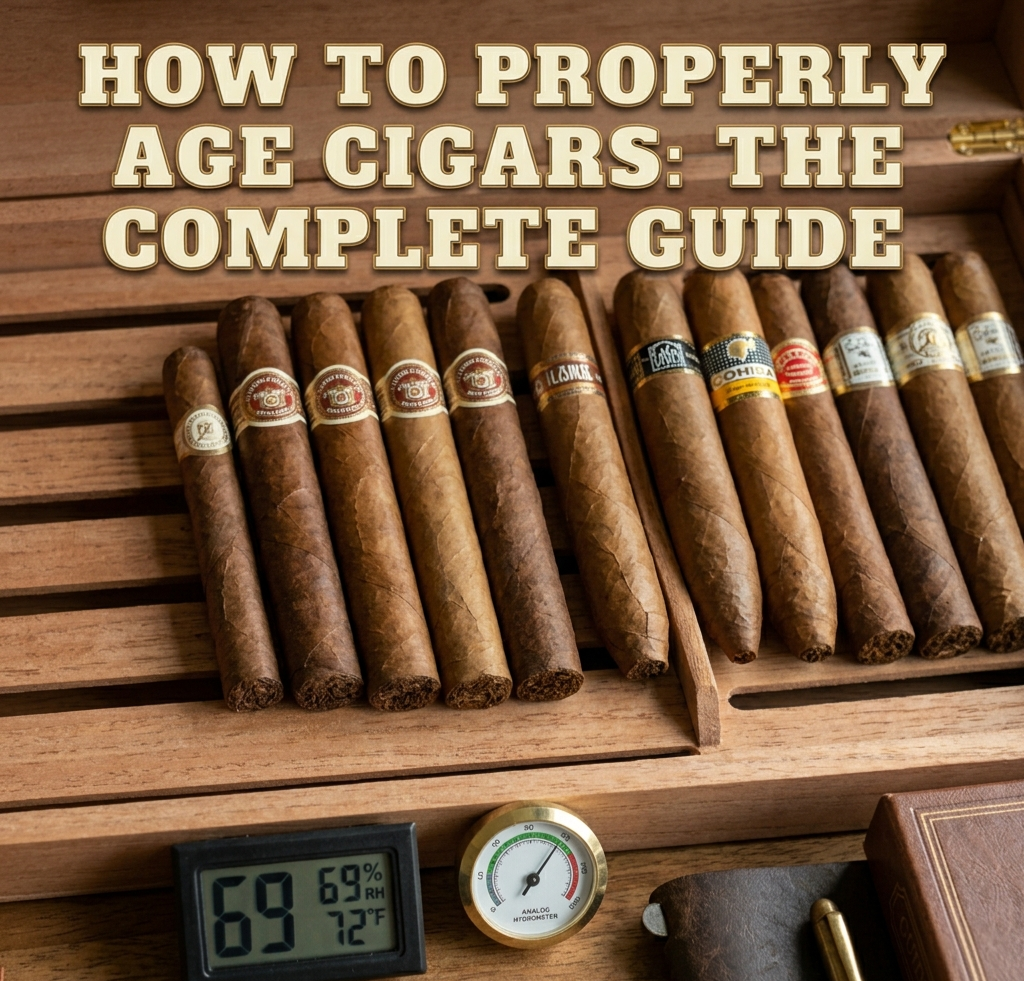
Most cigar smokers know aging matters. Few know what it actually does — or how to do it correctly.
After more than a decade of smoking cigars across four continents, and spending years interviewing the people who grow, ferment, blend, and roll premium tobacco for a living, one thing comes up repeatedly: the gap between how aging is talked about and how it actually works is enormous. Done right, it transforms a good cigar into something genuinely memorable. Done wrong, it wastes your time, your money, and your tobacco.
This guide covers what aging actually does, the difference between aging and resting, how to execute both properly, and the honest truth about what time can and cannot achieve.
What Actually Happens When a Cigar Ages
A premium cigar arrives having already completed an extensive journey. After harvest, the tobacco is cured, then fermented, then aged in bales — sometimes for years — before a single cigar is rolled. At the factory, freshly rolled cigars rest again before shipping, allowing the filler, binder, and wrapper tobaccos to begin settling into one another.
Your humidor continues that process.
Given time and stable conditions, the tobaccos inside a rolled cigar keep slowly integrating. Harsh edges round out. The sharpness of a young smoke softens. Flavors that competed against each other on first light begin pulling in the same direction. The result is a cigar that burns cooler, tastes rounder, and reveals depth that simply was not accessible when the cigar was young.
The most important thing to understand going in: aging refines quality, it does not create it. A poorly blended cigar will not improve meaningfully with time. A great cigar, given the right conditions, will become better than you thought possible. That distinction matters before you commit humidor space and years of patience to something.
Aging vs Resting: Understanding the Difference
These two terms get used interchangeably in cigar culture, and they should not be. They describe different things with different goals and different timelines.
Resting is short-term. It is the recovery period a cigar needs after being handled, shipped, or exposed to unstable conditions. Every cigar needs to rest before it can be fairly evaluated. Resting gets a cigar back to a stable, smokeable baseline — it is not improving the cigar beyond what it was designed to be, it is simply returning it to that point.
Aging is intentional and long-term. It is the deliberate decision to hold a cigar in stable conditions for months or years with the goal of developing complexity, softening harshness, and allowing the blend’s components to integrate at a level the manufacturer could not achieve before shipping. Aging takes a cigar beyond its factory baseline and into a different category of experience.
You need to rest every cigar you buy. You choose which cigars to age, and you choose them deliberately. The two processes are sequential, not interchangeable — resting comes first, aging follows if the cigar merits it.
The Sick Period: What Nobody Tells You
One of the most overlooked parts of cigar aging is what happens in the days immediately after purchase — before any real aging begins.
During rolling, leaves are moistened to make them workable. Transit adds stress. A box of cigars has often been through fluctuating temperature and humidity across multiple shipping legs before it reaches your hands. A cigar smoked within the first few days of arrival can taste flat, harsh, or simply wrong — worse, in some cases, than you would expect from the blend’s reputation.
This is the sick period. Every cigar goes through it to some degree.
Rest new cigars in stable humidor conditions for at least four to six weeks before forming any opinion about the blend. What reads as a flaw on first smoke is often nothing more than a cigar that has not yet recovered from the journey. Many excellent blends have been unfairly dismissed because someone smoked them too soon after delivery. More on the exact recovery timeline in the guide on when cigars are ready to smoke after purchase.
The Conditions of Proper Aging
You are managing four variables: temperature, humidity, airflow, and darkness. All four matter, and neglecting any one of them will compromise the result.
Temperature
Aim for 18–21°C (65–70°F). This range allows cigars to develop slowly and steadily without stress.
Above 24°C, tobacco beetle eggs — present in virtually all natural leaf — can hatch and spread through a collection rapidly. Pinhole-sized entry points in the wrapper are the warning sign. If you see them, quarantine immediately and inspect every cigar in the humidor. Below 15°C, aging essentially stops. The cigars are paused rather than developing. Consistency matters more than hitting a precise number. A humidor that holds steady at 19°C year-round outperforms one swinging between 16°C and 24°C with the seasons, every time.
The full breakdown of what temperature does to cigars — including seasonal management and beetle prevention — is covered in the complete temperature guide for storing cigars.
Humidity
The correct range for long-term aging is 65–68% relative humidity.
Much older guidance recommends 70% RH. That number is too high for aging purposes. Mold risk increases meaningfully above 68% — and mold does not give you a second chance. At 65–68%, cigars stay properly humidified, age cleanly, and draw better than over-humidified sticks that burn unevenly and taste damp.
If your home has fluctuating temperatures — seasonal swings, rooms that heat up in summer or cool significantly in winter — running closer to 65% rather than 68% gives you an important buffer. Temperature and humidity interact directly: when temperature rises, the air inside the humidor can hold more moisture, which effectively raises the relative humidity even if your humidification source has not changed. At 65%, that natural fluctuation is less likely to push conditions into the danger zone above 70%. It is a simple, practical adjustment that protects a collection without requiring any additional equipment.
One non-negotiable: calibrate your hygrometer. An uncalibrated sensor can read 3–5% off without any visible sign of failure, meaning you could be running 72% while believing you are managing 67%. The calibration process is covered in detail in the hygrometer calibration guide.
For everything on humidity management, including Boveda packs and passive versus active systems, see the complete humidity guide for humidors.
Airflow
A good humidor should seal well — well enough that humidity holds stable without constant replenishment. But it should not be completely airtight. A slight, natural exchange of air is part of how aging works. Cigars off-gas as they develop, and completely stagnant air allows those gases to build up and distort flavor over time rather than dissipate.
In practice, opening the humidor to retrieve a cigar provides sufficient air exchange for most collections. You do not need to deliberately air it out on a schedule, but opening it periodically is normal, healthy use — not a problem to be avoided.
Cellophane: Remove it entirely from any cigar you intend to age. Cellophane restricts how much the tobacco breathes and slows the exchange of gases that aging depends on. For a few weeks of storage it makes little practical difference. For aging measured in years, it actively works against you.
Tubos: The same logic applies to metal tubes. Remove the cigar before placing it in the humidor for any extended rest. Tubos are designed for transport and short-term protection — not for the slow, respiratory process that proper aging requires.
Do not cut the cap of a cigar you intend to age. Leave it intact.
Darkness
Light degrades the oils in tobacco leaves, and those oils are the primary carriers of aroma and flavor. A glass-top humidor positioned near a window will slowly strip your cigars of exactly what you are trying to develop. Keep aging cigars in a cool, dark location. It is a simple requirement that is easy to overlook and costly to ignore over years of storage.
How Long Should You Age Your Cigars
There is no universal answer. It depends on the cigar, the blend, and your own palate. But the following framework holds across most premium tobacco.
0–3 months is recovery and stabilization. New cigars rest, the sick period resolves, and the tobaccos begin settling. Every cigar benefits from this window, regardless of whether you plan to age further. Do not skip it.
3–12 months is early integration. Harsh or sharp notes begin rounding. The filler, binder, and wrapper start reading as a unified smoke rather than competing components. Many medium-bodied blends reach a satisfying balance somewhere in this window and need little beyond it.
1–3 years is where most premium full-bodied cigars begin to reveal their true character. Pepper rounds toward spice. Bitterness resolves into earthiness. Secondary notes — cedar, leather, dark fruit, roasted coffee — become more distinct and better balanced. For boutique Nicaraguan and Dominican puro blends, this window consistently produces the most rewarding results.
3–5 years brings a noticeable reduction in strength. A cigar that smoked at full body when young will often read as medium-full after four years — and is frequently the better for it. Smokers who want complexity over raw power find this range particularly rewarding.
5–10 years and beyond is connoisseur territory. Only the finest, most oil-rich cigars hold together here. Those that do develop a character that is difficult to describe without experiencing it: rounded, deep, and extraordinarily unified. After ten years, most well-stored premium cigars smoke as a single cohesive experience rather than a collection of individual notes competing for attention.
One important truth that no aging guide should omit: cigars peak and then decline. There is a window, not a one-way street. The only reliable way to track where your sticks are on that curve — and know when to smoke the rest before it is too late — is to pull one periodically and take honest notes.
How to Know When a Cigar Has Peaked
Knowing when to start aging a cigar is straightforward. Knowing when to stop is where most collectors come unstuck.
A cigar approaching its peak will show a particular character when you smoke it. The flavors are distinct but no longer fighting each other. The strength sits at the right level for the blend — not sharp, not flat. The retrohale is clean and integrated. The finish lingers and develops rather than cutting off abruptly. There is a sense of completeness to the smoke that younger versions of the same cigar simply did not have.
A cigar that has passed its peak tells you in different ways. Flavors begin to flatten and merge into an undifferentiated whole rather than developing through the thirds. The finish shortens. What was once complexity becomes sameness. The character that made the blend interesting in younger form is still there, but muted to the point where it requires effort to find. Some collectors describe over-aged cigars as tasting “quiet” — not unpleasant, but without the vitality that defined earlier iterations of the same smoke.
The practical implication: when a cigar you are tracking starts to taste simpler rather than more complex, you have passed the peak and it is time to smoke the rest of the box. Do not wait for further improvement. It will not come.
Which Cigars Age Well — and Which Do Not
The single most important factor is the quality of the leaf. No amount of time fixes a poorly made cigar. That is the starting point, and everything else builds from it.
Beyond raw quality, these characteristics reliably predict strong aging potential.
Wrapper type is the first signal. Maduro wrappers — dark, oil-rich leaves that have undergone extended fermentation — are among the best candidates for long-term aging. Their bold flavors deepen over time, and the natural sweetness they carry becomes more refined and pronounced with years in the humidor. Natural Colorado and Oscuro wrappers also age with real distinction. Connecticut Shade wrappers have a narrower and more precise aging window. Extended time can strip away the creaminess that defines them rather than enhance it — but a well-made Connecticut Shade can absolutely benefit from six to eighteen months of rest. The key is not pushing beyond that window without checking progress along the way.
Body and leaf priming is the second signal. Full-bodied cigars built with leaf from the upper portions of the plant — slowest-burning and most oil-rich — have the raw material to age for years. Lighter blends peak earlier and offer little return on patience beyond the first year.
Vitola plays an underappreciated role. Larger ring gauges contain more filler tobacco and tend to have more to offer over extended time. A 58-ring Toro or a Churchill typically carries more aging potential than a narrow 38-ring Lancero — though the Lancero’s high wrapper-to-filler ratio means it can age with remarkable elegance over a shorter, more defined window.
What does not age well: machine-made cigars, short-filler cigars, flavored or infused cigars, and mild Connecticut-wrapped smokes made for immediate enjoyment. Aging space is finite and patience is not free. Reserve both for cigars that will actually reward the wait.
Organizing Your Humidor for Aging: Separation and Flavor Transfer
One topic that rarely gets addressed in aging guides is what happens when you store multiple blends together over a long period.
Cigars absorb aroma and flavor from their environment. In a humidor with diverse blends aging side by side over years, some degree of cross-influence between sticks is real. For a short rotation — cigars you smoke within three to six months — it is not a meaningful concern. For long-term aging measured in years, it becomes something worth managing.
The practical solution is cedar dividers. Spanish cedar is the right material for this because it contributes its own complementary aromatics rather than acting as a neutral barrier. Separating a full-bodied Nicaraguan blend from a mild Connecticut-wrapped cigar with a cedar board protects the integrity of both over time. More importantly, it keeps infused and flavored cigars completely out of the equation — these should never share a humidor with natural tobacco at any aging duration, as the flavoring agents transfer readily and do not wash out.
A second approach preferred by serious collectors is to keep a dedicated aging humidor separate from the everyday rotation. The aging humidor runs at 65–67% RH and is opened as infrequently as possible. The rotation humidor holds cigars at 68–70% RH and gets opened regularly. This separation keeps the stable micro-environment of the aging setup protected from the humidity fluctuations that come with frequent access.
If a dedicated second humidor is not practical, at minimum: keep your aging boxes in their original cedar boxes, label everything clearly, and position them away from the most frequently accessed area of the main humidor.
Humidor Setup for Aging
For everyday rotation, most decent humidors are adequate. For aging over years, the choice of setup matters considerably more.
Spanish cedar is the right lining material. It regulates moisture, contributes subtle aromatics that complement tobacco oils over long periods, and naturally resists tobacco beetles. A solid hardwood Spanish cedar humidor will outlast a box lined with a thin cedar veneer over cheaper wood by a significant margin — a distinction worth paying for if serious aging is the goal.
For larger collections, a converted wine fridge — sometimes called a wineador — with a digital controller gives more precise and consistent management than passive humidification systems. The larger the mass of tobacco inside, the more stable the micro-environment becomes, and stability is what aging requires above everything else. The guide on storing cigars in the fridge covers the wineador setup in full.
Season a new humidor properly before placing cigars inside. The full process is covered in the humidor seasoning guide.
Plume, Mold, and What They Tell You
Open a humidor after a year of proper aging and you may find a fine white or greyish dusting on some wrapper leaves. This is plume — also called bloom — and it is one of the most encouraging signs a cigar collector can encounter.
Plume forms when the natural oils inside a cigar migrate slowly to the surface of the wrapper and crystallize there. It appears as a uniform, dry, powder-like coating. It brushes away cleanly with a fingertip, leaves no stain, and smells of nothing alarming. It is more common on oily wrappers and means your storage conditions are doing exactly what they should. When you see plume, your humidor is working.
Mold is different in every possible way. Mold is a fungus. It appears in color — green, blue, grey — in fuzzy or web-like patches rather than an even dusting. It most commonly appears at the foot of the cigar. It leaves a stain after wiping. It smells distinctly musty. It forms when humidity climbs above 72–75% RH, particularly when combined with warm temperatures and poor airflow.
If you find mold: remove all cigars immediately and isolate the affected ones. Wipe the humidor interior with a cloth lightly dampened with isopropyl alcohol and leave it open to air for 24–48 hours. Find what caused the humidity spike before restocking — a leaking humidification source, a seasonal temperature rise, improper seasoning. A surface mold on the wrapper that has not reached the foot or filler may be salvageable: wipe it, isolate the cigar, and smoke it within a reasonable window. Mold that has penetrated the filler means the cigar is gone.
How to Track Aging Progress
Most guides tell you to check on your cigars periodically. That instruction is too vague to be useful on its own.
When you place a box in the humidor for aging, smoke one cigar immediately. Write down what you taste — strength, body, specific flavor notes, harshness, draw, and burn character. Date the entry. Repeat with another cigar from the same box every three to six months.
Over time you build a tasting record of that blend’s development. You see where it mellows, where new notes emerge, and — critically — you identify the peak before the cigar passes it. Without notes, you are guessing. With notes, you are managing a collection with intention.
What to record with each tasting: the date, the humidity and temperature your humidor was running, the specific flavors in each third, the retrohale character, the finish length, the overall strength, and any observations about burn and draw. Five minutes of notes per cigar creates a record that becomes genuinely useful over a two to three year aging window.
Rotate cigars in your humidor every four to six weeks. Humidity is not perfectly uniform even in a well-maintained setup. Moving cigars from top to bottom and front to back ensures that every stick ages in approximately equivalent conditions.
Label everything. A strip of masking tape on the inside of the box lid with the date of entry and the blend name is sufficient. Memory across a three-year window is not reliable, and there is nothing more frustrating than not knowing how long something has been resting when you are trying to make a decision about smoking it.
Common Mistakes That Ruin Aging
Running humidity too high. 70% RH is where most older guidance points. It is too high for long-term aging. Mold risk climbs steeply above 68%, particularly in summer or warmer climates. Set your target at 65–68% and verify it with a calibrated instrument — not the hygrometer that came free with the humidor.
Mixing cigars from different storage backgrounds. A cigar that has been sitting at 72% RH placed next to one kept at 60% creates moisture imbalance across both sticks. Bring all new acquisitions to your target humidity over a week or two before integrating them with an established collection.
Storing infused cigars with natural tobacco. Flavored cigars release their flavoring agents into the surrounding environment. Even in the short term this affects neighboring sticks. For aging purposes, infused cigars belong in an entirely separate container, full stop.
Aging the wrong cigars. Not every cigar benefits. Lighter blends, infused cigars, and machine-mades do not. Aging space is finite. Use it for cigars with genuine potential, not everything that comes through the door.
Opening the humidor too frequently. Every time you open the lid, you introduce outside air and disturb the environment the cigars have settled into. For a rotation humidor this is unavoidable. For a dedicated aging setup, limit access. Check every few weeks rather than every few days.
Dismissing a cigar after smoking it too soon. Forming a negative opinion within the first week of delivery is one of the most common assessment errors in cigar culture. Give every new acquisition at least four to six weeks of rest before drawing any conclusion about the blend.
Expecting transformation. This is the biggest mistake and the most important one to understand. A mediocre cigar aged for five years is still a mediocre cigar — smoother at the edges, perhaps, but not exceptional. Aging amplifies what is already in the tobacco. It is a finishing process, not a rescue operation. The quality has to be there before the clock starts.
Frequently Asked Questions About Aging Cigar
No. Full-bodied cigars with oily wrappers and high-priming leaf have the most to gain. Lighter blends, infused cigars, and machine-made cigars do not improve meaningfully with time. Age cigars that are already well-made and genuinely worth the wait.
Yes. Cigars peak and then decline. After the peak, flavors begin merging into a single, less distinct whole — and eventually the cigar loses vitality entirely. Most premium cigars reach their best somewhere between one and seven years of additional home aging, depending on the blend. The only way to know where your specific cigars are on that curve is to smoke one periodically and keep notes.
Resting is short-term recovery — getting a cigar back to stable, smokeable condition after transit or handling. It typically takes two to six weeks. Aging is deliberate long-term development — holding a cigar for months or years with the goal of building complexity beyond the factory baseline. Every cigar needs to rest. Not every cigar needs to age.
For serious aging, yes. Cellophane slows the natural breathing of the tobacco and restricts the gas exchange that aging depends on. For storage of a few weeks or months, it makes little practical difference. For aging over a year or more, remove the cellophane and rest the cigars directly in the humidor or in their original cedar box.
No. Metal tubos are designed for transport and short-term protection, not aging. Remove the cigar from the tube before placing it in the humidor for any extended rest. The sealed tube prevents the tobacco from breathing and will not allow proper aging to take place.
For long-term aging, yes. 70% RH is the point where mold risk starts climbing meaningfully, particularly in warmer months. For aging purposes, 65–68% is the correct range. It keeps the tobacco properly humidified while minimizing mold risk and maintaining a cleaner, firmer smoke over time.
The sick period is the recovery phase a cigar goes through after rolling and shipping, during which it can taste harsh, flat, or chemically off. It typically lasts two to six weeks. Rest all new cigars in your humidor for at least four to six weeks before forming any judgment about the blend. What seems like a fundamental flaw is often just a cigar that has not yet recovered from transit.
Yes, gradually. A cigar that smoked at full body when young will often read as medium-full after three to five years. For smokers who find certain blends too strong fresh, controlled aging is a practical solution. For those who want to preserve the full strength of the blend, keep the aging window shorter and track progress carefully.
Yes, both work well provided the conditions are correct — 65–68% RH, stable temperature below 21°C, and a seal that is tight but not hermetically closed. Adding a cedar tray or a few loose Spanish cedar sheets inside will contribute the aromatics and moisture regulation that a fully lined humidor provides naturally.
A cigar at its peak offers distinct, developed flavors that integrate through all three thirds without fighting each other. The strength is appropriate for the blend. The finish is long and evolving. When those qualities begin to flatten — when the smoke becomes simpler rather than more complex from one tasting to the next — the peak has passed. Smoke the remaining cigars from that box within a reasonable period rather than waiting for further improvement.
For aging over months, cedar dividers in the main humidor are sufficient. For aging over years, keeping different blends separated more deliberately — either in their original boxes or in a dedicated aging humidor — preserves each blend’s character more accurately. Never store flavored or infused cigars in the same environment as natural tobacco, regardless of aging duration.
The Honest Summary
Aging works. The improvement is real, and a properly aged premium cigar is a meaningfully different experience from the same stick smoked fresh. Flavors integrate. Harshness softens. Depth emerges that simply was not accessible in a young cigar — depth that no amount of money can shortcut, only time.
The requirements are not complicated: a quality humidor, stable humidity in the mid-60s, consistent temperature below 21°C, separation of blends, and the discipline to take notes, rotate regularly, and track progress honestly.
Start with one box of a cigar you already respect. Smoke one immediately and write down everything you taste. Set the rest aside. Check back at six-month intervals, compare what you find against your initial notes, and let the record tell you where the cigar is going. That single comparison — a fresh smoke against an eighteen-month-aged version of the same cigar — will show you more about what aging actually does than any guide ever could.
Subscribe to our newsletter and find out about all new posts
Check out our latest posts
- What Is a Connecticut Cigar? The Wrapper Explained

- How a Cigar Is Made, From Seed to Shop

- Top 30 Best Winter Cigars (2026): Reviewed by Flavor, Body and Smoke Time

- Cigar Ring Gauge in mm: Every Size, and What Thickness Actually Changes

- Horacio 8 Classic Review: A Small, Nutty Costa Rican Everyday Smoke

- Karina Owen: The Woman Who Built Her Own Name (Part 3 of 3)

- Horacio Heritage 6 Review: A Full-Bodied Costa Rican With a Perfumed Floral Edge

- Karina Owen: The Years That Taught Her People (Part 2 of 3)

- Brun del Ré Privado Gran Toro Review: A Two-Hour Costa Rican Puro

- Aroma de Nicaragua and Hernan Lopez: Up to a Year in the Pilón, and the Nicaraguan Cigar Built Without the Pepper

- Interview with Karen Berger

- The $1 Challenge: Helping Philadelphia Youth With the Roberto Martinez Foundation

- Robusto vs Toro: Real Smoke Times, Flavor and Which One to Choose

- Macanudo Maduro Diplomat Review: A Smooth, Fruity Maduro in a Short Figurado

- Brun del Ré Cigars and Carlo Corazza: The Costa Rican Puro That Ferments for Over a Year

- The story of Karina Owen Part 1 of 3: At the End of the Night

- The Leaf That Changes Everything: Why La Flor de Zaida and Medio Tiempo Belong in the Same Sentence

- La Flor de Zaida Brings the Diamond Collection and Ralf Moeller to InterTabac 2026

- Casa Magna Colorado Torito Review: A Rich, Approachable Everyday Full-Bodied

- Aroma de Nicaragua Connecticut Toro Review: A Long, Gentle Nicaraguan With Unusual flavors

