
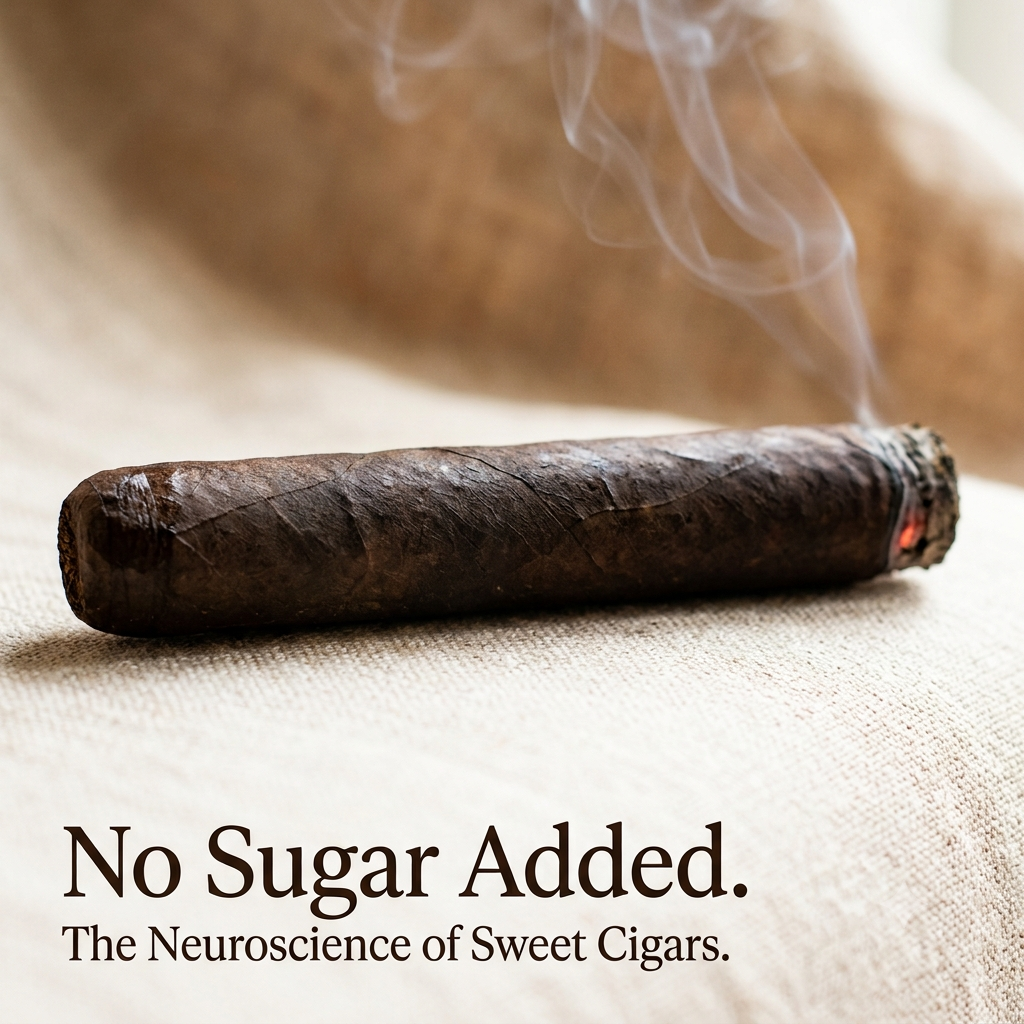
You smell it before you light it.
Something about the foot of the cigar — earthy, warm, a little dark — registers as familiar. Comfortable. Your body relaxes slightly before you have done anything at all. And when the first draw comes and there is that unmistakable hint of chocolate or dried fruit or something close to vanilla, your brain responds with a quiet, steady satisfaction.
No sugar caused that. No sweetener. Nothing was added.
So what just happened?
This is the part most cigar content never touches. Not because it is complicated — it is actually simple once you see it — but because most people assume the pleasure of a sweet cigar is just a matter of taste. Personal preference. Subjective.
It is not. It is neuroscience.
Your brain has a reward system that evolved over hundreds of thousands of years to keep you alive. It responds to things that signal safety, energy, and pleasure. Sweet taste is one of the oldest triggers in that system. And here is what makes premium cigars genuinely fascinating: a well-made cigar with fermentation-derived sweetness activates that same system without a single gram of sugar involved.
The perception is enough. The signal fires anyway.
Before you even cut the cap, your brain is already preparing the response. The scent of the wrapper reaches your olfactory system — the part of the brain most directly connected to emotion and memory — and begins building anticipation. By the time you take that first draw, the reward pathway is already primed.
What follows is an explanation of exactly how that works. The brain science behind the sweetness. Where it comes from in the tobacco. And why some cigars trigger it and others simply do not.
What “Sweet” Actually Means in a Premium Cigar
Before getting into the neuroscience, let’s clear up what produces sweetness in a premium handmade cigar. Because it does not come from added flavoring.
It comes from fermentation.
When a Maduro wrapper leaf undergoes extended fermentation — temperatures inside the fermentation pile can reach 60–74°C for weeks or months under controlled heat and pressure — the natural starches inside the leaf break down. The leaf darkens. The chlorophyll dissipates. The ammonia burns off. And what emerges are flavor compounds that register on your palate as chocolate, coffee, cocoa, dried fruit, and genuine sweetness. No additives. No syrups. No dipping of the cap.
This is why a Connecticut Broadleaf Maduro and a Mexican San Andrés Maduro can both taste sweet while tasting nothing alike. The fermentation process is the same; the leaf’s character and position on the plant determine what that sweetness actually expresses as.
The Maduro’s sweetness tends to be dark and rich — chocolate, espresso, molasses, sometimes raisin or fig. It is a full-bodied sweetness that coats the palate rather than sitting lightly on it. For many experienced smokers, this is the most satisfying expression of natural cigar sweetness there is.
Connecticut Shade wrappers express sweetness differently. Grown under shade cloth that slows photosynthesis and concentrates certain aromatic compounds, they produce a creamier, more delicate sweetness — vanilla, cream, and toast rather than dark chocolate. Lighter in body. Subtler in register. A different kind of sweetness, not a lesser one.
Cameroon wrappers sit in their own category. Earthy, woody, slightly floral — but with a background sweetness that experienced smokers often describe as bittersweet, something like dark cacao layered with cedar and spice.
None of this is added. All of it is grown, cured, fermented, and aged into the leaf itself. The complete breakdown of cigar anatomy on VDG explains how wrapper, binder, and filler each contribute differently to what ends up on your palate.
If you want to understand how wrapper type shapes the full flavor experience, that is covered in depth in the VDG wrapper guide. But for this article, the key fact is simple: the sweetness in a premium cigar is a product of craft and patience, not flavoring.
What Happens in Your Brain When You Taste Sweetness Without Sugar
Here is where most cigar writing stops short. They describe the sweet flavors. They rarely explain what those flavors do to your head.
Your tongue carries taste receptors that detect five basic flavors: bitter, salty, sour, umami, and sweet. When sweet receptors fire — whether from glucose, from a natural sweetener, or from a flavor compound your brain interprets as sweet — they send a signal upstream into the brain.
That signal eventually reaches a small cluster of nerve cells called the nucleus accumbens. Think of it as the brain’s reward hub. When it receives a sweet flavor signal, it releases dopamine — the chemical responsible for feelings of pleasure, motivation, and satisfaction.
And here is the critical detail: your brain does not verify whether those sweet flavors came from actual sugar before releasing dopamine. It responds to the perception. Research from PLOS ONE confirms that sweet flavor alone activates the brain’s reward pathways — no glucose required. The dopamine response is smaller than what actual sugar consumption produces, but it is real and measurable. And it begins within seconds of your first draw. Before anything has been digested. Before anything has entered your bloodstream.
So when a well-aged Maduro opens up with notes of dark chocolate and dried fruit, your brain is not being tricked. It is doing exactly what it was built to do. The fermentation-derived sweet compounds hit the same receptors, trigger the same signal, and produce the same quiet wave of dopamine that the brain learned to associate with something worth repeating.
That is why a good sweet cigar feels good in a way that goes beyond preference. The neurochemistry is real.
The Retrohale Connection: A Second Dopamine Pathway
There is a second mechanism at work — and most casual smokers never use it.
Most of what we call “taste” is actually smell. Research consistently shows that aromatic molecules — detected through the nasal passage, not the taste buds — are the dominant contributors to flavor perception. When you draw on a cigar, those aromatic compounds travel backward from the mouth through the back of the throat and reach your smell receptors. That is what retrohaling deliberately channels.
Retrohaling is not a technique for show. It opens a completely different sensory layer. The vanilla-adjacent notes, the cocoa, the dried fruit — those emerge through the smell pathway, not through the taste buds. And that matters because of where the smell pathway goes in the brain.
Unlike every other sense — sight, hearing, touch — smell does not route through the brain’s central sorting station before reaching the areas that handle emotion and memory. It goes there directly. The limbic system is the seat of emotion and memory. It includes the amygdala, which evaluates emotional significance, and the hippocampus, which encodes memory. Both respond to scent faster and more directly than they respond to any other sense.
This is why the foot aroma of a well-made cigar can produce a sense of calm before you have even lit it. The sweet aromatic compounds — the ones that read like vanilla or cocoa, produced naturally by fermentation — reach that emotional part of the brain and trigger something that feels almost like recognition. Anticipation. Comfort.
No vanilla was added. Fermentation produced those compounds. Your brain simply knows what to do with them when they arrive.
The Third Mechanism: Anticipatory Dopamine and the Ritual
There is one more layer, and it is the most underappreciated of all.
Your brain does not only release dopamine when something pleasurable happens. It releases dopamine when it predicts that something pleasurable is about to happen.
Neuroscientists call this anticipatory dopamine. The phenomenon was first formally documented by Professor Wolfram Schultz at Cambridge — his research showed that dopamine neurons fire not in response to reward itself, but in response to cues that predict reward. Once a cue becomes associated with something pleasurable, the dopamine signal shifts from the reward to the cue.
This is why the ritual matters beyond ceremony. Cutting the cap. Toasting the foot slowly. Taking the cold draw. By the time the first real draw comes, your brain has been releasing anticipatory dopamine through the whole preparation. The sweet flavors of the first puff are not the beginning of the reward response. It is the confirmation of one that started earlier.
It also explains something every long-term cigar smoker notices but rarely articulates: the same cigar tastes better in the right setting. The right chair. The right hour. The right silence. The stimulus is identical. The brain’s readiness to receive it is not.
For more on how environment, ritual, and sensory attention interact, the VDG cigar palate guide covers this in practical detail.
Why This Understanding Changes How You Smoke
Knowing the mechanisms is not just interesting. It changes what you do with the cigar in your hand.
Retrohale, even briefly. The smell pathway delivers sweet aromatic compounds straight to the part of your brain that processes emotion and memory — in a way the taste buds simply cannot. A partial retrohale — not a full exhale through the nose, just a brief pass of smoke through the nasal passage — adds a dimension of sweetness the taste buds alone will never give you.
Smoke slowly. A cigar smoked too fast overheats. Heat destroys the delicate aromatic compounds that carry the sweet flavors. Thirty to sixty seconds between draws preserves the temperature range where those compounds survive and express cleanly.
Build the ritual. The anticipatory dopamine response builds through your pre-light routine. A rushed, distracted smoke shortchanges the brain’s preparation phase. The same cigar in a deliberate context will taste meaningfully different than the same cigar grabbed between appointments.
Age your cigars. If you are not resting cigars in a properly maintained humidor for at least several months, you are missing what many of them were built to become. Those sweet flavors are often not fully accessible on day one. One sign that a Maduro is aging well in the humidor is the appearance of plume — a crystalline bloom on the wrapper that signals oils are migrating to the surface. The VDG guide to cigar mold vs plume explains what to look for and what to avoid.
And if you are new to premium cigars and finding everything tastes like pepper and smoke, learning to identify what you are tasting is a skill with a real learning curve. The sweet flavors are there. The palate needs time to find them.
The Takeaway
Your brain is wired to find sweet flavors rewarding. That is not a quirk. It is survival architecture — hundreds of thousands of years of evolution that associated sweet with safe, with energy, with something worth returning to.
Premium cigars with fermentation-derived sweetness tap into that architecture without sugar. They hit the taste receptors. They trigger dopamine. They send aromatic compounds straight to the part of the brain that handles emotion and memory. And when a ritual is built around the experience, the reward response starts before the cigar is even lit.
The satisfaction you feel when a good Maduro opens up is not placebo. It is not habit. It is measurable neurochemistry produced by genuine craft — months of fermentation, the skill of the blender who knew which tobaccos would produce something worth smoking slowly.
The blenders who built those tobaccos probably did not think about the nucleus accumbens when they designed the fermentation process. But they understood, through craft and repetition and taste, that certain tobaccos feel good in a way that keeps people coming back.
That is the oldest form of flavor science there is.
Frequently Asked Questions
No. Premium handmade cigars contain only tobacco — no added sweeteners, flavorings, or sugar at any stage of production. The natural sweetness found in Maduros and certain other premium cigars comes entirely from fermentation, which converts starches in the tobacco leaf into sugar-like compounds over weeks or months of controlled heat and pressure.
Maduro wrappers undergo extended fermentation at high temperatures — sometimes reaching 60–74°C for months. This process breaks down the leaf’s natural starches and concentrates sugars, producing flavor compounds that register as dark chocolate, molasses, dried fruit, and sweetness on the palate. No sugar is added at any point in the process.
Yes, significantly. Most of what we perceive as sweet flavor in a premium cigar comes through the olfactory system rather than the taste buds alone. Retrohaling routes smoke through the nasal passage to the olfactory receptors, which pick up sweet aromatic compounds — vanillin-adjacent molecules, cocoa esters — that the taste buds cannot detect at the same intensity. Even a partial retrohale adds a meaningful sweet dimension to the experience.
The primary factors are wrapper type, fermentation quality, and age. Connecticut Broadleaf and San Andrés Maduros have the highest natural sweetness potential. Poor fermentation leaves harsh compounds that mask whatever sweetness the leaf produced. Young cigars often taste more aggressive than the same cigar after 6–12 months of proper humidor rest.
Yes. Sweet flavor compounds — whether from glucose or from fermentation-derived compounds in tobacco — activate taste receptors on the tongue, which send signals to the brain’s nucleus accumbens, triggering dopamine release. Research confirms the brain does not verify whether sugar is present before releasing dopamine. The reward response fires on the perception of sweet flavors, not on the chemistry of glucose.
In most cases, yes. As a cigar rests in a properly maintained humidor, harsh volatile compounds dissipate through the wrapper over time. What remains is the underlying sweetness built in during fermentation, now with fewer competing notes. A cigar that tastes flat or slightly aggressive when fresh can become noticeably sweeter after 6–12 months of patience.
The foot and wrapper of a premium cigar release aromatic compounds at room temperature. Those aromatics reach the olfactory system when you bring the cigar close, and olfactory signals connect directly to the limbic system — the brain region that handles emotion and memory. The limbic system responds to familiar, pleasant scents with anticipatory dopamine before you have even lit the cigar.
Certified Cigar Sommelier (IACS). All flavor descriptions are based on firsthand smoking experience. No fabricated statistics or unverified claims.
External sources:
- PLOS ONE — Intense Sweetness, Dopamine, and the Brain Reward System
- ScienceDirect — Sweet Taste and Tobacco Nicotine Reward Pathways
- Journal of Neurophysiology — Wolfram Schultz: Predictive Reward Signal of Dopamine Neurons
- Harvard Gazette — How Scent, Emotion, and Memory Are Intertwined
- NCBI — Retronasal Olfaction as the Dominant Contributor to Flavor Perception
Subscribe to our newsletter and find out about all new posts
Check out our latest posts
- What Is a Connecticut Cigar? The Wrapper Explained

- How a Cigar Is Made, From Seed to Shop

- Top 30 Best Winter Cigars (2026): Reviewed by Flavor, Body and Smoke Time

- Cigar Ring Gauge in mm: Every Size, and What Thickness Actually Changes

- Horacio 8 Classic Review: A Small, Nutty Costa Rican Everyday Smoke

- Karina Owen: The Woman Who Built Her Own Name (Part 3 of 3)

- Horacio Heritage 6 Review: A Full-Bodied Costa Rican With a Perfumed Floral Edge

- Karina Owen: The Years That Taught Her People (Part 2 of 3)

- Brun del Ré Privado Gran Toro Review: A Two-Hour Costa Rican Puro

- Aroma de Nicaragua and Hernan Lopez: Up to a Year in the Pilón, and the Nicaraguan Cigar Built Without the Pepper

- Interview with Karen Berger

- The $1 Challenge: Helping Philadelphia Youth With the Roberto Martinez Foundation

- Robusto vs Toro: Real Smoke Times, Flavor and Which One to Choose

- Macanudo Maduro Diplomat Review: A Smooth, Fruity Maduro in a Short Figurado

- Brun del Ré Cigars and Carlo Corazza: The Costa Rican Puro That Ferments for Over a Year

- The story of Karina Owen Part 1 of 3: At the End of the Night

- The Leaf That Changes Everything: Why La Flor de Zaida and Medio Tiempo Belong in the Same Sentence

- La Flor de Zaida Brings the Diamond Collection and Ralf Moeller to InterTabac 2026

- Casa Magna Colorado Torito Review: A Rich, Approachable Everyday Full-Bodied

- Aroma de Nicaragua Connecticut Toro Review: A Long, Gentle Nicaraguan With Unusual flavors

