
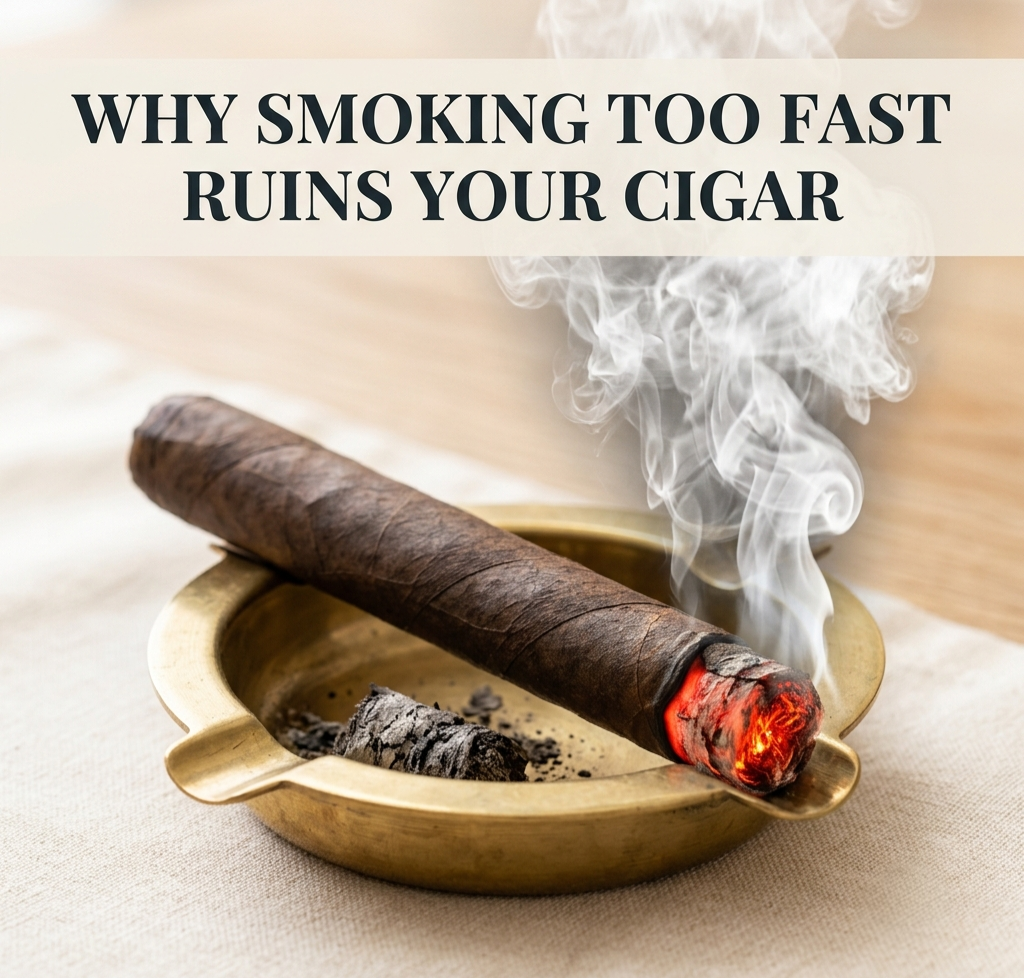
The robusto is already down to a nub, and the last third tasted like an ashtray. The smoke went hot enough to feel in the back of the throat, and somewhere around the halfway point the flavor stopped developing and started deteriorating instead. None of that is the cigar’s fault.
Smoking too fast is the single most common way a good cigar gets wasted, and it causes more downstream problems than almost anything else on this site. This is the complete picture of what it actually does and why, with links to the full depth on each specific consequence.
What Too Fast Actually Means
There’s no stopwatch requirement, but the standard guideline experienced smokers converge on is one draw roughly every 30 to 60 seconds, treating the cigar closer to a slow sip than a steady stream. It’s not just about frequency either. A hard, aggressive pull pulls more oxygen through the ember in one go than a gentle draw does, so two people puffing at the same interval can still overheat a cigar at different rates depending on how forcefully they’re drawing. Cigarettes train the opposite habit on both counts, frequent, hard, shallow puffs in quick succession, and that muscle memory is the single biggest reason new cigar smokers rush without realizing it. Set the cigar down in the ashtray between draws instead of holding it. If it’s in your hand, you’ll puff on it more often than you mean to.
What Actually Happens Inside the Cigar
Every draw pulls air through the ember and accelerates combustion, then the ember cools slightly in the gap before the next one. Space those draws out properly and each cycle of heating and cooling stays controlled, letting the tobacco burn at a complete, steady rate. Draw too often and the ember never gets that recovery window. Heat builds faster than it can dissipate, and combustion becomes incomplete. Tar, aldehydes, and residual ammonia compounds that would otherwise burn off cleanly at a normal pace start accumulating in the filler instead, and they travel straight into the next draw. The faster the pace, the more these compounds pile up, which is why a rushed cigar tends to taste noticeably worse in the second half than the first.
Everything It Costs You
Flavor turns bitter and one-dimensional. This is the most immediate effect and the easiest to notice. Why cigars taste bitter covers the full mechanism in depth, but pace-driven bitterness follows a specific pattern: fine for the first several draws, then progressively harsher as heat and combustion byproducts build up.
The wrapper can crack. Heat travels ahead of the burn line as you smoke, and at a controlled pace the wrapper has time to adjust. Rush it, and heat accumulates faster than the leaf can accommodate, drying and stressing the wrapper section ahead of the ember before the flame even reaches it. Why cigar wrappers crack walks through exactly how this happens.
The burn goes crooked. Overheating doesn’t just affect flavor, it affects the physical burn. A wrapper that’s racing ahead of the filler underneath it produces a distinct coning pattern, a raised point of exposed tobacco at the tip rather than a flat, even burn. Understanding what’s inside a cigar explains why wrapper and filler don’t always combust at matching rates to begin with.
You lose the ability to actually taste anything. Flavor perception depends on a controlled temperature and a palate that isn’t overwhelmed. Learning to taste notes in cigars is essentially impossible at a rushed pace, since the subtle notes a blender spent years developing get buried under harshness before you have a chance to register them.
Nicotine hits harder and faster. Puffing frequently delivers nicotine to your system faster than your body metabolizes it, which is a major contributor to the lightheaded, nauseous feeling some smokers experience. How to avoid getting sick or dizzy from a strong cigar covers the full prevention picture.
You get less cigar for your money, twice over. A rushed cigar burns through faster in raw time, so you’re physically smoking less of it, and what you do get to taste is the degraded, bitter version rather than the one the blender intended. How long a cigar actually takes to smoke lays out realistic timing by vitola, which is a useful gut check if you’re consistently finishing well ahead of that range.
How to Tell You’re Doing It Right Now
A few signals show up before the cigar is ruined, if you’re paying attention:
- The smoke feels noticeably hot on the draw
- The taste turns sharp or acrid rather than staying smooth
- The ash goes flaky and grey rather than holding together in a firm, solid column
- The cigar is visibly shrinking faster than the time elapsed would suggest for its size
Any one of these on its own might mean nothing, but two or three together almost always mean the pace needs to come down.
The Fix Is Almost Insultingly Simple
Slow down. One draw every 30 to 60 seconds, cigar resting in the ashtray in between rather than staying in your hand. If you catch yourself puffing out of habit rather than actual enjoyment, that’s the tell. A cigar that keeps going out from being smoked too slowly is a real, separate problem, but it’s rarely the one people accidentally create. Can you relight a cigar? covers what to do if you overcorrect and it goes out, though most smokers find the right rhythm within their first several cigars and rarely think about it again.
Frequently Asked Questions
Hot smoke on the draw, flavor that turns harsh or bitter as you go, ash that’s flaky and falls apart easily, and finishing a cigar in noticeably less time than its size would suggest are the clearest signs.
One draw roughly every 30 to 60 seconds is the standard guideline, with full-bodied cigars often rewarding an even slower pace to avoid overwhelming both the tobacco and your palate.
Yes. A thin panatela or corona has less tobacco mass to absorb and dissipate heat, so it runs hotter at the same pace than a thick gordo or toro does. Thinner ring gauges generally reward an even more patient rhythm than the standard guideline, while a large ring gauge cigar has a bit more built-in tolerance.
Yes. Puffing frequently increases how much nicotine you absorb per minute, which is a major contributor to the lightheaded, nauseous feeling some smokers call nicotine sickness.
It’s progressive rather than instant. The first few draws are usually fine, and harshness builds as heat and combustion byproducts accumulate, which is why a rushed cigar often tastes markedly worse in the second half than the first.
This is the classic pace-driven pattern. Tar, aldehydes, and residual ammonia compounds accumulate as the tobacco overheats, and the effect compounds the longer the fast pace continues.
Yes, and it causes its own separate problems, mainly a cigar that keeps going out and needs frequent relighting, though it’s generally less damaging to flavor than smoking too fast.
Peter | VDG Cigars | Certified Cigar Sommelier
Peter Stefanic is the editor of VDG Cigars and a Certified Cigar Sommelier through the IACS (International Association of Cigar Sommeliers). He has conducted more than 25 exclusive interviews with cigar brand owners, blenders, and founders, and has spent over a decade smoking, reviewing, and troubleshooting premium cigars.
Subscribe to our newsletter and find out about all new posts
Check out our latest posts
- Karina Owen: The Woman Who Built Her Own Name (Part 3 of 3)

- Horacio Heritage 6 Review: A Full-Bodied Costa Rican With a Perfumed Floral Edge

- Karina Owen: The Years That Taught Her People (Part 2 of 3)

- Brun del Ré Privado Gran Toro Review: A Two-Hour Costa Rican Puro

- Aroma de Nicaragua and Hernan Lopez: Up to a Year in the Pilón, and the Nicaraguan Cigar Built Without the Pepper

- Interview with Karen Berger

- The $1 Challenge: Helping Philadelphia Youth With the Roberto Martinez Foundation

- Robusto vs Toro: Real Smoke Times, Flavor and Which One to Choose

- Macanudo Maduro Diplomat Review: A Smooth, Fruity Maduro in a Short Figurado

- Brun del Ré Cigars and Carlo Corazza: The Costa Rican Puro That Ferments for Over a Year

- The story of Karina Owen Part 1 of 3: At the End of the Night

- The Leaf That Changes Everything: Why La Flor de Zaida and Medio Tiempo Belong in the Same Sentence

- La Flor de Zaida Brings the Diamond Collection and Ralf Moeller to InterTabac 2026

- Casa Magna Colorado Torito Review: A Rich, Approachable Everyday Full-Bodied

- Aroma de Nicaragua Connecticut Toro Review: A Long, Gentle Nicaraguan With Unusual flavors

- Aroma de Nicaragua Ecuador Robusto Review: A Long-Burning Nicaraguan Value

- Valentino Siesto at InterTabac 2026: Orange Black Arrives and Velero Sets Sail

- El Septimo at InterTabac 2026: Mi Familia and Queen Sheba Series II Come to Europe

- Top 20 Best Robusto Cigars 2026: Reviewed by Flavor, Body and Smoke Time

- The Children Nobody Reaches

