
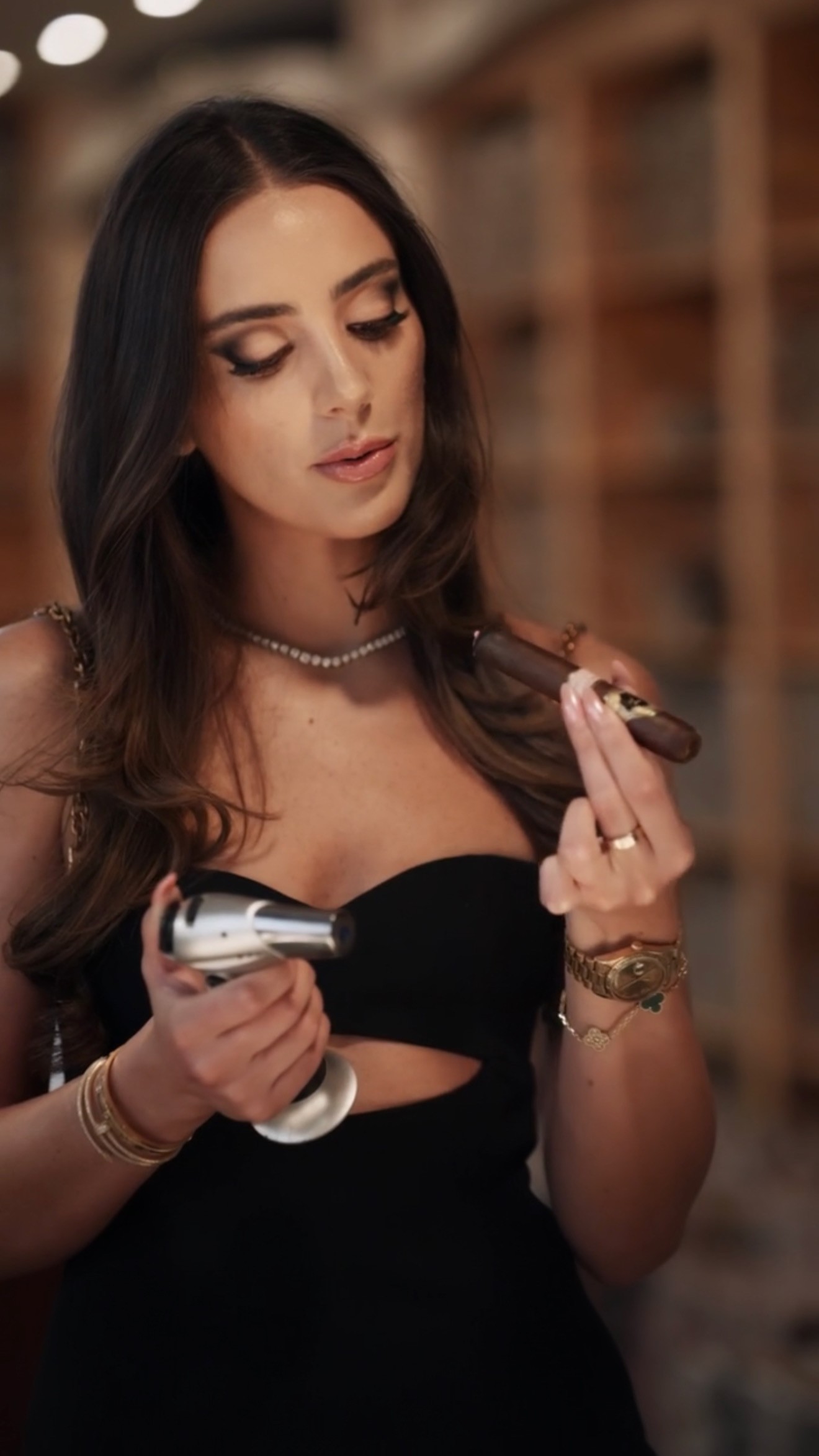
Women Who Shape the Cigar Industry
Some people are born into legacy. Alexandra Younan chose to earn it.
The only daughter among four brothers. A business degree built from three disciplines. A brand acquired by her family just as she stepped into the industry. None of it was handed to her — and she would not have wanted it that way.
Behind El Septimo’s global ambition, there is a woman who measures success not by what she has built, but by who she is becoming.
She calls it simple. Nothing about it is.
I have previously had the honor of interviewing Zaya Younan, Alexandra’s father. One of the hardest working and most humble men I have ever met — a story that left a deep mark on me and one that can teach you something about life.
I will be honest: I wasn’t sure this conversation could reach the same level. It did. If you listen closely to Alexandra’s words and take her advice to heart, I am sure your life will be better for it.
This is a story about more than cigars and business. It is about the power of friendship, how to face adversity without losing yourself, and how every woman — regardless of where she comes from — has the right to follow her dreams. It is a reminder that giving up is always a choice, and so is refusing to.
Who She Is
1. For those who don’t know you yet — tell us a little about yourself. Who is Alexandra Younan outside of El Septimo?
Outside of El Septimo, I’m simply a daughter, a sister, a friend, and someone who is constantly trying to become better than I was yesterday. I value family, learning, discipline, and meaningful relationships. At the end of the day, I’m much more interested in who I am than in a title.

I have heard these words before. Trying to become better than I was yesterday. They are words I first heard from Zaya. Among the most powerful words you can carry through life. What they mean is different for everyone. For some it means becoming a better parent. For others it means building self-confidence, learning something new, or strengthening a skill they know is weak. At its core it means waking up with the goal of improving your own wellbeing — for yourself, for your family, and for the world around you. The person who wakes up with that goal wakes up with a reason to build a better life. You will read Alexandra’s own definition of these words in question 10.
2. You grew up as the only daughter among four brothers. How did that shape you?

Growing up with four brothers gave me strength, independence, and a thick skin. I learned very early how to speak up, stand my ground, and never expect the world to make room for me — I learned to make my own room.
I want you to read that last sentence again. She did not wait for the world to change. She did not sit quietly and hope that one day there would be space for her. She made her own room. In a world that teaches women to be patient, to wait their turn, to soften their edges so others feel comfortable — Alexandra learned something different. She learned that no one is coming to hand you your place. You build it. You claim it. And you do it before anyone gives you permission.
3. How did you grow up around cigars?
Cigars were always part of the environment I grew up in, but I didn’t fully understand their significance when I was young. Over time, I began to appreciate that the cigar was only one part of something much bigger — tradition, craftsmanship, relationships, and family legacy. Time stands still for my family when we get together and enjoy a cigar together, catch up and talk about life.
Education & The Path She Chose
4. Business Administration, Law, and Marketing Analytics — was that always the plan?
It evolved, but it was always intentional. I wanted to understand business from different angles — how to build it, protect it, analyze it, and communicate it. Those three areas gave me a very strong foundation.
5. What did university teach you that you couldn’t have learned anywhere else?
It taught me how to think independently. Knowledge is important, but learning how to question, analyze, communicate, and make decisions under pressure has stayed with me far beyond the classroom.
6. You stepped straight into Younan Company as El Septimo was being acquired. How did that feel?

It was exciting and overwhelming at the same time. I was stepping into something with enormous responsibility, but I also saw it as an opportunity to learn quickly and prove myself.
When something feels overwhelming, many people step back. Not because the dream is too big — but because too many feelings arrive at once and the fear of not being enough takes over. The most important thing to understand is that a feeling is just a feeling. Overwhelming most often means you are on the right path. The moment things stop feeling big is often the moment you have stopped growing.
7. Was El Septimo always the dream?
Not necessarily. Life has a way of showing you opportunities you couldn’t have planned for. El Septimo became the chapter where my personal ambitions and my family’s legacy came together.
Family, Heritage & El Septimo
8. What does it mean to be part of El Septimo?
It means carrying something bigger than myself. I’m not just building a brand; I’m helping protect a story, a standard, and a legacy for my family that has meaning far beyond business.
Working for a brand does not mean working for happiness. But when you build something that feels bigger than yourself — a story worth protecting, a legacy for your family — that is when work stops being work and becomes a passion. Too many people today spend more hours at a job they dislike than with the people they love, and that energy follows them home. When you work for something you believe in, that same energy becomes a gift to everyone around you. You spend more waking hours at work than with your family. Make sure those hours mean something. Build something of value — for yourself and for the people around you.
9. How has your father’s journey shaped you?

His journey taught me that your starting point does not define your destination. He showed me what discipline, vision, sacrifice, and persistence can create when you refuse to give up on yourself.
Your starting point does not define your destination. A daughter who watched her father live those words from the very beginning knows exactly what they cost.
If you have read my interview with Zaya, you know his story. A boy who left Tehran at thirteen with twenty-five dollars and a dream that had no business surviving. Alexandra grew up watching what happened next. She did not just inherit a brand. She inherited a belief system — one that was proven before she was old enough to question it.
That is what makes her different. Most people are told that anything is possible. Alexandra was shown.
10. “Every day I work to become a better version of myself…” What does that mean to you?
It means growth is never finished. Success isn’t a destination where you stop improving — it’s a responsibility to yourself, your family, and the people around you to keep becoming better.
11. Working alongside family — what does that give you, and what does it ask of you?
It gives me trust, perspective, and a deeper sense of purpose. But it also demands accountability, because when your name is attached to what you build, you understand that every decision matters.
12. Is there an El Septimo memory you will always carry?
Some of the most meaningful moments aren’t the big ones — they’re the conversations, the long days, the celebrations, and the moments where you realize you’re building something together as a family.
13. What important things did your parents instill in you?

Work ethic, humility, gratitude, discipline, and respect. I was taught that success without character is empty.
I wasn’t sure whether to write my thoughts on this answer. But I cannot help myself — and if what I say makes you uncomfortable, then perhaps you are the one who needs to hear it most.
Today too many people expect others to take care of them. Gratitude for what we have has quietly disappeared. Discipline is rarely seen, and respect for others has become something we talk about but rarely practice. If we teach our children a real work ethic, they will not grow up expecting the world to carry them. They will grow up with self-confidence, with the ability to help others, and with the inner strength to handle the moments when life gets hard. Gratitude reminds us that someone giving us their time is choosing our wellbeing over their own. Discipline means doing what needs to be done regardless of how you feel. These are not complicated lessons — but they must be taught early, quietly, and consistently. The values Zaya and Sherry instilled in Alexandra are the foundation of a child’s wellbeing in adult life. Your children have nothing to lose from learning them. Only everything to gain.
14. How do you carry your family’s story into the way you lead?
I try to lead with the same values that built my family: work hard, stay humble, keep your word, and never become so successful that you forget where you came from.
15. Is El Septimo an extension of your family, or has it taken on a life of its own?
It started with family, but it has become much bigger than us. Our values are at its foundation, but El Septimo has developed its own identity, global community of luxury aficionados, and vision.
16. What did your father teach you by example?

He taught me that excuses don’t build anything. You can acknowledge challenges, but you still have to move forward. Talk about the problem 10% of the time, and the solution 90% of the time. Become the smartest person on whatever it is you are trying to learn, so that you can become the best.
10% on the problem. 90% on the solution. Ask yourself honestly how much of your day looks like that.
Most people do it the other way around. They live inside the problem — talking about it, replaying it, letting it define how they feel about themselves. And the longer you stay there, the heavier it gets. Not because the problem grew. Because your focus fed it.
Acknowledge it. Understand it. Then turn everything toward the solution. That one shift changes not just what you build — but who you become while building it.
The problem will always be there. The question is whether you choose to live in it — or move through it.
Dreams — How You Follow Them
Dreams do not die because they were impossible. They die because life got loud, doubt got comfortable, and one day you stopped asking yourself what you actually wanted. Alexandra Younan has thought deeply about what it really means to follow a dream — not the version that looks good on social media, but the version that requires something from you when no one is watching. What she shares here is not theory. It is the lived experience of someone who chose to move forward even when the path was not clear. Read slowly.
17. What does it really mean to follow a dream?
It means being willing to work for it long after the excitement wears off. A dream sounds beautiful in your head; pursuing it requires discipline when nobody is watching.
The excitement of a new dream is one of the best feelings in the world. The idea, the vision, the possibility. But that feeling fades. It always does. And what is left when it fades is the only thing that actually matters — are you still willing to do the work? Not when it feels inspiring. Not when people are watching and cheering. But on the quiet Tuesday morning when no one knows and no one cares. That is where dreams are either built or abandoned. A dream can fade for many reasons. Most of the time it fades when you hit a challenge that feels overwhelming. This is when you need to push through the lonely hours and never give up.
18. What separates people who pursue their dreams from those who don’t?
Action. You don’t need to know every step — you just need the courage to take the first one.
19. How do you handle doubt when progress is slow?
I remind myself that slow progress is still progress. I focus on what I can control, stay consistent, and trust that the work will eventually compound.
20. What role has failure played in your journey?
Failure has taught me more than success ever could. It has made me more resilient, more thoughtful, and less afraid of getting something wrong.
Less afraid of getting something wrong. That phrase alone is worth more than most advice you will ever receive. We live in a world that has made failure feel like a verdict. Like it says something permanent about who you are. It does not. Failure is information. It tells you what did not work, which means it is pointing you toward what will. The people who are less afraid of getting something wrong are the ones who eventually get it right.
21. Does everyone have a dream?
I think everyone has something inside them that they want to become or create. Sometimes the first step isn’t chasing the dream — it’s giving yourself enough quiet to discover what it is.
22. Advice for someone at the beginning of something scary but exciting?
Be afraid and do it anyway. Courage isn’t the absence of fear; it’s refusing to let fear make the decision for you.
I have heard many definitions of courage in my life. This is one of the best. Fear will never disappear. The only thing you can control is whether you let it sit in the driver’s seat.
Facing Tough Challenges
23. What’s your relationship with tough challenges?
I don’t look for challenges, but I don’t run from them either. Some of the most important growth in my life has happened because I was forced outside my comfort zone.
24. A challenge that tested you?
Some of the hardest moments have been the moments when I questioned myself. They taught me that confidence isn’t always feeling certain — it’s continuing to move forward even when you’re not.
25. What keeps you grounded?
Family, perspective, and remembering why I started. When everything gets loud, I go back to what actually matters.
26. How do you know when to push through or change direction?
I ask myself whether the obstacle is testing my commitment or telling me the strategy needs to change. Persistence matters, but so does knowing when to adapt.
27. What does toughness really look like in a woman?
Toughness isn’t being emotionless. It’s being able to feel deeply, remain grounded, and still make strong decisions.
How many people do you know who confuse strength with coldness? Alexandra showed me something different. Real strength has warmth in it.
28. Have you ever felt completely alone in a challenge?
Yes. And those moments taught me that sometimes you have to become your own source of reassurance. You discover your strength when there is nobody else to hand it to you.
We spend so much of our lives looking for someone to tell us we are enough. A parent, a partner, a friend, a mentor. Someone whose words can quiet the doubt. And sometimes that person is simply not there. Sometimes you are standing completely alone in the middle of something hard and no one is coming. Alexandra learned something in those moments that most people never learn — that the reassurance you were searching for was always inside you. You just need the silence of being alone to finally hear it. Trust yourself. Trust what you have already survived.
29. What do you know now that you wish you’d known then?
Not everything needs to happen immediately. Timing matters, and sometimes what feels like a delay is actually preparation.
30. Is struggle necessary for growth?
I think both struggle and joy teach us, just in different ways. Struggle builds resilience, but joy teaches us gratitude — and both are necessary.
31. What does resilience look like in your daily life?
It looks like showing up again. Answering the call, solving the problem, keeping your commitments, and moving forward even on days when you don’t feel like it.
The People Around You
This is perhaps the most important section in the entire article. The people around us shape our standards, our beliefs, and what we think is possible for our own lives. Most people never examine this honestly. We drift into friendships, stay in them out of habit, and never ask whether the people closest to us are actually helping us become who we want to be. The right people will lift you, support you in difficult moments, and push you to achieve things you never thought possible. The wrong ones will do the opposite — make you doubt yourself, take advantage of your success, and never show true loyalty or love.
The words Alexandra shares in this section are among the most important in this entire conversation. Words that can change your life as an adult — and if you teach them to your children, change theirs too. Take your time here. Read, reflect, and build yourself a safer and better circle.
32. Do you believe you become the people you surround yourself with?
Absolutely. The people around you influence your standards, your mindset, and even what you believe is possible.
33. How do you know who belongs in your life?
Time reveals people. I pay attention to consistency, integrity, and how someone behaves when there is nothing to gain.
When there is nothing to gain. That is the test most people never apply. It is easy to be loyal when loyalty costs nothing. It is easy to be supportive when your support makes you look good. But what does a person do when there is no audience, no benefit, no reward? That is when you find out who they really are. Time is the only thing that reveals this. You cannot rush it. You can only pay attention.
34. Have you ever had to let go of someone you cared about?
Yes, and it’s never easy. But sometimes protecting your future means accepting that not everyone is meant to go with you into the next chapter.
35. What qualities do you value most?
Integrity, loyalty, ambition, kindness, and emotional intelligence. I want people around me who are genuine when nobody is watching.
36. What are the quiet signs someone isn’t really in your corner?
They celebrate your struggles more than your growth, create unnecessary doubt, or only support you when it benefits them. Pay attention to how people make you feel after you leave the room.
Stop here. Not what they said. Not what they did. How you felt when they were no longer there. I want you to think about the people in your life and ask yourself that question honestly. Some people leave you feeling lighter. Some leave you feeling smaller. You rarely notice it in the moment. But if you pay attention — really pay attention — your body already knows the answer long before your mind is willing to admit it.
37. Has someone believed in you before you believed in yourself?
Absolutely. Having someone believe in your potential before you can fully see it yourself can change the trajectory of your life. Sometimes belief is the first form of confidence.
38. How do you protect your energy?
Boundaries. Not everything deserves access to you, your attention, or your peace.
Not everything deserves access to you. I think this might be one of the hardest lessons a person can learn. We are taught to be available, to be generous, to say yes. And generosity is a beautiful thing. But there is a version of generosity that costs you everything — where you give so much of yourself to everyone around you that there is nothing left for the people and the work that actually matter. A boundary is not a wall. It is a decision about what you value enough to protect.
39. Difference between people who lift you and people who make you comfortable?
People who make you comfortable may keep you where you are. People who lift you challenge you to become more.
A Woman Who Chases Her Dreams

I have spoken to many people in my life about dreams. Most talk about them the way you talk about something that belongs to someone else — someone luckier, braver, or better positioned than themselves. Alexandra Younan does not talk about dreams that way. She talks about them like they are a responsibility. Something every woman not only has the right to chase, but an obligation to herself not to abandon. What she shares in this section stayed with me long after our conversation ended. I think it will stay with you too.
40. What would you say to the woman carrying a dream quietly?
Say it out loud. Give it a name. You cannot build a future around something you are too afraid to admit you want.
Think about how many dreams have died in silence. Not because they were impossible. Not because the person lacked talent or courage. But because they never said it out loud. There is something that happens the moment you give a dream a name. It stops being a fantasy and starts becoming a direction.
41. What holds women back most?
Often, it’s the fear of judgment. I wish more women understood that people will have opinions whether you succeed or fail — so you might as well build the life you want.
If you succeed, people will have opinions. If you fail, people will have opinions. If you do nothing at all, people will still have opinions. The judgment never stops. It does not disappear when you play it safe. It just changes shape. Alexandra is not telling you to ignore the world. She is telling you that the world will talk regardless — so you might as well give it something worth talking about.
42. A moment where everything felt uncertain?
There have been many. What kept me going was remembering that uncertainty doesn’t mean you’re on the wrong path — it often means you’re entering unfamiliar territory.
43. Is there a woman who shaped you?


The women in my family have had a tremendous influence on me. Their strength, grace, and resilience taught me that you can be both powerful and compassionate.
44. What does it mean to be someone young women might look up to?
It’s a responsibility I don’t take lightly. I want women to see me and think, “There is room for me here too.”
There is room for me here too. I want every woman reading this to stop and feel those words. Not read them. Feel them. Because for too long, too many women have walked into rooms and felt like guests in a space that was never built for them. They have softened their voice, adjusted their presence, made themselves easier to accept. Alexandra is not asking women to fight their way in. She is simply reminding them that the door was never truly locked. It just needed someone willing to push it open. She is one of those people. And every time she walks into a room, she makes it a little easier for the next woman who comes after her.
45. What would you tell a young woman afraid to start?
Start before you feel ready. You’ll never eliminate the fear completely, but you can refuse to let it control your future.
46. Is confidence born or built?
Built. Confidence comes from keeping promises to yourself — doing difficult things, learning from failure, and proving to yourself that you can handle more than you thought.
47. What decision changed everything?
Choosing not to wait for permission. The moment you realize you are responsible for creating your own opportunities, everything changes.
Everything changes. Not some things. Everything. I think this is the most important thing Alexandra said in our entire conversation. We are raised to wait. To raise our hand before we speak. To be invited before we enter. And there is a time and a place for patience. But there is a dream-killing version of waiting that has nothing to do with patience and everything to do with fear. The moment you stop waiting for permission is the moment your life actually begins.
48. How do you balance ambition with being everything to everyone?
By accepting that I can’t be everything to everyone — and I shouldn’t have to be. Ambition becomes much healthier when you stop measuring yourself by impossible expectations.
49. Is there a version of yourself you had to leave behind?
The version of me that cared too much about what everyone else thought. Growth required me to become more comfortable trusting my own judgment.
A Woman in a Male-Dominated Industry

There are industries that were not built with women in mind. The cigar world is one of them. Alexandra walked into it anyway — not to make a point, but because she had something to contribute and she refused to let the room define her place in it. What she shares here is not bitterness. It is quiet strength.
50. Were you aware the cigar industry was male-dominated?
Yes, but I never allowed that to become the defining part of my experience. I focused more on what I could contribute than on who else was in the room.
Most people who enter a space where they are the minority spend enormous energy on the fact that they do not fit. It becomes the story they tell themselves before they even begin. Alexandra made a different choice. She decided that her contribution was more important than the composition of the room. That is not naivety. That is strategy. And it is a large part of the reason she is sitting where she is today.
51. Have you felt you had to prove yourself more?
There have certainly been moments where I felt that way. My response has always been the same: let the quality of my work speak louder than any assumption.
52. What has navigating that world taught you?
To trust myself. You don’t always need everyone to understand you immediately — you need to know who you are and what you bring to the table.
53. Advice to a young woman entering an industry that doesn’t look like her?
Don’t wait for the industry to look different before you enter it. Be part of changing what it looks like.
Paths are not found. They are made. Every woman who entered a room before she was invited made it slightly easier for the next one. Alexandra is one of those women. And she is asking you to be one too.
What You Wish More Young Women Knew
Some lessons take years to learn. Others you wish someone had simply told you at the beginning — before the self-doubt, before the compromises, before you made yourself smaller than you needed to be. Alexandra did not have to share what she knows. She chose to. This section is for every young woman who is still figuring it out. Read this as if it were written for you. Because it was.
54. One thing the world never tells young women?
You don’t need to make yourself smaller to make other people comfortable.
One sentence. Read it as many times as you need to. Then teach it to every young woman you know.
55. What do you wish women understood about the gap between where they are and where they want to be?
That gap is where the work happens. Don’t be intimidated by how far away the goal looks — focus on becoming the person capable of reaching it.
56. What belief should women unlearn?
That they need permission to be ambitious. Ambition is not a flaw, and wanting more for yourself does not make you selfish.
57. What gives you hope about young women today?
Their fearlessness. I see more women questioning old definitions of success and creating their own.
If You Could Change the World
58. If you could change three things?
I would invest more deeply in education, create more meaningful opportunities for women and young people, and encourage a culture where kindness and success aren’t treated as opposites.
59. An injustice that doesn’t get enough attention?
The quiet inequalities — the ones that don’t always make headlines but still determine who gets opportunity, who gets heard, and who gets taken seriously.
The quiet ones. That is what stayed with me. The injustices that make headlines are the ones we march for, the ones we post about, the ones that are impossible to ignore. But the quiet inequalities — the moment someone is talked over in a meeting, the assumption made before a woman has even opened her mouth, the opportunity that silently goes to someone else for reasons that are never stated out loud — those are the ones that accumulate. Slowly. Invisibly. They rarely leave a mark you can point to. But over time they build a ceiling. And the most damaging thing about a quiet inequality is that it makes the person on the receiving end question themselves rather than the system. Alexandra sees it. And she is talking about it. That matters more than most people realize.
60. How would you change the world’s view of women?
I would stop separating strength and femininity. A woman can be ambitious, intelligent, compassionate, powerful, and elegant — all at the same time.
El Septimo — Building a Brand

61. How do you build and protect a brand with so much heritage?
You respect the past without becoming trapped by it. Heritage gives you a foundation, but protecting a brand also means having the courage to evolve.
62. What does luxury mean to you?
Luxury is the combination of product, craftsmanship, experience, and emotion. It is creating something that people don’t simply purchase — they remember.
63. How do you evolve while staying true to El Septimo?
We evolve in how we express the brand, but not in what we believe. The details can change; the standards cannot.
64. Biggest challenge in growing El Septimo globally?
Growing globally while maintaining consistency. When a brand becomes international, you have to protect its identity while understanding that every market is different.
65. What excites you most about the next chapter?
The potential. We have an incredible foundation, and I believe the next chapter is about taking that foundation to places people haven’t seen yet.
Words of Wisdom & Closing Reflections
66. Do you have words of your own that guide you?
“Never stop becoming.” There is always another level of growth, another lesson to learn, and another way to become better.
67. What would you tell yourself ten years ago?
Trust yourself sooner. You don’t need to have everything figured out to take the next step.
This is something I believe has become one of society’s quiet diseases. Too often we are raised to listen to others and to distrust our own instincts. It becomes a question of self-confidence — and self-confidence is something every person should work on, almost daily. The day you begin to trust yourself more is the day you dare to follow your dreams, face your challenges, and believe that whatever comes your way, you are capable of finding a way through. Self-confidence is not arrogance. It is the foundation of everything you will ever achieve.
68. What do you hope your story inspires in other women?
I hope it reminds women that they don’t have to choose between being feminine and being powerful. They can build, lead, dream, and still remain completely themselves.
69. Anything you’ve been waiting to say?
You don’t have to fit into someone else’s definition of success. Build a life and a career that are meaningful to you — not simply impressive to someone else.
70. Where do you see yourself and El Septimo in five years?
I see continued global growth, stronger innovation, and an even deeper connection between the brand and the people who believe in it. Personally, I want to keep learning, keep building, and keep raising the standard.
The Personal
71. What is your favourite cigar right now, and why?

My favourite El Septimo is the Coco part of my Collection — the Alexandra Collection. I love it because it represents what I value most about cigars: craftsmanship, complexity, and an experience that deserves to be slowed down and appreciated. Although designed for women to fit their preferences in regards to strength, flavor and size, men love this cigar too. It is the perfect balance of creamy and mild, not too overpowering, strong, or peppery.
72. Is there something you wish people knew about you that most don’t?
I’m much more driven by purpose than by attention. I care deeply about the people around me, and behind the ambition, I’m someone who genuinely values family, loyalty, and living a meaningful life.
Alexandra, thank you for the time you gave me and for the honesty you brought to every single answer. The words you have shared, the lessons you have offered, and your genuine desire to help others build a better life — that says more about who you are than any title ever could. It has been a genuine honor to write this article.

If you would like to know more about El Septimo cigars, visit El Septimos website https://el-septimo.com/


Subscribe to our newsletter and find out about all new posts
Latest posts
- Interview: Alexandra Younan & El Septimo

- K by Karen Berger Habano Toro Review: A Spicey Nicaraguan Puro

- New World Cameroon by AJ Fernandez Torpedo Review

- K by Karen Berger Maduro Toro Review: A Dark, Full-Bodied Nicaraguan

- Why Are Cuban Cigars Illegal in the United States?

- El Pulpo by AJ Fernandez Toro Grande Review: The Octopus That Won’t Let Go

- Don Kiki Gold Label El Gordo Review: Kiki Berger’s Legacy in a Cigar

- K by Karen Berger Cameroon Toro Review

- New World Decenio by AJ Fernandez Robusto Review

- Platinum Nova Classic Robusto Review

- Bossner Rolando Robusto Review: A Full-Bodied Maduro That Welcomes You In

- No Sugar Added: The Neuroscience of Why Sweet Cigars Rewire Your Brain

- Amar by AJ Fernandez Robusto Review: A Cigar Born From Fire

- K by Karen Berger 25th Anniversary by AJ Fernandez Review: A Full-Bodied Collaboration Full of Unique Character

- Don Kiki Brown Label Barber Pole Figurado Review: A Small Cigar With Big Character

- Gilbert de Montsalvat Anniversary Gran Robusto Review: A Sweet, Complex Value cigar

- Why Does My Cigar Taste Metallic?

- Stauffenberg Cigars: The Complete Guide, Reviews, Interview and the Story Behind the Brand

- Don Kiki Green Label Toro Review: A mild cigar from Karen Berger

- Stauffenberg Edition 3 Dark Toro Review: A Full-Bodied Honduran With a Corojo Wrapper

