
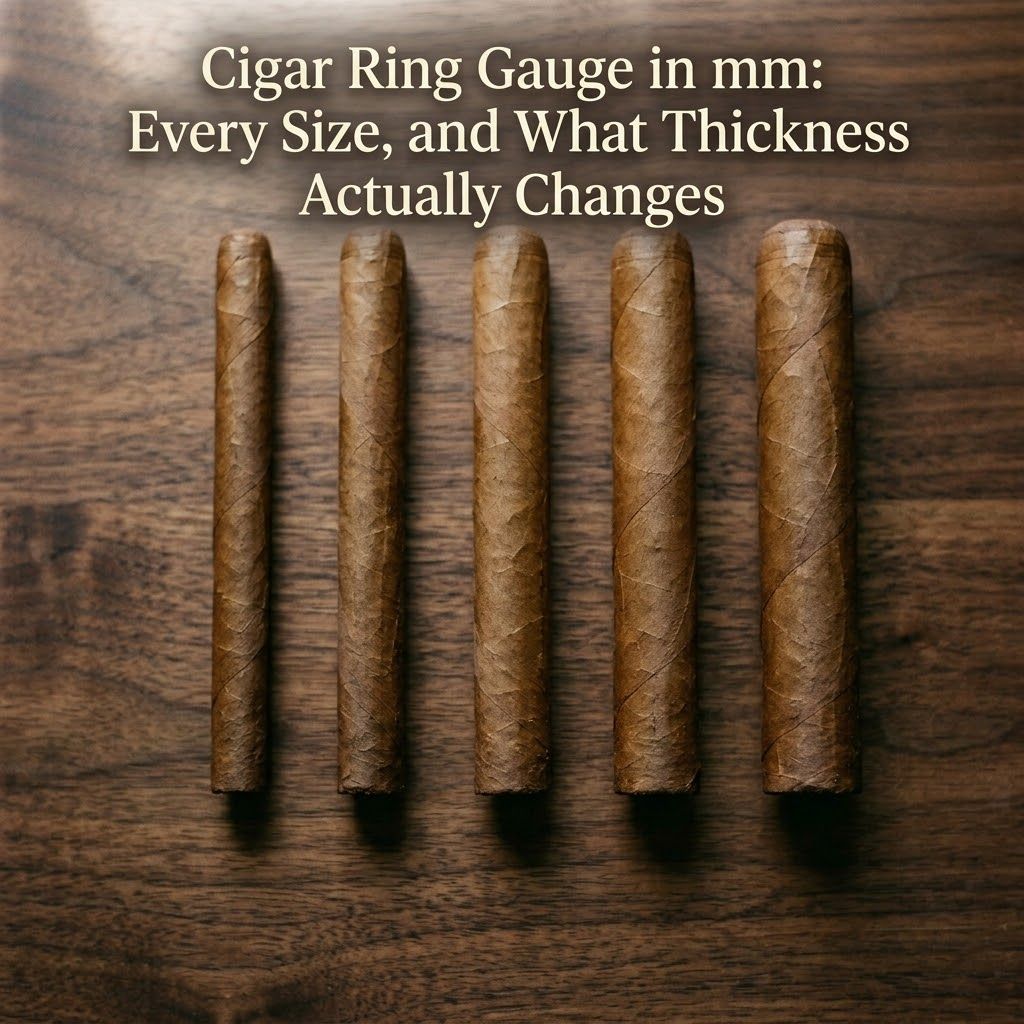
Ring gauge is how thick a cigar is. The second number in a 5 x 50 is the ring gauge, and it counts in sixty fourths of an inch. So a 50 is fifty sixty fourths of an inch wide, which is 19.84 mm.
That is the whole measurement. Below is the full chart, and after it the part worth reading, which is what the number actually does to the cigar.
Three things people get wrong
It is the width, not the way around. If you measured around a Robusto you would get about 62 mm, and nobody quotes that number. Habanos lists a Robusto as 50 ring gauge and 19.84 mm, and that 19.84 is how wide it is.
It includes the wrapper. The number describes the finished cigar, not the bundle of leaf inside it.
It is a target, not a promise. These are made by hand. Two cigars out of the same box can measure a little differently, and that is handwork rather than a fault.
One more, because I see it claimed a lot. Ring gauge is not an American measurement that the rest of us translate. It is what everybody uses, here in Europe too. Millimetres get printed next to it, not instead of it, which is exactly how Habanos writes their own specifications.
So the reason to convert is not that anyone measures differently. It is that sixty fourths of an inch is a strange way to think about an object you are holding, and millimetres are not. You need the millimetre when you are matching a cigar to a cutter, a punch or a travel tube. And you need it to see how big the difference between two sizes really is, which is where most people guess wrong.
The one bit of maths
One ring gauge is 25.4 divided by 64, so 0.396875 mm.
Multiply by that to get millimetres. Divide by it to go back the other way.
The number to remember is 64, because a ring gauge of 64 is exactly one inch, exactly 25.4 mm. Everything else you can work out from there. A 32 is half an inch. A 50 is a bit under four fifths of one.
Cigar ring gauge to mm: the full chart
Every size from 26 to 80, odd numbers included, because cigars are not only made in even ones. The Cuban Double Corona is a 49.
| Ring gauge | Millimetres | Inches |
|---|---|---|
| 26 | 10.3 mm | 0.41 |
| 27 | 10.7 mm | 0.42 |
| 28 | 11.1 mm | 0.44 |
| 29 | 11.5 mm | 0.45 |
| 30 | 11.9 mm | 0.47 |
| 31 | 12.3 mm | 0.48 |
| 32 | 12.7 mm | 0.50 |
| 33 | 13.1 mm | 0.52 |
| 34 | 13.5 mm | 0.53 |
| 35 | 13.9 mm | 0.55 |
| 36 | 14.3 mm | 0.56 |
| 37 | 14.7 mm | 0.58 |
| 38 | 15.1 mm | 0.59 |
| 39 | 15.5 mm | 0.61 |
| 40 | 15.9 mm | 0.63 |
| 41 | 16.3 mm | 0.64 |
| 42 | 16.7 mm | 0.66 |
| 43 | 17.1 mm | 0.67 |
| 44 | 17.5 mm | 0.69 |
| 45 | 17.9 mm | 0.70 |
| 46 | 18.3 mm | 0.72 |
| 47 | 18.7 mm | 0.73 |
| 48 | 19.1 mm | 0.75 |
| 49 | 19.4 mm | 0.77 |
| 50 | 19.8 mm | 0.78 |
| 51 | 20.2 mm | 0.80 |
| 52 | 20.6 mm | 0.81 |
| 53 | 21.0 mm | 0.83 |
| 54 | 21.4 mm | 0.84 |
| 55 | 21.8 mm | 0.86 |
| 56 | 22.2 mm | 0.88 |
| 57 | 22.6 mm | 0.89 |
| 58 | 23.0 mm | 0.91 |
| 59 | 23.4 mm | 0.92 |
| 60 | 23.8 mm | 0.94 |
| 61 | 24.2 mm | 0.95 |
| 62 | 24.6 mm | 0.97 |
| 63 | 25.0 mm | 0.98 |
| 64 | 25.4 mm | 1.00 |
| 65 | 25.8 mm | 1.02 |
| 66 | 26.2 mm | 1.03 |
| 67 | 26.6 mm | 1.05 |
| 68 | 27.0 mm | 1.06 |
| 69 | 27.4 mm | 1.08 |
| 70 | 27.8 mm | 1.09 |
| 71 | 28.2 mm | 1.11 |
| 72 | 28.6 mm | 1.13 |
| 73 | 29.0 mm | 1.14 |
| 74 | 29.4 mm | 1.16 |
| 75 | 29.8 mm | 1.17 |
| 76 | 30.2 mm | 1.19 |
| 77 | 30.6 mm | 1.20 |
| 78 | 31.0 mm | 1.22 |
| 79 | 31.4 mm | 1.23 |
| 80 | 31.8 mm | 1.25 |
It reads both ways. If the millimetre is the number you have, which it usually is when you are working from a cutter or a caliper, find it in the middle column and read the ring gauge off the left.
Length, the other number on the box
Length is the first number, and it is in plain inches.
| Inches | Millimetres |
|---|---|
| 3″ | 76 mm |
| 3.5″ | 89 mm |
| 4″ | 102 mm |
| 4.5″ | 114 mm |
| 5″ | 127 mm |
| 5.5″ | 140 mm |
| 6″ | 152 mm |
| 6.5″ | 165 mm |
| 7″ | 178 mm |
| 7.5″ | 191 mm |
| 8″ | 203 mm |
A cigar written 5 x 50 is five inches long and 50 ring gauge. That is 127 mm by 19.8 mm. Length always comes first.
The sizes you will actually meet
Most of that chart is theory. In practice you will spend your life in a narrow band.
A Corona is usually 42, so 16.7 mm. A Robusto is usually 50, so 19.8 mm. A Toro is usually around 52, so 20.6 mm. A Gordo starts at about 60, so 23.8 mm. Those four cover most of what sits in a walk in humidor, and I compared how they actually smoke in Robusto vs Toro vs Churchill vs Corona.
Two things the chart will not tell you.
The Cuban range stops at 57. Habanos lists nothing above it, so every 60, 64 and 70 you come across is a New World cigar. Smoke mostly Cuban and the top third of that chart is academic.
And a box pressed cigar is sold under its round ring gauge even though it is not round any more. The number describes the cigar it was before the press.
Why a small jump in ring gauge is a big jump in tobacco
Here is the bit the charts never mention.
A Gordo at 60 is four millimetres fatter than a Robusto at 50. It holds forty four percent more tobacco.
That sounds wrong until you remember a cigar is round. Make a circle slightly wider and the space inside it grows much faster than the width does. So every step up in ring gauge buys more leaf than the millimetres let on.
| Ring gauge | Diameter | Tobacco compared to a Robusto |
|---|---|---|
| 38 | 15.08 mm | 0.58 times |
| 42 | 16.67 mm | 0.71 times |
| 46 | 18.26 mm | 0.85 times |
| 50 | 19.84 mm | 1.00 times |
| 52 | 20.64 mm | 1.08 times |
| 54 | 21.43 mm | 1.17 times |
| 56 | 22.23 mm | 1.25 times |
| 58 | 23.02 mm | 1.35 times |
| 60 | 23.81 mm | 1.44 times |
| 64 | 25.40 mm | 1.64 times |
Two comparisons worth keeping in your head. Going from a 50 to a 54 is 1.6 mm, which sounds like nothing, and it is seventeen percent more tobacco. And a Corona at 42 next to a Gordo at 60 looks like a moderate step up, when the Gordo holds a little over twice as much leaf.
This is why a blender has far more freedom in a fat cigar than the width suggests. More room means more kinds of leaf and more of each, which is the real reason wide cigars often taste layered and thin ones taste focused.
It also means thin cigars are the harder job. There is less space to work in, so every leaf in the recipe has to earn its place. I think that is why a good Lancero impresses me more than a good Gordo.
Two more things thickness changes
It burns cooler, usually. A fat cigar spreads the heat across more tobacco, so at the same pace it runs cooler than a thin one. Pace matters more than thickness, though. A thin cigar smoked slowly stays cool, and a Gordo smoked fast will go hot and bitter like anything else.
The wrapper gets quieter. This one catches people out. A wrapper is a thin skin, about the same thickness whatever it is wrapped around. So on a thin cigar it makes up a bigger share of what you are smoking, and on a fat one a smaller share. A 42 gives you roughly a fifth more wrapper than a 50 does, relative to its size.
Which gives you something useful. If you want to know what a wrapper really tastes like, smoke it thin, where it has the loudest voice. If you want to know what a blender can do, smoke the same blend fat.
What length changes
Length is not only about how long you will be sitting there. It changes the smoke as well, and it does it by giving the cigar room to develop.
Two things happen in a long cigar. The smoke has further to travel through unlit leaf before it reaches you, so it opens more gently and builds as you go. And there is simply more cigar for the oils to gather and change in while you smoke.
That is why the long formats are where you meet real transitions. The cigar that is one thing in the first third and clearly another by the last. A short cigar arrives more concentrated from the start and has less distance in which to turn into something else.
But length gives a blend room to develop. It does not promise that it will. Whether a cigar actually goes anywhere comes down to the blend and to how the leaf is laid along the body. A long cigar built on a flat blend just stays flat for longer.
So the two numbers answer two different questions. Ring gauge tells you how much the blender had to work with. Length tells you how much room there was for it to change.
For the rest of it, including why the market drifted towards fatter cigars over the last twenty years, see cigar sizes explained.
FAQ
19.8 mm, or 19.84 mm exactly. That is a standard Robusto.
23.8 mm. That is a Gordo, and about as fat as most people want to smoke.
A 50, near enough. 20 mm works out at 50.4, and nothing is made at 50.4.
The width. A 50 is fifty sixty fourths of an inch across, which is 19.84 mm, and that is how Habanos states it. Measured around, a Robusto would be about 62 mm, and nobody uses that number.
Ring gauge, the same as everywhere. Millimetres turn up next to it rather than in place of it.
Not by itself. Ring gauge is thickness, not strength. A fat cigar holds more leaf so the blend has more room, but strength comes from which leaves went in and how much ligero is among them.
1.6 mm across, and about seventeen percent more tobacco. The width difference sounds trivial and the tobacco difference is not, because a cigar is round and the space inside a circle grows faster than its width.
Because the wrapper is a thin layer of roughly fixed thickness, so it is a larger share of a thin cigar than a fat one. A 42 shows more wrapper character than a 60 of the same blend.
Yes, through development rather than through the blend. In a longer cigar the smoke travels further through unlit leaf, and there is more cigar for the oils to gather and change in. That gives the blend room to evolve, which is why long formats are where you find clear transitions. Room rather than a promise, since the blend and the construction decide whether it happens.
It has more chance to be. More length means more body for the smoke to pass through and more time for the character to shift, so a blend built to develop has somewhere to do it. A long cigar made from a flat blend will just stay flat for longer.
Between 46 and 52, so 18.3 to 20.6 mm. Thin cigars run hot if you rush them, and very fat ones are a lot of smoke for a first cigar.
Subscribe to our newsletter and find out about all new posts
Check out our latest posts
- How a Cigar Is Made, From Seed to Shop

- Top 30 Best Winter Cigars (2026): Reviewed by Flavor, Body and Smoke Time

- Cigar Ring Gauge in mm: Every Size, and What Thickness Actually Changes

- Horacio 8 Classic Review: A Small, Nutty Costa Rican Everyday Smoke

- Karina Owen: The Woman Who Built Her Own Name (Part 3 of 3)

- Horacio Heritage 6 Review: A Full-Bodied Costa Rican With a Perfumed Floral Edge

- Karina Owen: The Years That Taught Her People (Part 2 of 3)

- Brun del Ré Privado Gran Toro Review: A Two-Hour Costa Rican Puro

- Aroma de Nicaragua and Hernan Lopez: Up to a Year in the Pilón, and the Nicaraguan Cigar Built Without the Pepper

- Interview with Karen Berger

- The $1 Challenge: Helping Philadelphia Youth With the Roberto Martinez Foundation

- Robusto vs Toro: Real Smoke Times, Flavor and Which One to Choose

- Macanudo Maduro Diplomat Review: A Smooth, Fruity Maduro in a Short Figurado

- Brun del Ré Cigars and Carlo Corazza: The Costa Rican Puro That Ferments for Over a Year

- The story of Karina Owen Part 1 of 3: At the End of the Night

- The Leaf That Changes Everything: Why La Flor de Zaida and Medio Tiempo Belong in the Same Sentence

- La Flor de Zaida Brings the Diamond Collection and Ralf Moeller to InterTabac 2026

- Casa Magna Colorado Torito Review: A Rich, Approachable Everyday Full-Bodied

- Aroma de Nicaragua Connecticut Toro Review: A Long, Gentle Nicaraguan With Unusual flavors

- Aroma de Nicaragua Ecuador Robusto Review: A Long-Burning Nicaraguan Value

