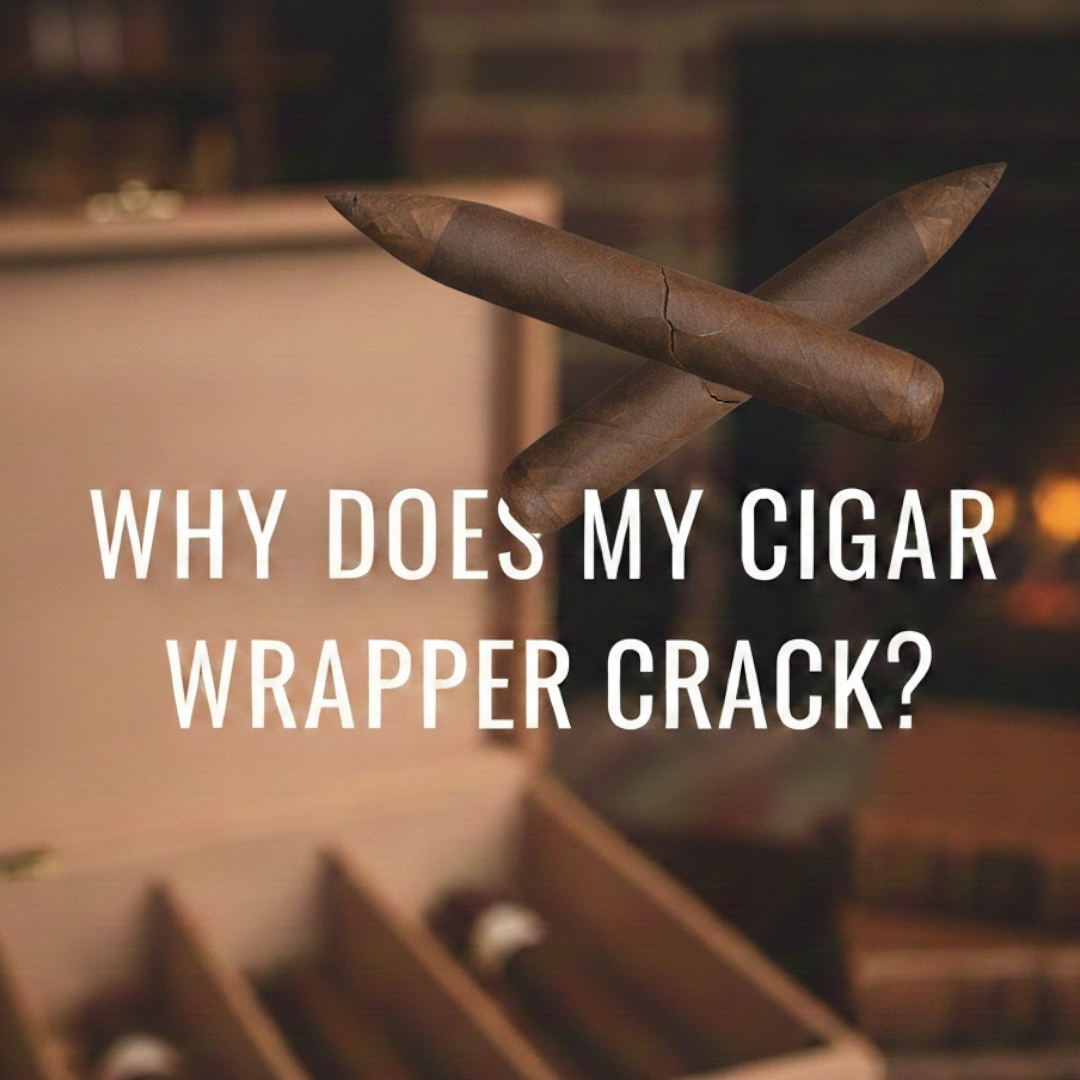
A cigar wrapper crack is frustrating in a way that feels personal. The wrapper is the most visible part of a premium cigar — it’s what draws the eye in the humidor, what the hands feel first, what the palate tastes most. Many cigar lovers wonder, why does my cigar wrapper crack? Causes, prevention, and fixes for this issue are important to understand because when a cigar wrapper crack appears, it compromises everything: the burn line, structural integrity, and sometimes the smoke itself.
Cigar wrapper cracks are also almost always preventable. The causes are specific, the fixes are practical, and understanding what’s actually happening to the leaf explains both why a cigar wrapper cracks and what stops it from happening in the first place.
What the Wrapper Is and Why a Cigar Wrapper Cracks
The wrapper is a single tobacco leaf wound in a spiral from the foot to the cap. It’s typically among the most carefully grown and selected leaves in the entire blend — smooth, elastic, and often responsible for a major share of the flavor profile. Some blenders estimate the wrapper contributes 60–80% of what a smoker actually tastes.
A healthy wrapper leaf is supple. It has natural oils that keep it flexible and allow it to expand and contract slightly as temperature and humidity fluctuate. When those oils evaporate — through drying, heat exposure, or rough handling — the leaf loses flexibility. It becomes brittle. A brittle wrapper cracks under the stresses placed on it, whether from handling, temperature changes, or the natural internal pressure of a cigar as it breathes.
The key to understanding why a cigar wrapper cracks is in the oil content of the leaf. All wrapper types have oil. Thin wrappers have less of it. When oil evaporates from a thin wrapper, the leaf becomes paper-like — and a cigar wrapper crack follows quickly.
The 7 Most Common Causes of a Cigar Wrapper Crack
1. Low Humidity — The Primary Cause
The vast majority of cigar wrapper cracks come down to one thing: the cigar was too dry.
When relative humidity in a humidor falls below 62%, tobacco leaves begin losing moisture faster than they retain it. The wrapper, as the outermost and most exposed layer, dries out before the filler and binder do. As it loses moisture, it loses the elasticity that normally allows it to flex without breaking. Eventually a cigar wrapper crack appears — sometimes from the simple stress of picking the cigar up, sometimes from the thermal expansion at the foot when it’s lit.
Thin wrapper varieties develop a cigar wrapper crack faster than thick ones. A Connecticut shade wrapper is among the most delicate in the industry — it’s grown under fabric to limit sun exposure, producing a thin, supple leaf with distinct flavor characteristics but low tolerance for humidity drops. Ecuadorian Connecticut and Cameroon wrappers have similar vulnerability. Maduro and Habano wrappers are thicker and oilier by nature — they hold up longer under imperfect conditions but are not immune to a cigar wrapper crack when conditions deteriorate significantly.
The target for cigar storage is 65–70% relative humidity, held consistently. Stability matters as much as the specific number — a humidor holding a steady 67% protects wrappers better than one bouncing between 63% and 72%. The swings themselves stress the leaf repeatedly, making a cigar wrapper crack more likely over time.
Full storage guide: How to Store Cigars: The Complete Humidity Guide for Your Humidor
2. Temperature Swings and Heat Exposure
Rapid temperature changes cause tobacco to expand and contract. When a cigar moves from a cold environment to a warm room, the wrapper absorbs that thermal change at a different rate than the filler inside. The outer leaf expands or contracts faster than the inner tobacco can match. Where the stress concentrates, a cigar wrapper crack forms.
Heat exposure without rapid movement is also dangerous. A humidor sitting in afternoon sunlight, near a heating vent, or in a car on a summer day can reach temperatures where the tobacco dries rapidly and the wrapper becomes fragile. A cigar wrapper crack from heat exposure often appears as a fine longitudinal split along a vein — the weakest point in the leaf buckles first.
Cigar storage should be between 18°C and 21°C, in a location with stable temperature throughout the day. Interior walls and closets offer the most stability. Window ledges, kitchen counters near ovens, and spaces near any heat source are among the worst places for cigars likely to develop a cigar wrapper crack.
Temperature guide: The Right Temperature for Storing Cigars: Your Complete Humidor Guide


3. Re-Humidifying Too Quickly
This counterintuitive cause catches many smokers off guard. A dry cigar gets placed immediately into a properly humidified environment — and a cigar wrapper crack appears in the process.
The mechanism is rate of absorption. The wrapper, being the outermost layer and most directly exposed to ambient humidity, absorbs moisture much faster than the filler inside. The wrapper swells and expands while the filler is still dry and contracted. The outer leaf tries to stretch around tobacco that hasn’t caught up. The tension triggers a cigar wrapper crack — caused not by dryness, but by rehydrating too fast.
Gradual re-humidification prevents this. Start the dry cigar in an environment at 62–65% RH and allow it to slowly draw moisture over several days before moving to normal storage at 68–70%. This lets the moisture gradient between wrapper and filler equalize before either layer is under stress. A cigar wrapper crack from fast rehydration is almost always avoidable with patience.
Recovery guide: How to Rehydrate a Cigar: The Complete Recovery Guide
4. Physical Handling — Squeezing and Pinching
Wrapper leaves do not tolerate hard squeezing. When a cigar is gripped firmly to test construction, check draw resistance, or simply held too hard, direct mechanical stress is applied to the wrapper. A well-humidified wrapper can usually absorb this. A wrapper at the lower end of ideal humidity may not — and the result is a cigar wrapper crack right where the grip was applied.
The correct technique for checking construction is to roll the cigar gently between thumb and two fingers. This detects soft spots and assesses firmness without applying the pinching pressure that causes a cigar wrapper crack. Never squeeze a cigar from the side to test draw — it risks cracking the wrapper or shifting the filler while achieving almost nothing useful.
5. Construction Problems — Tight Wrapping and Prominent Veins
Some cigar wrapper cracks originate at the factory. A wrapper wound too tightly during rolling is already under tension before it leaves the production line. As the tobacco inside naturally expands and contracts with humidity and temperature, the overtightened wrapper has no room to flex. A cigar wrapper crack forms at the stress points — often appearing as a clean split along the spiral seam where the wrapper is pulled tightest.
Prominent veins in the wrapper leaf are similar weak points. A thick vein running along the side of a cigar acts as a rigid structure within an otherwise flexible leaf. When the leaf on either side of the vein flexes, the vein itself doesn’t — and the leaf tears along the vein line. A cigar wrapper crack that follows a visible vein exactly is almost always a construction-related failure.
The Joya de Nicaragua Clasico Original Seleccion B Corona showed this pattern — a soft section visible before lighting contributed to wrapper issues during the smoke. Inspecting before purchasing prevents the worst of these cases. Run a finger gently along the full length, check for thin spots, prominent veins, or areas where the wrapper looks stressed already.
6. Smoking Too Fast
As a cigar is smoked, heat travels up the shaft ahead of the burn line. At a controlled pace — one draw roughly every 60 seconds — this heating is gradual and the wrapper adjusts. When smoked too fast, heat accumulates faster than the wrapper can accommodate. The wrapper section ahead of the burn line gets hot rapidly, loses moisture rapidly, and a cigar wrapper crack can appear before the burn even reaches it.
The Perdomo 10th Anniversary Connecticut Robusto has a silky, delicate wrapper — exactly the type most at risk from a pace-driven cigar wrapper crack. The construction was praised because the cigar’s tight rolling and oily wrapper held perfectly throughout a properly paced smoke. Rush the same cigar and the result would likely be different.
7. Poor Long-Term Aging Conditions
Aging cigars requires consistent, stable storage. A cigar aged for 12 months in a humidor with fluctuating humidity and temperature doesn’t come out improved — it comes out fragile. The wrapper has been stressed repeatedly over that period, losing oils with each humidity dip and partially recovering them each time conditions improve. Eventually the leaf becomes papery and a cigar wrapper crack appears at the slightest provocation.
If aging is the goal, the humidor setup must be correct before the cigars go in. Correcting conditions after a cigar wrapper crack appears during aging is too late for that cigar.


Can a Cigar Wrapper Crack Be Repaired?
Yes, in many cases — depending on severity and location.
Hairline cigar wrapper crack, not at the burn line: Smoke it. A superficial crack that doesn’t affect the burn line can usually be smoked through without issue. Monitor whether the cigar wrapper crack propagates during the smoke.
Cigar wrapper crack mid-smoke, away from the burn: Apply a tiny amount of saliva to the cracked edges using a fingertip and press gently together. Moisture softens the dried tobacco and allows the leaf to bond briefly when pressed. Hold the edges in place for a few seconds. This holds through most of the remaining smoke on minor splits. For a more reliable repair before smoking, use actual pectin powder (sold in grocery stores in the canning aisle) mixed with a few drops of water — the same adhesive professional cigar rollers use.
Cigar wrapper crack at the burn line: Rotate the cigar so the crack faces away from the primary direction of combustion for the next few puffs while applying gentle pressure to reseal the edges. This prevents a minor cigar wrapper crack from becoming a full unravel.
Wrapper unraveling: Attempt to reseal using the saliva method plus sustained gentle pressure, then rest the cigar in the ashtray for 60 seconds without smoking to let the seal set. For a larger unravel, a thin strip of tobacco leaf from another cigar’s foot can be used as a patch — but this takes practice.
Prevention: What Consistently Prevents a Cigar Wrapper Crack
Keep humidity at 65–70% RH, stable. This single factor prevents the majority of cigar wrapper cracks. Boveda packs are the most reliable and lowest-maintenance option — two-way control packets that maintain a specific RH level without adjustment or monitoring.
Maintain temperature at 18–21°C. No windows, no heating vents, no sun exposure. Interior closets are ideal for preventing a cigar wrapper crack from temperature stress.
Handle gently. Roll to inspect, never pinch. Check construction at the foot where rough handling leaves no mark on the smoking surface.
Re-humidify slowly. Gradual moisture recovery over several days prevents the differential expansion that triggers a cigar wrapper crack during rehydration.
Choose storage appropriate for the wrapper type. Connecticut shade and other thin wrappers need the most stable conditions. If storage isn’t fully stable yet, cigars with Maduro or Habano wrappers tolerate imperfect conditions better and are less prone to a cigar wrapper crack. See: How to Make a Cheap Homemade Humidor
Invest in construction quality. The Eladio Diaz 70 Aniversario had an oily, perfectly wound wrapper — the kind that holds regardless of minor condition changes. The Zino Toro had an exceptionally oily wrapper noted immediately on inspection. Quality construction and natural oils in the wrapper leaf are genuine predictors of resilience against a cigar wrapper crack under real-world conditions.
FAQ: Why Does My Cigar Wrapper Crack?
A cigar wrapper crack at lighting is almost always caused by under-humidification. The dry leaf has no elasticity, and the sudden heat at the foot causes it to split rather than flex. Cigars should be stored at 65–70% RH before smoking. If they’ve been stored improperly or arrived dry, allow them to rehydrate gradually before lighting to prevent the cigar wrapper crack.
Temperature fluctuations are the most common cause of a cigar wrapper crack in stored cigars. Even with correct humidity, repeated thermal expansion and contraction stresses the wrapper over time. Verify the humidor is not near any heat source, window, or vent. Temperature should stay between 18°C and 21°C consistently to prevent a cigar wrapper crack from developing during storage.
In most cases, yes. A hairline cigar wrapper crack that isn’t at the burn line can usually be smoked through without issue. Larger cracks near the burn line can often be repaired with a small dab of saliva and gentle pressure. A wrapper that has fully unraveled is harder to manage but can sometimes be partially resealed.
Apply a very small amount of saliva to the cracked edges with a fingertip and press together gently. The moisture softens the dried tobacco and allows the leaf to bond temporarily when held together. Hold for a few seconds, then rotate the repaired section away from the burn line for the next few puffs to give the cigar wrapper crack time to set. For a more durable repair before lighting, use pectin powder mixed with a few drops of water — the food-safe adhesive cigar rollers use.
A cigar wrapper crack is caused by storage and handling conditions — not price. A premium cigar stored in dry or temperature-unstable conditions will develop a cigar wrapper crack. The same cigar stored at 65–70% RH in a stable temperature environment will stay intact. Price buys quality tobacco and construction — it doesn’t override physics.
Smoking pace is the most common cause of a mid-smoke cigar wrapper crack when storage is correct. Smoking too fast generates heat ahead of the burn line that rapidly dries the wrapper section above it. Slow the pace to one draw per minute. Also check whether the cigar had a visible vein — veins are stress points that can produce a cigar wrapper crack when heat reaches them.
Related Topics
- How to Store Cigars: The Complete Humidity Guide for Your Humidor
- The Right Temperature for Storing Cigars: Your Complete Humidor Guide
- How to Rehydrate a Cigar: The Complete Recovery Guide
- Understanding Cigar Anatomy: A Complete Breakdown of What’s Inside Your Smoke
- How to Make a Cheap Homemade Humidor
- How to Choose the Right Humidor
- Why Your Hygrometer Might Be Lying to You (And How to Fix It)
Subscribe to our newsletter and find out about all new posts
Check out our latest posts
- The 20 Best Cigars for the Money
 The best cigars for the money are not the lowest-priced cigars on the shelf. They’re the ones where the price and the quality don’t match.… Read more: The 20 Best Cigars for the Money
 - How to Put Out a Cigar Properly: The Complete Guide
 Most guides online skip this entirely. They’ll walk you through cutting, lighting, draw technique — then nothing. The session just ends and you’re left staring… Read more: How to Put Out a Cigar Properly: The Complete Guide
 - Interview Escobar Cigars: Two Markets, One Brand, Zero Compromises
 Escobar Cigars has been carving out its place in some of the world’s most demanding markets — navigating strict European regulations, building a brand without… Read more: Interview Escobar Cigars: Two Markets, One Brand, Zero Compromises
 - Swecigars: Premium Cigar Distribution in Sweden Explained
 Most people pick up a premium cigar and never think twice about what it took to get there. Behind every cigar on a Swedish shelf… Read more: Swecigars: Premium Cigar Distribution in Sweden Explained
 - Do you inhale cigar smoke?
 Do you inhale cigar smoke? No. The smoke stays in your mouth, you taste it, then blow it out. Cigarettes get inhaled into the lungs.… Read more: Do you inhale cigar smoke?
 - El Septimo Cigars: The Complete Guide — cigar Reviews, Interviews & the Story Behind the Brand
 El Septimo cigars are a Swiss-founded luxury cigar brand owned by Zaya Younan. Tobacco is grown without pesticides at high altitude, fermented for 12 months… Read more: El Septimo Cigars: The Complete Guide — cigar Reviews, Interviews & the Story Behind the Brand
 - Cigars vs Cigarettes: What’s the Difference?
 Cigars and cigarettes both involve tobacco, but that’s about where the similarities end. The difference between smoking a premium cigar and grabbing a quick cigarette?… Read more: Cigars vs Cigarettes: What’s the Difference?
 - Sex and Cigars Trigger the Same Parts of Your Brain
 It’s that hour. The one you’ve been quietly looking forward to all day. You settle into your chair — the leather cool for just a… Read more: Sex and Cigars Trigger the Same Parts of Your Brain