

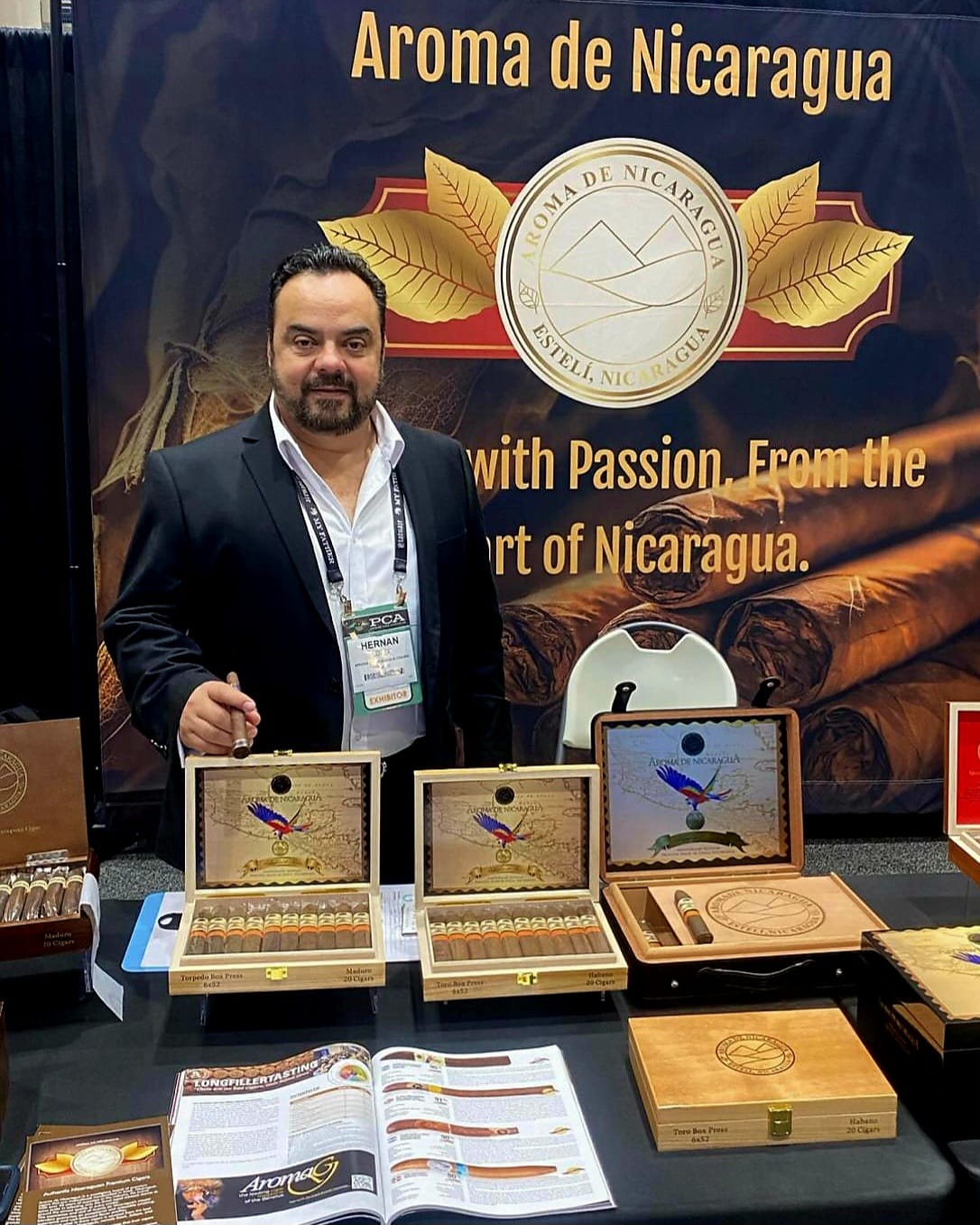
By Peter Stefanic, VDG Cigars
I’ll be honest with you. I didn’t plan this interview.
I smoked the cigars first, which is the wrong way round. Normally there’s an email, a plan, a set of questions before I light anything at all. This time I sat with a small robusto that ran eighty-five minutes, never got hot, never went out, never once asked me for a lighter, and by the time I put it down I wanted to know who was behind it and how on earth they’d done it. So I wrote to Hernan Lopez, the founder and owner of Aroma de Nicaragua, and asked him for an hour.
What I got back was one of the most useful conversations I’ve ever had about how a cigar is actually made. Not the marketing version. The factory floor version.
We talked about pepper and where it really comes from, which isn’t where most smokers think. We talked about a machine that tests the draw of every finished cigar and throws away the ones that fail, after all the work is already sitting in them. We talked about a grandfather’s sister-in-law rolling cigars in her own house and selling them in paper bags, and about the two sizes she made, which happen to be the two sizes Hernan makes today.
And then, about halfway through, he said a number that stopped me.
Fermentation, in his own pilones, running up to a year. Most of the industry works in ninety days. I’ve now heard that one year figure from Hernan and from a small handful of other producers, and that’s the whole list as far as I know it. Once you understand what a year in the pilón costs a company, the length of that list makes sense.
There’s a second thing in here that I’ll be following for a long time, and that’s the high altitude tobacco he’s about to start growing himself, on his own land, up in the mountains. It comes further down, and for me it’s the most interesting thing on this brand’s horizon.
Hernan, thank you for the time, and for putting up with the questions I kept firing at you out of order.
Let’s get into it.
Where Aroma de Nicaragua comes from

What is the history behind the brand?
It starts with a grandfather who smoked, and a house full of tobacco.
Hernan was born in the central part of Nicaragua, and his grandfather smoked cigars for as long as he can remember. Part of the family made them too, and not in a factory. In a house.
“My grandfather used to smoke cigars, so when I was a little kid I was kind of involved with the smokes and the smells of the tobacco and everything, because part of our family was making those little cigars. That’s the way they used to call them. So that’s why I got involved in the beginning, and then, seeing the industry in Nicaragua, I decided to come up with the brand, pick up some very good blenders and start making our cigars, to represent really what Nicaragua is bringing out to the world on cigars.”
The woman doing the rolling was his grandfather’s sister-in-law, and the way he describes walking into that house as a boy is more or less the reason this brand exists.
“I was walking into the place and it was mountains of tobacco, getting ready to be rolled. And again, the smell of the tobacco there was incredible when I was a little kid. I always had it in my mind. And I saw her do it with all the workers, and they used to put it in this paper craft bags. That’s the way they used to sell it. They used to put like 10 cigars in the bag or 20 cigars in the bag.”
She made two sizes, both the same shape, a perfecto. One roughly a robusto. The other closer to a toro.
There was a reason for the two, and I love it.
“They used to take the long cigar because maybe it took an hour, 45 minutes and an hour to get wherever they want. So they used to smoke the big cigar. For small shots, a little play here and there, a couple of drinks, a small one.”
The long one was for riding out to the farms on horseback. The short one was for company and a drink. Hernan makes both sizes today, in that same perfecto shape, and the blend carries the name his family used for those cigars.
“That’s the original tobacco. Before all the boom of tobacco in Nicaragua.”
That’s a line worth stopping on. Nicaragua is one of the biggest cigar producing countries in the world now, but people were smoking there long before the industry showed up, and it’s that older tradition the brand is reaching back for, not the boom.
What did Hernan Lopez do before cigars?
Trade, for years, and it tells you a fair bit about how he runs things now.
“We moved out of Nicaragua to Miami after the revolution, and then I started working with the industrial companies in Central America, exporting and importing raw materials, and then reselling stuff in the United States. That’s why my base is in the United States, in Miami. I had my office here, and I traveled to Nicaragua, and then when the conditions were good to go back to Nicaragua, I went back.”
That was somewhere close to 2000, and the blending started then. It wasn’t quick.
“It took us about three or four years to develop the blends, before putting it into the market.”
Three or four years of mixing before a single box left the building. Hold onto that one, because it explains the first thing I noticed about these cigars.
He owns all of it, by the way. I asked whether there were partners behind him.
“I’m the owner of the company, and I’m the one behind everything, from the beginning, to do the blend when I see an opportunity. Since I own the factory, I have the capability to do whatever the market asks for, in sizes, in blends, in wrappers.”
Why Aroma de Nicaragua cigars aren’t peppery


Isn’t Nicaraguan tobacco supposed to be spicy?
That’s the expectation, and Hernan spends a decent part of his time at trade shows correcting it.
When I told him his cigars were far more mellow than I’d expected from Nicaragua, he didn’t take it as a compliment on a happy accident. He took it as the plan working.
“I’ve been to different shows and people usually have an idea of a Nicaraguan cigar being very spicy. When I was developing the brands, that’s one of the things that I eliminated from the tobacco, because me personally, I don’t like spice in my mouth. There’s some people that like it, but personally I don’t.”
Then he told me where he thinks pepper actually comes from, and this is the bit I’d like every reader to sit with for a minute.
“Why you get a spice in your cigars is because sometimes the tobacco is very young, it’s not treated well, and you get spice in your mouth. The palate is the more delicate part when you’re smoking a good cigar. You have to be very nice to your palate. So we decided, throughout the years, to eliminate that pepper from our cigars, and we use aged tobacco to eliminate that. Immature tobacco gives you some chemicals that hit your mouth in a peppered way, in a bad way.”
So the answer was age. Nothing goes into a blend until it has two to three years on it at the very least, and that’s before you count the fermentation.
He gave me a comparison I’m going to steal.
“It’s like you drink a six-year-old, 12-year-old, 18-year-old. When you go softer to your palate, 18-year-old, it’s very nice to your palate. You go to a three, four-year-old, it’s very harsh. That’s what happens exactly with the tobacco.”
My favourite thing in this whole section is a story about a friend of his, a manufacturer from the Dominican Republic, who asked him for a cigar at a show.
“He told me, it’s the first cigar that I smoked from Nicaragua that doesn’t hurt my palate.”
Coming from a competitor, standing in the middle of a trade show, that’s worth more than any rating anybody could hand him.
Up to a year in the pilón
How long does Aroma de Nicaragua ferment its tobacco?
Some of the tobacco is bought in and some is fermented in house, and when they do it themselves the pilones can run up to a year.
“Maybe we go up to a year, you know. We just keep checking temperature.”
He said it as though it were nothing.
I want to be careful here, because I’ve heard the same figure from a couple of other producers and I’m not going to hand anybody a crown they didn’t ask for. Nobody in this article is claiming to be the only one doing it.
What I will say is that the club is small. Most of the industry works in ninety days or thereabouts, and there are good business reasons for that. A year in the pilón is a year of capital standing still, a year of stock you can’t sell, floor space you can’t use for anything else, and a real risk that a pile turns on you and takes twelve months of work down with it. Hardly anybody wants to carry that, and the few who do tend not to shout about it, because it lives on the cost side of the business rather than the marketing side.
For my money it’s the most important fact in this article. Everything I liked about these cigars comes back to it in the end.
Hernan was blunt about what the shortcut does to the cigar in your hand.
“What is happening in the industry, Peter, is people trying to produce fast tobacco. And that fast tobacco, when you do the fermentation, you get rid of ammonia and a bunch of chemicals, and they’re hard to eliminate. That’s why you find some tobaccos, they’re very harsh to your palate, because they haven’t been fermented correctly. In a rush, they wrap it and they send it out and that’s it. We’re focusing on getting a product that will give you a nice thing on the palate. The longer, the better.”
How does he know a pilón is any good?
He buys the way I wish more people bought.
“We evaluate every single one. We get the blenders, they get a leaf, they roll it right there in front of the pilón, they smoke it. And they can tell you more or less what it is and how it is, because these blenders are very expert on doing that.”
No lab report, no paperwork. Somebody who’s been doing this for thirty years pulls a leaf off the pile, rolls it on the spot, lights it, and tells you what you’re looking at.
The part that explains the eighty-five minute robusto
Why do these cigars burn so slowly and so cool?
I asked him straight out what the trick was, because a small robusto that runs eighty-five minutes with no relight and a cool draw the whole way isn’t normal.
There are two answers, and the first is the rolling.
“We’re hand rolled 100%. We never use machinery to roll the tobaccos. And we use a special technique, it’s called the tube technique, which gives you a better flow through the whole body of the tobacco.”
That’s entubado, where each filler leaf is rolled into its own little tube instead of being folded into the bunch.
The second answer I didn’t see coming. They own a machine that measures the draw on every finished cigar, and they use it as a gate rather than as a report.
“Everything that doesn’t qualify for the flow, we eliminate. Because sometimes you just do it by hand, and you can do a good work, but sometimes it can be too tight, sometimes it can be too loose, and then it may smoke good, but it may smoke too fast, and then you may have a very hard effort to pull the smoke out of there. The experience should be a gentle experience, really nice. You sit down, you smoke, you enjoy the aroma, enjoy the smoke.”
Picture that on the factory floor. A roller has already spent his time on that cigar, the tobacco inside it has been aged for years and fermented for months, and if the draw falls outside the range they’ve decided is pleasant, it doesn’t go in the box.
That’s why my robusto behaved the way it did, and there’s no way to see any of it from the other side of a humidor.
Micro regions, and the island with two volcanoes
Where does the tobacco come from?
Almost all of it from Nicaragua, and deliberately not from one single place.
“It’s very difficult to make blends when you only have one source of tobacco. The land is different, gives you different flavours from different places of Nicaragua. So we have partnerships with different producers all over Nicaragua, in these micro regions, so we can offer different blends.”
Five blends, each one sitting at a different level on the palate.
The one that caught me is Ometepe, an island in the middle of Lake Nicaragua with two volcanoes on it, one of them still active, and they grow tobacco in the valleys there.
“It gives a special flavour to the blends when we use that tobacco.”
I asked whether it came out more mineral and he said yes. If you’ve ever wondered why volcanic soil keeps coming up in cigar conversations, that island is about as far as the argument goes.
What is coming from Aroma de Nicaragua
High altitude tobacco, grown on his own land
Now the part I’ve been waiting to tell you about.
Until now, Aroma de Nicaragua has bought its tobacco, worked with growers across the micro regions and fermented some of it in house. That changes this year. Hernan has land up in the mountains and he’s going to start planting it himself.
High altitude tobacco. Maybe wrappers. Maybe something good enough to build a blend around. He ran samples last year and liked what came back well enough to commit.
“There’s a nice place that, maybe we can produce some wrappers there and some special high altitude tobacco. I ran some samples last year and the tobacco came out very nice.”
The reason high altitude interests him is one I hadn’t heard put quite this way before, and it’s the sort of detail that makes this job worth doing.
“At high altitude you get a lot of clouds. So it gives you the effect of having tobacco in shade in lower altitudes. But this shade is a natural shade from the clouds.”
Shade grown wrapper without the tapado and without the cloth, because the mountain does it for you. And the higher you go, the less you need to spray. Cleaner leaf, naturally shaded, on volcanic ground.
He’s not the first to look up. He brought up Plasencia’s Alma del Cielo, soul of the sky, which is built on high altitude tobacco, and he was careful to say he’s running tests rather than making announcements.
But the list of people doing it is short, and when I said so he didn’t pretend otherwise.
“Yeah, it is. Yes, it is, but it’s possible.”
Growing up there is hard work and it’s worth knowing why. The air is thinner, with less oxygen and lower pressure, and the plant feels that. Growth slows down. Nights are colder, the season stretches out, and the plant takes longer to get to the point where you can do anything with it, so the yield drops. Then the same clouds that hand you all that free shade keep the leaf damp, and damp leaf brings mould and fungus, which means you’re watching the crop far more closely than you ever would on flat ground. And the ground itself is its own problem. Mountain plots are steep, awkward to work, hard to get machinery onto, and every leaf you cut has to come back down to the barn somehow.
Smaller crop, later, more risk, off land that fights you the whole way. That’s why most people stay in the valley.
The timeline is long and he didn’t dress it up either. Planting at the end of this year, cultivation mid next year, then fermentation, which on this brand’s terms could mean up to another year in the pilón before anybody smokes anything.
“So it’s going to be a while. Maybe a year or so.”
I asked him to keep me in the loop, and we’ll be following this one from the seed to the first cigar. If a brand already built on patience starts growing its own leaf above the cloud line, whatever comes out at the end of it is worth the wait.
The Blue Label
The newest line, and not in Europe yet. There’s a Gordito at 4 by 60 and a Pyramid, which he says is the complicated one to make.
“The pyramid is a very complicated cigar to make, but it’s a nice cigar, because it’s skinny, it gives you like a lancero type of feeling of the tobacco. In thinner ring gauges you get more taste of the tobacco.”
On a brand built around aged tobacco, that should be worth tasting. It may go out with the next order to Belgium.
A word about Nicaragua
I told Hernan I don’t know his country, and asked him what it’s actually like.
He talked about the people before he talked about the place.
“We’re very welcoming people. We’ve been through many things in life, but within Nicaragua the openness of the people is very sincere and very nice. You look at life a little bit different. You look at life more in a slow way, not in the rush of a big city.”
Then the geography, which he clearly loves. Two oceans, volcanoes, lagoons, rainforest. Micro regions that each give tobacco its own signature. A few million people and no huge cities. And that island in the middle of a lake with two volcanoes on it, where they grow leaf for his blends.
“It’s a very tropical country. It’s lush, very green, very nice. You should go to Nicaragua.”
I intend to.
What it takes to follow a dream
I ask this of everybody I interview, because I don’t think enough people are doing it.
Hernan built his own brand and his own factory from nothing, in a country where the biggest names in the industry are his neighbours. He left Nicaragua young, built a career somewhere else entirely, then went back and started again in a business he had no track record in. So I asked him what it takes.
“Like always in life, you got to be consistent. I think we had an education where one of the values that was enforced was perseverance through life. And there are ups and downs always, in business. You got to be able to have a long-term focus, because it takes some time to develop something, to get it to the point where you want it to be. Perseverance and quality are two words that are within my soul and within my company, in order to reach our goals.”
I believe him, and I’ll tell you why. Three or four years of blending before he sold anything. Up to a year in the pilón. Two to three years of age on the leaf before it goes anywhere near a blend. Finished cigars thrown out because a machine says the draw is wrong.
A man in a hurry doesn’t do any of that. So if you’re looking for the lesson in this interview, it isn’t really about tobacco. It’s that whatever you’re trying to build probably takes longer than you’d like, and the people who get there are the ones who made peace with that early.
What you get for the money
Aroma de Nicaragua sits in the middle of the shelf, and Hernan told me that’s deliberate. A new brand priced too high makes people hesitate, and he wants them to try it.
I’d only add that what’s inside is worth more than the shelf suggests.
You can read my full reviews of the Aroma de Nicaragua Connecticut Toro and the Ecuador Robusto on the site, and the thing you’ll notice in both is time. Long, gentle, cool smokes. Now you know where that comes from.
If you take one thing away from this interview, let it be what Hernan said about pepper. Next time a cigar bites your tongue, don’t assume that’s the blend being bold. Ask how long that tobacco sat before somebody rolled it.
Hernan, thank you. For your time, for being open about how the work really gets done, and for the invitation. If you make it to Sweden, the first one is on me.

Subscribe to our newsletter and find out about all new articles
Check out our latest articles
- Halftime Habano by Karen Berger Review: A Short, Spiced Habano That Burns Slow

- Oris Erhuero Interview Part 2: “It Is Never Too Late”

- Eladio Diaz La Diana Brevas Review: A Short, Full Dominican With Real Depth

- Oris Erhuero Interview Part 1: The Lost Passport That Changed Everything

- Mild to Medium Cigars: What the Category Actually Means

- Arturo Fuente Especiales Review: Serious Flavor at an Everyday Price

- Karen Berger Ixtelli Toro Review: A Nicaraguan Puro Named for Estelí Itself

- Halftime Maduro by Karen Berger Review: A Short, Full Maduro That Burns Slow

- Arturo Fuente Opus X Robusto Review: A Dominican Icon Lives Up to Its Name

- What Is a Connecticut Cigar? The Wrapper Explained

- How a Cigar Is Made, From Seed to Shop

- Top 30 Best Winter Cigars (2026): Reviewed by Flavor, Body and Smoke Time

- Cigar Ring Gauge in mm: Every Size, and What Thickness Actually Changes

- Horacio 8 Classic Review: A Small, Nutty Costa Rican Everyday Smoke

- Karina Owen: The Woman Who Built Her Own Name (Part 3 of 3)

- Horacio Heritage 6 Review: A Full-Bodied Costa Rican With a Perfumed Floral Edge

- Karina Owen: The Years That Taught Her People (Part 2 of 3)

- Brun del Ré Privado Gran Toro Review: A Two-Hour Costa Rican Puro

- Aroma de Nicaragua and Hernan Lopez: Up to a Year in the Pilón, and the Nicaraguan Cigar Built Without the Pepper

- Interview with Karen Berger

