
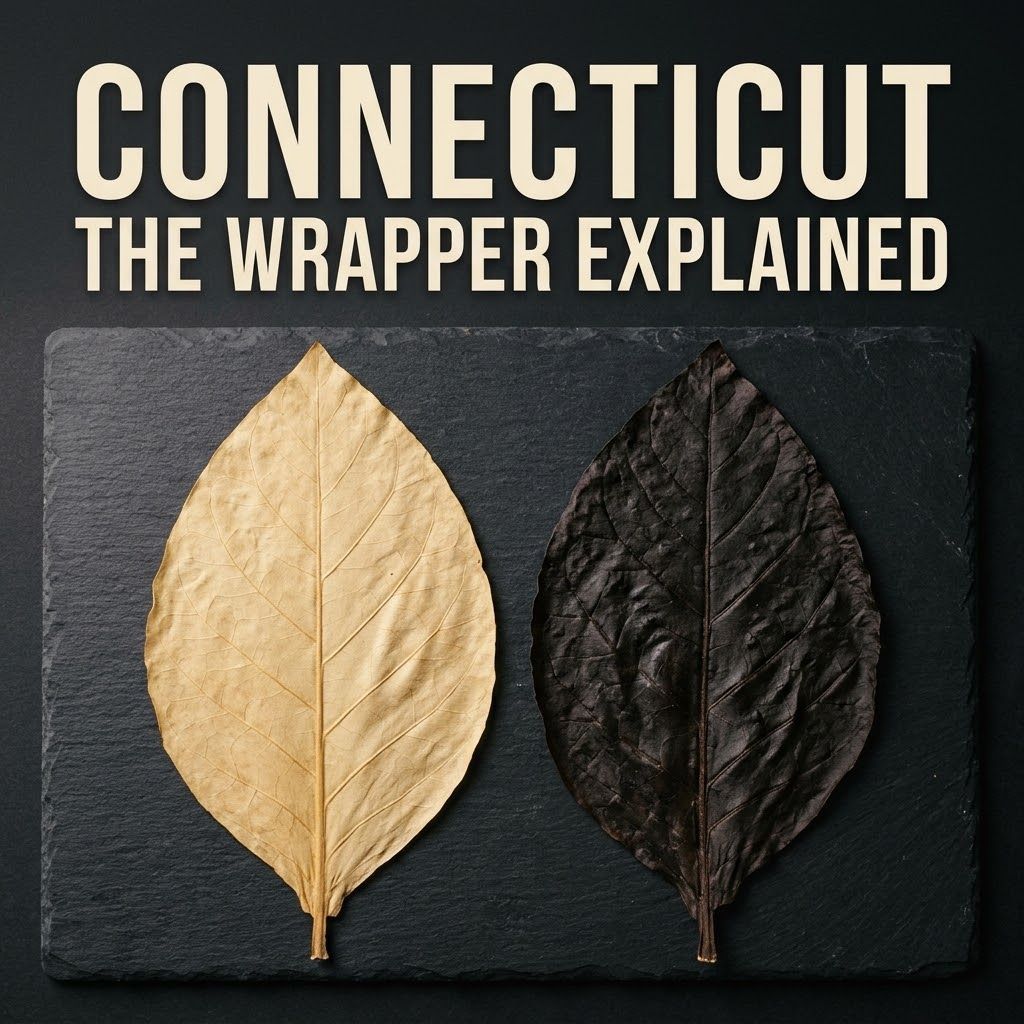
A Connecticut cigar is named after its wrapper. Not the country it was made in, not the filler inside it. The tobacco in the middle usually comes from Nicaragua or the Dominican Republic, and the band says Connecticut because of the leaf on the outside.
That is the simple answer. Two complications follow, and both are worth your time.
The word covers two leaves that are opposites. One is pale, thin and mild. The other is dark, thick and goes on maduros. Both are correctly called Connecticut.
And almost no Connecticut cigar contains Connecticut-grown leaf. In 2025 the entire American crop of Connecticut shade tobacco came to 35 acres, grown on a single farm, and one company bought all of it. I will come back to that, because it is the most useful thing on this page.
Connecticut Shade, the one most people mean
This is the pale golden wrapper that made the name famous, and it exists because of a competitive problem in the 1890s.
Fine Sumatran leaf was taking over the wrapper market and the Connecticut River Valley was losing it. So growers tried covering the fields with tents of woven cloth, cutting the direct sun and holding humidity underneath. The first shade tent went up in Windsor, Connecticut in 1900, over half an acre on River Street.
It worked. Less direct sun and more humidity grow a thinner, smoother, more elastic leaf with finer veins, which is exactly what a wrapper needs to be. The method has barely changed. Posts in a grid, fabric stretched over the top and sometimes down the sides, originally cotton and now synthetic.
What it gives you: cream, dry cedar, nuts and a gentle sweetness. Mild, smooth, and forgiving if you smoke a little faster than you should, which almost everyone does at first.
That is why Connecticut Shade became the standard wrapper for mild cigars and why it is still the first wrapper most smokers meet.
Connecticut Broadleaf, the one that surprises people
Same valley, opposite plant, opposite process.
Broadleaf grows in full open sun with no cloth at all. The leaf comes out thick, tough and considerably darker.
The harvest is different too, and this is the detail that explains the rest. Shade is picked leaf by leaf over several weeks. Broadleaf is stalk cut, meaning the whole plant is taken down in one pass and carried to the barn intact.
Then it is fermented hard. That matters more here than with any other wrapper, because a leaf that thick will stay harsh and ammoniac if the fermentation is rushed or badly managed. Done properly it turns dark and sweet. Done badly it bites.
What it gives you: dark earth, cocoa, molasses, pepper and leather. It is the classic maduro wrapper, precisely because only a leaf that heavy survives the fermentation a maduro needs.
So Broadleaf on a band means dark and rich. Connecticut Shade means pale and mild. The word they share tells you almost nothing on its own.
The part nobody puts on the shelf talker
Here is the number that reframes everything above.
In the 1930s the Connecticut River Valley grew around 30,000 acres of tobacco. By 2006 the whole valley was under 2,000. What is left today is mostly broadleaf, and the shade crop has gone somewhere else entirely.
Connecticut shade specifically came to 35 acres in 2025. All of it on one farm, and that farm is in Massachusetts rather than Connecticut. One cigar company contracted the entire crop before it was picked.
Do the arithmetic and the conclusion is unavoidable. If you are holding a Connecticut cigar, the wrapper on it is almost certainly not from Connecticut.
What it usually is instead is Connecticut seed grown in Ecuador. Ecuador sits on the equator under near permanent cloud cover, and that cloud does for free what the cloth tents in Windsor do by hand. Volcanic soil underneath, no tent to build, no labour to pay for building it. The result is a smooth, elastic, attractive wrapper at a fraction of the cost, and it has become so dominant that it is now more common in humidors than the real thing.
This is not a swindle and it is not inferior. Plenty of excellent Connecticut wrappers are Ecuadorian, and people in the trade will argue either way about whether the flavour of the original can be matched. But it does mean something specific:
Connecticut has stopped being a place on a cigar band and become a style. It describes a seed and a growing method, not an address.
Broadleaf has drifted too. The genuine Connecticut-grown article still commands a premium and is worth seeking out, but most broadleaf now comes from further south, principally Kentucky and Tennessee.
If you want what every other wrapper name means, I set them out in the guide to cigar wrappers.
How a Connecticut actually smokes
From my own reviews, so you get real numbers rather than brand copy.
The PDR Value Line Reserve Connecticut is the cheapest honest way to find out what the wrapper tastes like.
The AJ Fernandez San Lotano Requiem Connecticut came in medium bordering on mild and ran 55 minutes, which is a fair benchmark for the format.
The Oliva Flor de Oliva Connecticut is the cheapest way in. Rock solid in the hand, and a soft creamy smoke from the first draw that asks nothing of you.
And at the far end, the Aroma de Nicaragua Connecticut Toro ran about 100 minutes, mild to medium, with an almost dessert like character under the woody notes. A Connecticut that lasts an hour and forty is unusual and worth knowing about.
Should you buy one
If you are new to cigars, start here. Connecticut Shade is the most forgiving wrapper there is, and nearly every brand makes one, so there is a version at whatever you want to spend.
If you already smoke full bodied cigars, do not write it off. Mild is not the same as easy to make. A mild blend is the harder build, because there is nowhere for a flaw to hide. Smoking a well made one is a useful calibration.
If you want dark and rich, you want Broadleaf, which means you are really shopping for a maduro. I keep a list of the maduros worth smoking, and I put maduro against Connecticut head to head if you are deciding.
Frequently asked
A cigar wrapped in Connecticut leaf. The name describes the wrapper only. The filler and binder inside can come from anywhere and usually do.
Connecticut Shade is, and that is what most people mean by the word. Connecticut Broadleaf is not. It is dark, thick and used for maduros. Both are correctly called Connecticut, which is where most of the confusion comes from.
Shade gives cream, dry cedar, nuts and a gentle sweetness. Broadleaf gives dark earth, cocoa, molasses, pepper and leather.
It is the best starting wrapper there is. Mild, smooth and forgiving of a fast pace.
No. Mild is not weak, and strength comes from the filler rather than the wrapper anyway. A strong cigar can wear a Connecticut wrapper without any contradiction.
Subscribe to our newsletter and find out about all new posts
Check out our latest posts
- What Is a Connecticut Cigar? The Wrapper Explained

- How a Cigar Is Made, From Seed to Shop

- Top 30 Best Winter Cigars (2026): Reviewed by Flavor, Body and Smoke Time

- Cigar Ring Gauge in mm: Every Size, and What Thickness Actually Changes

- Horacio 8 Classic Review: A Small, Nutty Costa Rican Everyday Smoke

- Karina Owen: The Woman Who Built Her Own Name (Part 3 of 3)

- Horacio Heritage 6 Review: A Full-Bodied Costa Rican With a Perfumed Floral Edge

- Karina Owen: The Years That Taught Her People (Part 2 of 3)

- Brun del Ré Privado Gran Toro Review: A Two-Hour Costa Rican Puro

- Aroma de Nicaragua and Hernan Lopez: Up to a Year in the Pilón, and the Nicaraguan Cigar Built Without the Pepper

- Interview with Karen Berger

- The $1 Challenge: Helping Philadelphia Youth With the Roberto Martinez Foundation

- Robusto vs Toro: Real Smoke Times, Flavor and Which One to Choose

- Macanudo Maduro Diplomat Review: A Smooth, Fruity Maduro in a Short Figurado

- Brun del Ré Cigars and Carlo Corazza: The Costa Rican Puro That Ferments for Over a Year

- The story of Karina Owen Part 1 of 3: At the End of the Night

- The Leaf That Changes Everything: Why La Flor de Zaida and Medio Tiempo Belong in the Same Sentence

- La Flor de Zaida Brings the Diamond Collection and Ralf Moeller to InterTabac 2026

- Casa Magna Colorado Torito Review: A Rich, Approachable Everyday Full-Bodied

- Aroma de Nicaragua Connecticut Toro Review: A Long, Gentle Nicaraguan With Unusual flavors

