
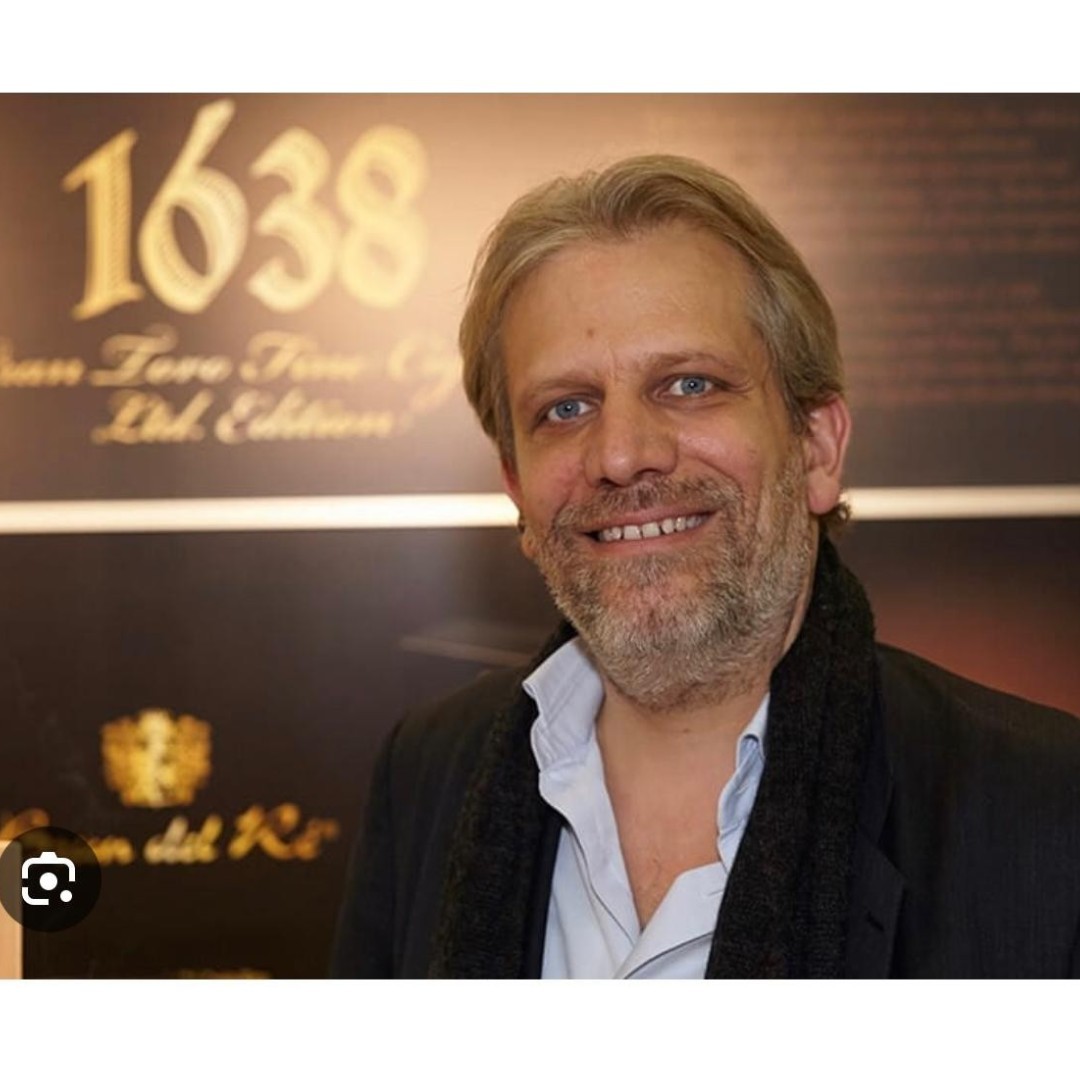
By Peter Stefanic, VDG Cigars
There is something magical about cigars and their ability to bring people together.
When my interview with Carlo Corazza of Brun del Ré began, I had pictured us starting at the beginning, with the story of the cigars. Instead we spent the first thirty minutes talking about everything from politics to work, and in the end we had to cut the conversation short just to get to the cigars at all.
But there is one thing from that conversation I want to tell you about, because it is something I think society misses, and the first time I have heard anyone say it out loud.
We got onto how people see work, on the fact that fewer and fewer of us work on Sundays, and from there onto people who live off the grid or on the street. For me, Sunday is a working day like any other. Carlo sees it the same way. A farmer has to work no matter the day, the weather, or whether he is sick, or there is no food on the table. But when a homeless person, or someone feeding himself from his own patch of ground, uses his body to get food for the day, we rarely call it work. That is exactly what Carlo picked up on. Anyone who does something, whatever it is, to put food on the table, is working.
As long as you fight for your living, you are working.
Plenty of people look down on those who live off the grid. Carlo gave their struggle a name and a value, a human value that most people miss.
Then we finally got to the cigars, and I’m glad we did, because I wasn’t prepared for what came out of the second half of that call. Brun del Ré cigars have a production story that I’ve been thinking about ever since we hung up.
So this article is about a family name that goes back three hundred years, a watch dealer who ended up building his own tobacco factory in Costa Rica, a country that got pushed out of the cigar world and wants back in, and a fermentation that runs longer than almost anything else you can buy. And somewhere in the middle of all that, a price tag I think is plain wrong.
Carlo, thank you for the time, and for being that open on a Sunday morning with another meeting already waiting for you.
Let’s get into it.
Brun del Ré cigars at a glance
- Owner and founder: Carlo Corazza, Swiss Italian, thirty-two years in Costa Rica
- Origin: Costa Rica, own factory, own tobacco from two hectares in the south of the country
- Lines: Gold, Premium, Colonial, 1787 Rainforest, 1638 which is paused, and the new Privado
- Production: somewhere between thirty and forty thousand cigars a month
- Exports: around twenty-four countries
- Fermentation: more than a year in the pilón, then at least six months resting after rolling
- A part of every Rainforest cigar sold goes to the Jaguar Foundation
The name behind the brand
Where does the name Brun del Ré come from?

It isn’t a marketing invention, which is the first thing I wanted to know. It’s his grandmother’s name, from his father’s side of the family.
They came out of northern Friuli, up near the Austrian border, back when that part of Europe still belonged to the Austro-Hungarian Empire, and around three hundred years ago they had tobacco plantations there. The name itself came from the family’s association with the Venetian royals and the circles around the king of Italy in those days.
“My grandmother Brun del Ré was originally called Brun del Ré because they were associated with the royalty of the Venetian society,” Carlo told me.
His great-grandfather and grandfather left for Switzerland before the First World War. His mother came later, after the Second, from Liguria, an hour from Monaco. Carlo himself was born in Switzerland, half Swiss and half Italian, and studied commercial economy in the French-speaking part of the country, in Neuchâtel.
How did a Swiss family end up making cigars in Costa Rica?

His father had construction companies and concrete factories, and Carlo could have walked into that. He wanted to build something of his own instead. His parents had bought two large farms in Costa Rica forty-seven years ago, so the door was already half open. He’s lived there thirty-two years now.
From Patek Philippe to Partagás: how Carlo Corazza found tobacco
What did Carlo Corazza do before cigars?
Watches, and not small ones.
In 1996 he became the legal representative in Costa Rica for Cartier, IWC, Chopard, Jaeger-LeCoultre, Vacheron Constantin and Patek Philippe, with two stores in San José. He and his business partner ran that business for almost thirty years before they closed it two years ago, partly so that he could finally give the cigars the time they needed.
Keep the watches in mind. You’ll see them turn up again in the way he talks about his own brand.
Where did the cigars start?
Cuba, in the year 2000, on his first trip there. Somebody took him to the Partagás factory, and they taught him how to smoke and they taught him about tobacco. He went back in 2001, and again in 2002.
In 2004 he opened a cigar lounge in San José, Mundo de los Puros. It started out as a Davidoff lounge, right down to the furniture.
The cigars weren’t the difficult part. The customers were.
“Those days everybody was Cuban oriented,” he said. So he worked on them one at a time. Try a Davidoff. Try a Perdomo. Try a Padrón. Then try something else.
Here’s where the watches come back:
“It’s like the watches. It’s not only Rolex. There are other better brands than Rolex. Just Rolex has a good marketing. That doesn’t mean it’s a good watch. It’s like the wines. It’s not only French wine.”
Eventually they understood him. There was a whole world outside the island, and some of it was better.
The batch that built a factory
Why did Brun del Ré build its own production?
There was a roller working outside the lounge, and after a while a second one. They were rolling with Nicaraguan tobacco, and it was good enough that customers started asking Carlo why he didn’t just make his own cigars.
He did what almost everybody does first. He went to a third party, a producer who was already making private labels for around forty different clients, and had him make the Gold line.
The first batch came back perfect. The second one didn’t.
That was the turning point. Carlo went to his business partner and said he wanted a factory of their own.
“If we do something wrong, we can control and correct it. But if the other guy does something wrong, maybe he gets offended. Then you depend on a person.”
Everything that follows in this article comes out of those two sentences.
The tobacco for the Costa Rican lines is grown on two hectares in the south of the country, where the farmer plants the majority of his crop for Brun del Ré and can sell the remaining twenty percent to whoever he likes. The factory is small, and Carlo describes it as being run the Swiss way. Order first.
The Brun del Ré lines: Gold, Premium, Colonial, 1638 and 1787 Rainforest


What does the Brun del Ré portfolio look like?
Three lines came first. Gold, built on Nicaraguan tobacco from Jalapa. Premium, with an Ecuadorian Connecticut wrapper. Colonial, with a Costa Rican wrapper. There was a fourth, Conocer, built around Sumatra, and the day the Sumatra stopped coming, the line stopped as well.
That small detail tells you more about this company than any brochure would, and it comes up again a few paragraphs down.
What does 1638 mean on a Costa Rican cigar?

1638 is the year Costa Rica exported a thousand pounds of tobacco through Panama to Nicaragua and on to Mexico, and Carlo built a line around that year to remind people that his country has a tobacco history at all.
The line is paused at the moment. It was built on Dominican tobacco with a Criollo wrapper, and at some point the leaf simply stopped coming back the way it used to.
“Something is wrong with the tobacco,” he said. “Effectively, the tobacco was something wrong there.”
He could have blended his way around it. I think most people would have. He stopped making the cigar instead, and he’s still looking for that exact tobacco so he can do the line properly.
“But it has to be the same tobacco.”
What is the 1787 Rainforest line?

1787 is the year the Captaincy General of Guatemala ordered Costa Rica to produce a high quality cigar for Guatemalan high society. Costa Rica was never outside the tobacco world. It got pushed out of it, and Carlo walked me through how.
In the sixties, Cubans leaving the island took their seed with them to Nicaragua, Honduras and the Dominican Republic and started building plantations there. At the same time Philip Morris and British American Tobacco moved into Costa Rica for cigarette leaf, the small short leaves, and the government of the day lost interest in cigar culture altogether. Nicaragua, Honduras and the Dominican Republic grew instead. When the cigar boom hit the United States in the late nineties, it was perfect timing for them and terrible timing for Costa Rica.
“We are trying to put back again Costa Rica on the map with the cigars.”
The 1787 Rainforest line is that attempt, and it’s one hundred percent Costa Rican puro. It took more than three years to get there. The filler was never the problem.
“The problem was the binder and the wrapper to get there. And finally, after three years, we could do it.”
More than a year of fermentation: how Brun del Ré makes its tobacco

How long does Brun del Ré ferment its tobacco?
This is where I put my pen down and asked him to say it again.
Most factories ferment in the pilón for six to eight weeks. They build the pile, they turn it, they get the ammonia out, they move on. Brun del Ré ferments for more than a year.
I asked him twice, because I wanted to be sure I hadn’t misheard it.
“Yes. Because that’s more than one year.”
“We do it by the book.”
If you’ve never smoked tobacco that’s been fermented that long, it’s hard to explain what it does. More time in the pilón means more ammonia gone and more of the harshness broken down, and what comes out at the other end is rounder and calmer. It also means a lot more labour, a lot more turning, and a much bigger risk, because a pile that goes wrong takes a year of work down with it.
What happens after fermentation?
The tobacco then ages for years before it goes anywhere near production. The finished cigars are frozen after rolling, as a safety measure against insect eggs, and then they go into what Carlo calls room number two, the reposo room, where they lie for six months at the absolute minimum.
He talks about two different kinds of fermentation. The pilón you see in every factory, and then the slow cold one that keeps going quietly while the finished cigars sit and breathe.
“The tobacco is like a sponge. They absorb. And so the more, the older they get.”
“We don’t do it like the big companies quick. Ferment quick, do that quick. It’s not the same.”
For me this is the whole story of the brand, and it’s the one thing a buyer standing in front of the humidor can’t see.
What Carlo means by a DNA cigar company
What is a DNA company?
He used the expression several times before I asked him to explain it.
A DNA company does everything itself, from the seed to the box. He puts Davidoff, Arturo Fuente and Perdomo in that group, and he puts Brun del Ré in it too. The opposite is the man who calls a factory, orders ten thousand cigars with his own name on the band and calls himself a manufacturer.
“We are the ones who will continue for the next 200 years or 500 years or whatever, the tradition of a DNA company. That makes the whole difference.”
Brun del Ré makes somewhere between thirty and forty thousand cigars a month and exports to around twenty-four countries, from Hong Kong, Macau and Japan through most of western Europe and the Balkans and on to Belize, Ecuador, Colombia, Argentina and the Republic of the Congo.
He called his own factory boutique, and I told him honestly that I hate that word. It puts him in the same bag as every brand under a million cigars, when what he actually runs is a small premium brand.
“Yeah, premium. That’s a good to say premium, yes.”
The jaguar and the howler monkeys


What does Brun del Ré give back?
A part of every cigar sold in the Rainforest line goes to the Jaguar Foundation.
This year the brand is also getting behind a howler monkey foundation, and the problem there is one of the odder ones I’ve come across. Howler monkeys move from tree to tree and almost never come down, so when they have to cross a road they go over the power lines. The cable itself isn’t what kills them. The transformers are.
The day before we spoke, Carlo had been sitting with a director from ICE, the national electricity company, trying to work out how to shield those sections so the animals can get across safely.
None of this is printed on the band, by the way. I had to dig it out of him.
It does fit the country. Costa Rica was the first nation in the world to run a serious reforestation programme, and protecting the national parks carries over from one government to the next no matter who wins. Around 360 microclimates, roughly one every seven kilometres, seven active volcanoes, and no army.
What is coming from Brun del Ré
Privado, a cigar built to be smoked slowly
A new addition to the Rainforest line, one hundred percent Costa Rican, made together with his master blender Alejandro. The draw is slow on purpose, and that was the entire point of it.
“I’m fed up with this quick smoke. Everybody smokes too quick. Nobody enjoys really.”
So he built one you can’t rush. The tobacco in it was naturally aged three years on top of the fermentation, and it comes in a cedar box. Retail will land somewhere around twenty-five dollars.
The twentieth anniversary
Two years away, and he has tobacco that’s been sitting for twenty years waiting for it. I told him that if that cigar happens, I’m getting on a plane.
A cigar retreat in Costa Rica


During the pandemic Carlo built a small boutique hotel and a restaurant on the coast, eight rooms with another eight planned. They already run yoga and acupuncture retreats there. Costa Rica has its own smoking restrictions, but a privately booked property is a different matter, so a cigar retreat was the obvious next question for someone to ask.
The part I have to say out loud
Are Brun del Ré cigars underpriced?
Yes, and I said so on the call.
Brun del Ré sells for around ten dollars a stick. A cigar fermented for over a year, aged for years after that, rested six months once it’s rolled, grown on tobacco the company controls from the field, is not a ten dollar cigar. It sits on the shelf next to sticks that spent eight weeks in a pilón and went out the door as soon as they were dry, at the same money.
That isn’t fair to him, and it isn’t fair to the brand either.
A hidden gem, in other words. But you should know what’s hiding in there, and that’s really why I wrote this.
A word to the cigar smoker
Near the end of the call, Carlo said the thing I’d already decided to open this article with, and he had no idea he was doing it.
What he loves about this business, whether he’s in Switzerland or Germany or France or Hong Kong, is that cigars bring people together. It doesn’t matter what you have or where you come from. You walk into a lounge, you sit down, you light up, and five minutes later somebody is talking to you.
“That’s the beauty about this business.”
I’ve looked, and you really can’t find that anywhere else.
If you take one thing with you from this interview, let it be this. The next time a cigar looks cheap for what it is, ask how long that tobacco sat before somebody rolled it. That’s where the value is hiding, and hardly anybody bothers to tell you.
Carlo, thank you. For your time, for your honesty, and for the invitation. One day I’ll take you up on it.

Subscribe to our newsletter and find out about all new Articles and recommendations
Our latest articles and recommendations
- Macanudo Maduro Diplomat Review: A Smooth, Fruity Maduro in a Short Figurado

- Brun del Ré Cigars and Carlo Corazza: The Costa Rican Puro That Ferments for Over a Year

- The story of Karina Owen Part 1 of 3: At the End of the Night

- The Leaf That Changes Everything: Why La Flor de Zaida and Medio Tiempo Belong in the Same Sentence

- La Flor de Zaida Brings the Diamond Collection and Ralf Moeller to InterTabac 2026

- Casa Magna Colorado Torito Review: A Rich, Approachable Everyday Full-Bodied

- Aroma de Nicaragua Connecticut Toro Review: A Long, Gentle Nicaraguan With Unusual flavors

- Aroma de Nicaragua Ecuador Robusto Review: A Long-Burning Nicaraguan Value

- Valentino Siesto at InterTabac 2026: Orange Black Arrives and Velero Sets Sail

- El Septimo at InterTabac 2026: Mi Familia and Queen Sheba Series II Come to Europe

- Top 20 Best Robusto Cigars 2026: Reviewed by Flavor, Body and Smoke Time

- The Children Nobody Reaches

- The 100 Best Cigars: Reviewed by Flavor, Body and Smoke Time

- A Life Without Limits: Angela Brown of Black Label Trading Company

- Karen Berger Cigars Compared: Eight cigars, by Body, Flavor and Smoke Time

- K by Karen Berger Connecticut Toro Review: A Smooth, Approachable Everyday Smoke

- Top 24 Best Toro Cigars: Reviewed by Flavor, Body and Smoke Time

- Top 50 Best Fall Cigars (2026): Reviewed by Flavor, Body and Smoke Time

- Cuban Cigars Explained for Beginners

- Interview: Alexandra Younan & El Septimo

