
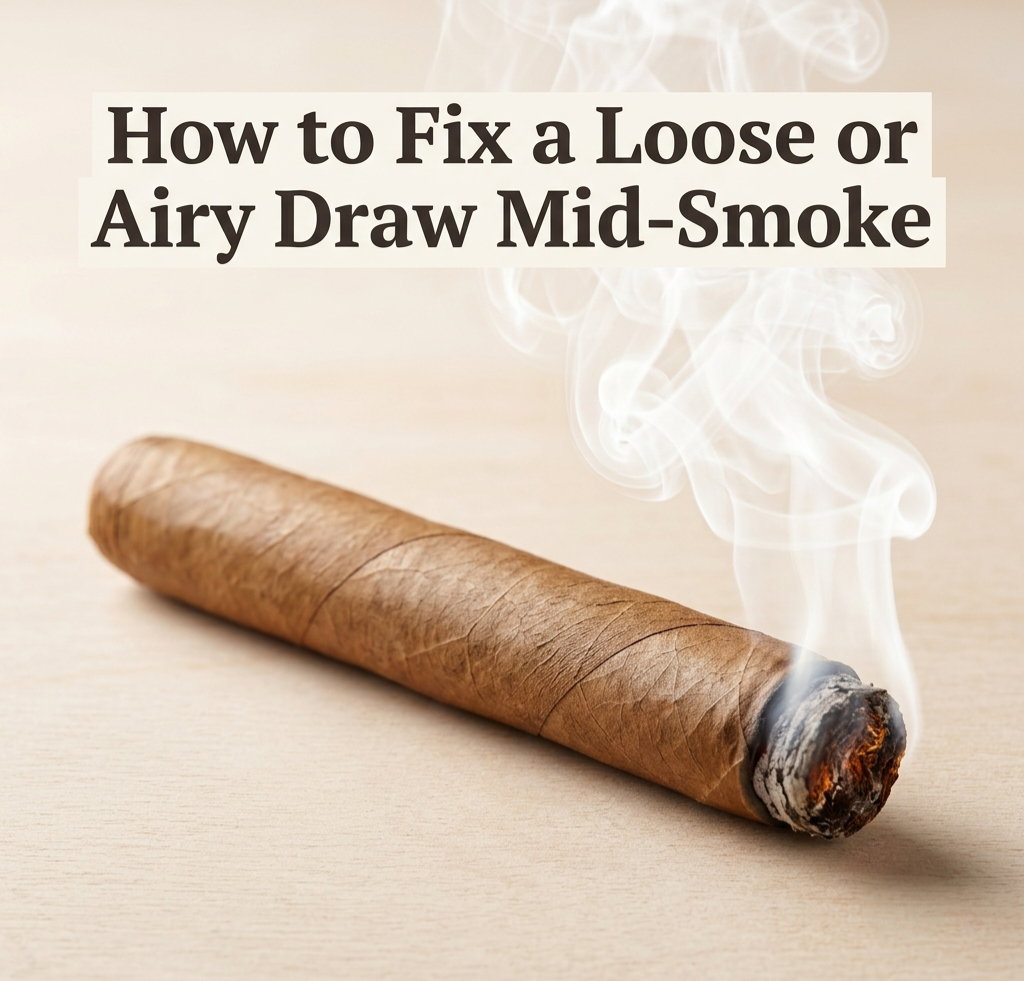
The draw feels like pulling on an empty straw. Smoke pours out with almost no effort, the foot is burning visibly faster than it should be, and the flavor tastes thin and weak instead of full. That’s a loose draw, the mirror image of a plugged cigar, and it causes its own separate set of problems.
Unlike a tight draw, there’s no piercing tool or deeper cut that adds tobacco back into a cigar that didn’t have enough to begin with. This is about recognizing what’s happening and adjusting around it rather than correcting it outright.
Is It Actually a Loose Draw?
A loose draw pulls with almost no resistance at all, the opposite sensation from a plugged cigar where you struggle to get any smoke through. You’ll typically notice large volumes of smoke arriving with very little effort, a foot that’s visibly consuming faster than the pace of your puffing would explain, and flavor that comes across thin and diluted rather than full, even on a cigar you know is a good blend, since picking up the actual notes depends partly on the smoke having enough resistance and concentration to carry them. Roll the cigar gently between your fingers and you may feel soft, slightly spongy sections rather than the firm, even resistance of a well-packed bunch. If you’re dealing with the opposite problem, barely any airflow at all, how to fix a tight or plugged cigar covers that side of the spectrum.
Why It Happens
An underfilled bunch. This is the dominant cause. During rolling, the buncher packs filler tobacco inside the binder before the wrapper goes on, and if less tobacco went in than the format calls for, air has more room to move through with less resistance. Understanding what’s actually inside a cigar makes it clearer why this layer matters so much for draw resistance.
Box-pressed shaping. Some box-pressed cigars are deliberately rolled a touch looser than their round counterparts so the bunch can take on the square shape during pressing without splitting the wrapper. Box-pressed construction explains the tradeoff in more depth, but a slightly airier draw is sometimes simply part of the format rather than a defect.
An overly deep or aggressive cut. Removing too much of the cap opens the draw wider than intended. This one’s at least worth checking before you assume the fault is inside the cigar. If a fresh, un-lit cigar from the same box draws normally, the one you’re smoking may have just been cut too generously.
Humidity, with real uncertainty attached. Over-humidified cigars are well established to swell and restrict airflow, producing a tighter draw, not a looser one, so it isn’t a reliable explanation for looseness on its own. Looseness traces back to construction far more consistently than to storage conditions, though stable humidor conditions remove humidity as a variable either way.
What You Can Actually Do About It
There’s no tool that adds tobacco back into an underfilled cigar the way a draw poker or piercer opens up a plugged one. The response here is entirely about technique.
Mild: slightly looser than ideal, still enjoyable
- Take shorter, gentler draws rather than your normal pull. Less air moves through per puff, which brings the burn rate back closer to normal.
- Extend the gap between draws a little beyond your usual rhythm, since the cigar is already running hotter than the pace alone would suggest.
Most mildly loose cigars are still genuinely enjoyable once you adjust to them, just not identical to a perfectly packed one.
Moderate: noticeably airy, burning hot and fast
- Slow down further than feels natural. The same overheating that comes from smoking too fast happens here too, even though your actual puffing frequency hasn’t changed, because it’s the extra airflow through the cigar doing the damage rather than the timing between draws.
- Take noticeably smaller, sipping-style draws instead of a full pull, so less volume moves through the ember each time.
- Expect the cigar to finish well ahead of the usual timing for its size, and adjust your expectations rather than fighting to slow the physical burn rate through technique alone.
Severe: essentially no resistance, burning through regardless of technique
At this point the underfilling is significant enough that gentler technique only helps marginally. The honest options are to keep smoking it for what it is, accepting a faster, thinner experience than the cigar was meant to deliver, or to set it aside and reach for another. Neither is a failure on your part. How VDG evaluates construction quality covers what separates a normal, expected variation in handmade tobacco from a genuine construction defect.
What Not to Do
Don’t try to compensate by drawing harder or longer to “get more” out of each puff. That pulls even more air through an already too-open draw and accelerates the overheating rather than solving anything.
Don’t assume a loose draw means the whole box is bad. Handmade cigars carry natural variation stick to stick, and how long a cigar typically takes to smoke is a useful reference if you want to confirm this one is meaningfully outside the normal range before drawing conclusions about the rest of the box.
Don’t try to squeeze or compress the cigar to force the filler tighter. It doesn’t meaningfully change the internal packing and risks cracking the wrapper for no real benefit.
Frequently Asked Questions
A plugged or tight draw resists airflow, sometimes to the point of barely pulling any smoke through at all. A loose draw is the opposite, air and smoke move through with almost no resistance, like drawing on an empty straw.
Mostly you adapt to it rather than fix it outright. Unlike a tight draw, which responds well to cutting deeper or using a piercing tool, there’s no way to add tobacco back into an underfilled cigar. Slower, gentler, shorter draws are the main tool available.
Not necessarily. An occasional loose stick is a normal part of handmade tobacco. A loose draw across an entire box, on every cigar, points more toward inconsistent filler packing at the factory worth noting for future purchases.
More air moves through the ember with each draw, which accelerates combustion the same way puffing too fast or too hard would, even if your actual puffing pace hasn’t changed at all.
It’s less reliable an explanation than with tight draws, where over-humidification consistently causes swelling and restricted airflow. Looseness traces back to construction far more consistently than to storage conditions.
Rolling the cigar gently between your fingers can reveal soft, spongy sections where the filler feels underfilled. That said, a truly loose draw is often only obvious once you’re actually smoking it.
Peter | VDG Cigars | Certified Cigar Sommelier
Peter Stefanic is the editor of VDG Cigars and a Certified Cigar Sommelier through the IACS (International Association of Cigar Sommeliers). He has conducted more than 25 exclusive interviews with cigar brand owners, blenders, and founders, and has spent over a decade smoking, reviewing, and troubleshooting premium cigars.
Subscribe to our newsletter and find out about all new posts
Check out our latest posts
- How a Cigar Is Made, From Seed to Shop

- Top 30 Best Winter Cigars (2026): Reviewed by Flavor, Body and Smoke Time

- Cigar Ring Gauge in mm: Every Size, and What Thickness Actually Changes

- Horacio 8 Classic Review: A Small, Nutty Costa Rican Everyday Smoke

- Karina Owen: The Woman Who Built Her Own Name (Part 3 of 3)

- Horacio Heritage 6 Review: A Full-Bodied Costa Rican With a Perfumed Floral Edge

- Karina Owen: The Years That Taught Her People (Part 2 of 3)

- Brun del Ré Privado Gran Toro Review: A Two-Hour Costa Rican Puro

- Aroma de Nicaragua and Hernan Lopez: Up to a Year in the Pilón, and the Nicaraguan Cigar Built Without the Pepper

- Interview with Karen Berger

- The $1 Challenge: Helping Philadelphia Youth With the Roberto Martinez Foundation

- Robusto vs Toro: Real Smoke Times, Flavor and Which One to Choose

- Macanudo Maduro Diplomat Review: A Smooth, Fruity Maduro in a Short Figurado

- Brun del Ré Cigars and Carlo Corazza: The Costa Rican Puro That Ferments for Over a Year

- The story of Karina Owen Part 1 of 3: At the End of the Night

- The Leaf That Changes Everything: Why La Flor de Zaida and Medio Tiempo Belong in the Same Sentence

- La Flor de Zaida Brings the Diamond Collection and Ralf Moeller to InterTabac 2026

- Casa Magna Colorado Torito Review: A Rich, Approachable Everyday Full-Bodied

- Aroma de Nicaragua Connecticut Toro Review: A Long, Gentle Nicaraguan With Unusual flavors

- Aroma de Nicaragua Ecuador Robusto Review: A Long-Burning Nicaraguan Value

