
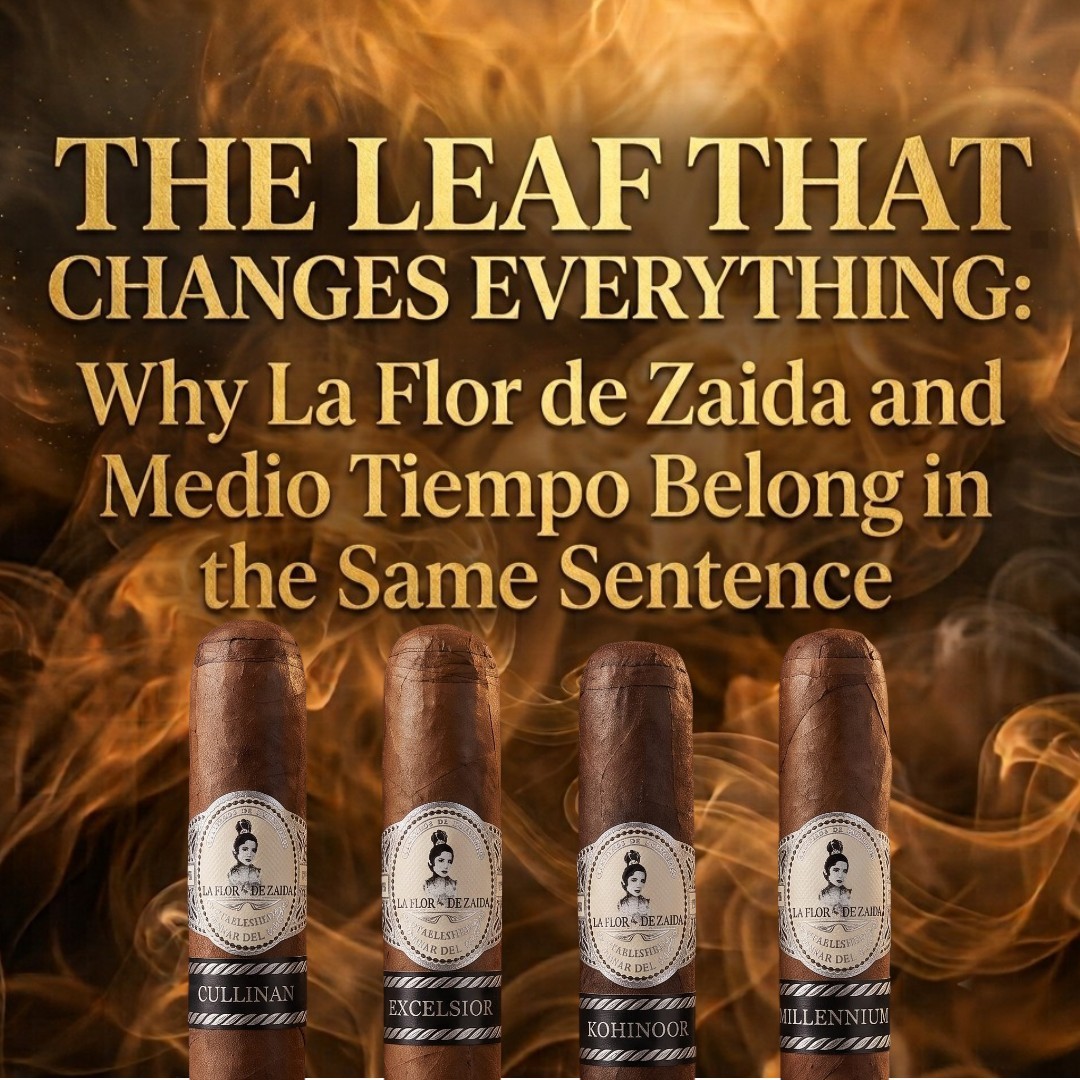
You buy a watch. A good one. You expect a reliable movement. But when you open the case, sitting inside is a hand-finished Swiss caliber. Every gear, every spring, every component touched by human hands. The same one that drives a Rolex Daytona. In every piece. As standard.
That is what Antonio Piredda built with La Flor de Zaida.
The leaf inside every La Flor de Zaida cigar is called medio tiempo. The rarest tobacco leaf in the premium cigar world. It grows on fewer than one in ten plants, cannot be farmed on demand, and has no shortcut. The industry reserves it for its most prestigious releases. The kind that earn a waiting list. The Cohiba Behike is the most famous example, and medio tiempo is exactly what separates it from every other Cohiba ever made.
Antonio Piredda uses that leaf as his standard. Not as a headline. Not as a special edition. As the foundation every La Flor de Zaida smoker encounters every time they light up.
If you want to understand the full story behind La Flor de Zaida, read our interview here: La Flor de Zaida: A Dream Over 100 Years in the Making.
What Medio Tiempo Actually Is and Why It Matters
To get why this matters, you need to understand the tobacco plant from the ground up.
Where a leaf grows on the stalk determines everything. At the bottom sit the seco leaves. Thin, light, built for combustion. In the middle comes the viso, carrying aroma and steady richness. At the top grows ligero. The powerhouse. Thick, oily, packed with nicotine. Ligero is what gives a cigar its strength and body.
Most smokers know this. What most smokers do not know is what sometimes grows above ligero.
On a small number of plants, two additional leaves appear above the highest priming. Right at the crown of the stalk. Higher than anything else on the plant. Closer to the sun than any other leaf on that field. They mature slower than the rest of the harvest, spending roughly 50 percent longer on the plant before they are ready to be picked. During that extra time they start curing while still alive on the stalk. More light, more heat, more of everything. By the time they are harvested, they are thicker, darker, and oilier than ligero, and more concentrated in flavor than anything below them.
That is medio tiempo. In Cuba it sits at fortaleza number four. The highest strength classification in the Cuban leaf grading system. The name is a paradox since it translates to half time, a nod to the extra half-life these leaves spend developing before harvest. The pyramid of tobacco has a top. Medio tiempo is it.
Why Medio Tiempo Is So Hard to Get
Here is where things get genuinely difficult.
You cannot grow medio tiempo on demand. You cannot plant a field and plan for a yield. Between 10 and 15 percent of tobacco plants in a field will ever produce a single medio tiempo leaf. Some growers put that number even lower. For every ten plants you water, fertilize, tend, and watch through a full growing season, eight or nine give you nothing at the crown. You still harvest good tobacco from those plants. You still put in the same work. You just get nothing up top.
The plants that do produce it give you two small leaves each. Two leaves. Per plant. On roughly one in ten plants. After a longer wait. With extra labor to identify and pull them separately from the standard ligero harvest.
Those two medio tiempo leaves are not generous in size either. They are noticeably smaller than standard ligero. A smaller leaf means less material at the rolling table. It limits how much can realistically go into each cigar. And it demands a higher level of skill from the roller to handle correctly. Standard techniques built around larger leaves do not translate. The torcedor has to adjust. Years of experience. Trained hands that understand the leaf before it is even touched. Not every pair of hands can do it well. So even when you have sourced the leaf, processed it separately, and aged it on its own timeline, the work is not done. This is where craft separates itself from production. Medio tiempo is unforgiving in the hands of anyone who does not know exactly what they are doing.
The leaf is also fragile in a way standard tobacco is not. Being at the crown means it takes the full force of every weather event before anything else on the plant. Heavy rain on a leaf that is already mid-cure on the stalk can wipe out the very qualities that make it worth chasing. No farmer controls the weather. No harvest is guaranteed.
After it comes off the plant, medio tiempo cannot go in with the rest of the ligero. The density and oil content demand their own pilón, their own fermentation, their own aging process. More time, more space, more cost at every step between the field and the rolling table.
By the time a manufacturer uses medio tiempo in a cigar, they have invested far more per leaf than anything else in their inventory. And the supply is never guaranteed. It changes season to season, field to field, year to year.
What the Cohiba Behike Tells Us About Medio Tiempo
When Habanos S.A. built the Cohiba Behike, they understood one thing clearly. Medio tiempo had to be the story, because the story is what the price required.
The Behike was built to be the definitive Cohiba. The crown jewel of the most iconic cigar brand in the world. When the team went looking for what would separate it from every other Cohiba ever rolled, they landed on medio tiempo. The leaf had existed in Cuban tobacco classification for decades. Almost nobody outside the industry had heard of it.
The Behike changed that. Habanos put medio tiempo front and center, named it explicitly, and built the entire narrative of exclusivity around it. The 52 size was named Cigar of the Year. A new benchmark for what premium meant was born, and medio tiempo was the proof behind it.
And here is what that really means. Cuba is the birthplace of the premium cigar. The island that defined what a great cigar is supposed to be. Cuban cigar culture runs deep, the knowledge, the tradition, the pride. Out of everything Cuba produces, out of every cigar that carries the Habanos seal, the Behike stands alone as the only one built around medio tiempo. The Cubans themselves, the people who invented this culture, looked at every leaf available to them and decided that medio tiempo belonged in only one place. Their finest cigar. Their most expensive. Their best. That says everything about what this leaf is.
That is how the industry handles it. You find something extraordinary, you protect it, you reserve it, and the price reflects it.
How La Flor de Zaida Does It Differently

La Flor de Zaida does not follow that playbook.
Antonio Piredda did not discover medio tiempo and build a limited release around it. He did not create a La Flor de Zaida prestige edition with a big price tag and a compelling story. He made medio tiempo the foundation of every cigar the brand produces. The thing every person who buys a La Flor de Zaida should expect inside, because it is always there. That decision alone demands a level of craftsmanship that most brands simply do not commit to. Every leaf sourced with care. Every step of fermentation and aging handled separately. Every roller trained to work with a leaf that punishes shortcuts. That is not production. That is craft.
He is also not chasing volume. La Flor de Zaida is not built around how many cigars ship in a year. It is built around what the smoker holds and what they experience from first draw to the last inch. Quantity was never the goal. The goal was that every La Flor de Zaida cigar is worth the name on the band.
All the challenges described above still apply. The scarcity of medio tiempo does not disappear because Antonio chose to use it as standard. If anything it gets harder. You are committing to source and process medio tiempo consistently, not just for a single prestige run you can plan around. You cannot have a difficult harvest year and quietly replace it. You told your customers what is inside every La Flor de Zaida. That has to hold, every time.
What changes is what the smoker gets.
When you light a La Flor de Zaida, you are not holding a limited edition. You are not paying extra because the brand positioned one release as something special. You are holding the same medio tiempo leaf the Cohiba Behike used to earn its place at the top of the cigar world, and you are holding it as your everyday smoke. Think about the labor, the unpredictable yields, the separate fermentation, the sourcing commitment behind every single leaf in that La Flor de Zaida cigar. What you get for what you pay is something the rest of the market rarely offers.
That takes real confidence. Confidence in the tobacco over confidence in the marketing. A willingness to absorb costs that most brands only accept when they can pass them straight to the consumer through a special-edition price. And it sets a standard that cannot be quietly walked back, because it is built into every box.
What Medio Tiempo Brings to a La Flor de Zaida Cigar


The oil concentration in medio tiempo is measurably higher than in standard ligero. Those oils, built up through longer sun exposure and extra time on the plant, carry concentrated flavor compounds that go directly into the smoking experience. The thicker cell structure holds them through fermentation and aging in a way thinner leaves simply cannot.
In many cigars, medio tiempo is the weight beneath everything else. Not the loudest note, but the foundation that makes everything above it feel complete. Without it a cigar can still be good. With it the whole experience gains a depth that is hard to put into words but easy to notice. Rich, complex, in a way that keeps building rather than peaking early and fading. In a La Flor de Zaida cigar, that depth is not a bonus you hope for. It is what the cigar is built around.
The Statement La Flor de Zaida Is Making with Medio Tiempo
The cigar world has a lot of ways to signal that something is exceptional. Limited runs. Numbered boxes. Releases aged for years before they reach a retailer. Wrappers that cost more per leaf than some producers spend on an entire cigar. Those tools work. The brands using them are often making genuinely great cigars.
But there is a different kind of statement. Harder to make and harder to hold onto. Made by a brand that builds its standard around what the rest of the industry builds its legend around. A brand that does not measure itself by how many cigars it ships, but by whether every La Flor de Zaida cigar that leaves is worth it.
The Cohiba Behike showed the world what medio tiempo can do. The world paid attention, and the price reflected it.
Antonio Piredda looked at that same medio tiempo leaf and decided it should be what every La Flor de Zaida smoker simply expects.
You bought a watch expecting a good movement. Inside was a hand-finished Swiss caliber. And it runs every day. Every time you light up a La Flor de Zaida, that movement is the medio tiempo roaring.
A sincere thank you to Antonino Piredda for his time and for sharing the knowledge and passion behind La Flor de Zaida. This article would not have been possible without him.
Subscribe to our newsletter and find out about all new articles and recommendations
Check out our latest articles and recommendations
- What Is a Connecticut Cigar? The Wrapper Explained

- How a Cigar Is Made, From Seed to Shop

- Top 30 Best Winter Cigars (2026): Reviewed by Flavor, Body and Smoke Time

- Cigar Ring Gauge in mm: Every Size, and What Thickness Actually Changes

- Horacio 8 Classic Review: A Small, Nutty Costa Rican Everyday Smoke

- Karina Owen: The Woman Who Built Her Own Name (Part 3 of 3)

- Horacio Heritage 6 Review: A Full-Bodied Costa Rican With a Perfumed Floral Edge

- Karina Owen: The Years That Taught Her People (Part 2 of 3)

- Brun del Ré Privado Gran Toro Review: A Two-Hour Costa Rican Puro

- Aroma de Nicaragua and Hernan Lopez: Up to a Year in the Pilón, and the Nicaraguan Cigar Built Without the Pepper

- Interview with Karen Berger

- The $1 Challenge: Helping Philadelphia Youth With the Roberto Martinez Foundation

- Robusto vs Toro: Real Smoke Times, Flavor and Which One to Choose

- Macanudo Maduro Diplomat Review: A Smooth, Fruity Maduro in a Short Figurado

- Brun del Ré Cigars and Carlo Corazza: The Costa Rican Puro That Ferments for Over a Year

- The story of Karina Owen Part 1 of 3: At the End of the Night

- The Leaf That Changes Everything: Why La Flor de Zaida and Medio Tiempo Belong in the Same Sentence

- La Flor de Zaida Brings the Diamond Collection and Ralf Moeller to InterTabac 2026

- Casa Magna Colorado Torito Review: A Rich, Approachable Everyday Full-Bodied

- Aroma de Nicaragua Connecticut Toro Review: A Long, Gentle Nicaraguan With Unusual flavors

