

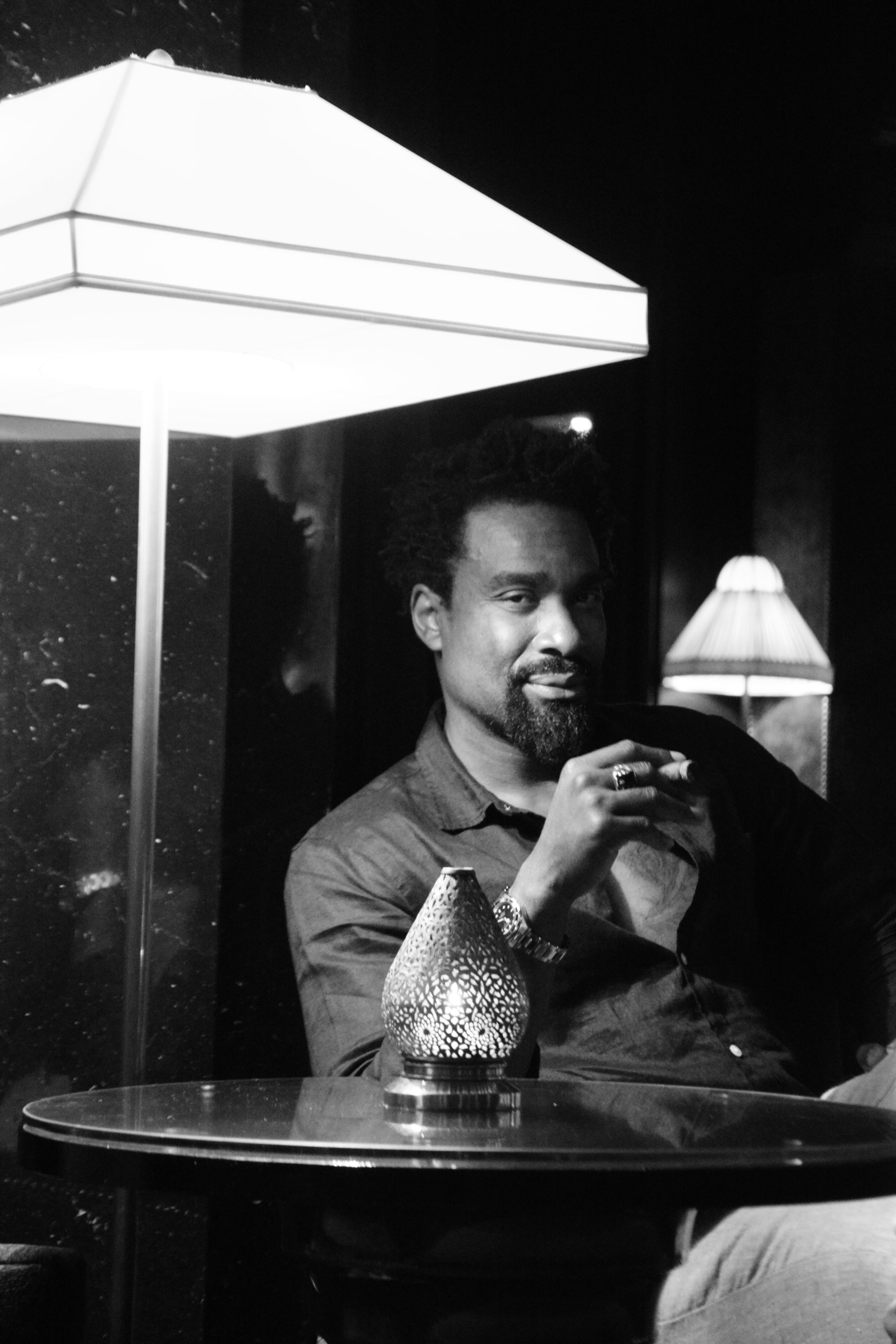
A celebration dinner in Cape Town. The pilot of a new TV series has just been approved in Los Angeles. On his way back from the bathroom, a young actor walks past a hidden corner, a quiet room full of men smoking cigars and drinking whiskey. He realises it is the wrong room and starts to pull back. Then an elderly South African gentleman calls out to him.
In Part 1 and Part 2, Oris Erhuero shared his journey from a café dream to the screen, his dreams, his friendships and the people who stood by his side. In Part 3, we light up. From a first Cohiba Esplendido in Cape Town to Havana, Boisdale and Oris’s Sanctuary, the award-winning The Art of Telling Lies and the memoir he is now finishing.
This is the part about the leaf. Not the bands, the prices or the ratings, but what the cigar really does to people. How one stranger in a smoking room can change the direction of a whole life. How a meeting that was supposed to take thirty minutes can turn into four hours and a friendship. And how sitting in silence with someone, without saying a single word, can feel like the deepest conversation you have ever had.
The cigar erases borders. It does not care where you come from, what you earn or what you believe in. It shows the true value of a person, and it brings together people whose paths would otherwise never have crossed. Oris and I are one example of that.
This is Part 3 of 3.
The wrong door
It all started in Cape Town, during Sinbad, in a smoking room. Tell us about that day and the person you met.
I have talked about this several times, and to be honest almoost forgotten amd got spme names mixed up .telling it but i getvto fix thing telling this and answeing this quetion this time around ….. but looking back, it feels like it happened just yesterday. We had just finished shooting the pilot episode of The Adventures of Sinbad and were having a dinner party to celebrate. After a pilot, there is always that fingers-crossed moment where you wait and pray that the studio back in LA likes it. Low and behold, the big guys loved it, and that’s when the real celebration began. We went to a really high-end steakhouse-slash-nightclub in Cape Town—one of those top-tier joints back then.
During dinner, like any other normal scenario, I got up to go take a leak. On my way back from the bathroom, I accidentally walked past a quiet, hidden corner. On one side of the venue you had the steakhouse, on the other side was the loud club, but right here in this quiet corner was a room full of men smoking cigars and drinking whiskey. I popped my head in, realized it was the wrong room, and immediately started to pull back. But an elderly, very talkative South African gentleman called out to me. He recognized me. I had already been in Cape Town for about a year and a half doing modeling and international commercial work, so my face was on posters in stores all around South Africa, alongside the odd TV commercial. The fact that he recognized me from my modeling work—beyond just the buzz of the new TV show—instantly drew me to him. People in the cigar world have an incredibly sharp, clear memory for details like that.
He was a very well-to-do guy, and it was obvious he wasn’t trying to hustle me. He asked if I wanted a cigar. I laughed and said, “No thanks.” I explained that when I lived in Miami waiting tables, the closest I ever got to a cigar on South Beach was running out to grab hand-rolled sticks for my wealthy clients. I used to run down to a Cuban shoe-repair shop on the beach where they fixed heels and shoes on one side, and rolled fresh cigars for two dollars and up right in front of you on the other. I’d grab them, run back to the restaurant, and serve them to my clients as part of their after-dinner ritual. I told him I had been around it, but I had never actually smoked one myself.
He looked at me and said, “Sit down, let me be the first to show you.” Before I knew it, he cut the cigar and lit it in one swift, masterful motion. You could just see his absolute love for the leaf. That very first cigar he handed me happened to be a Cohiba Esplendido. To this day, I can still recall that distinct, rich, grassy smell. Smoking your very first cigar and having it be an Esplendido in Cape Town during the mid-90s is like starting right at the absolute pinnacle of luxury.
I completely forgot about the crew and the people I came in with. We had arrived for dinner at 8:00 PM, and I didn’t leave that room until 2:00 AM. My production team was wondering where the hell I was; the funny part is they all assumed I had snuck off with a woman! If only they knew the kind of night I actually had.
That man was Carl Johannes. He is a real, classic South African gentleman in his seventies who works in the wine industry—I believe he was a part-owner of a winery in the beautiful Stellenbosch region—and he was out entertaining his own clients that night. The next day, he had me return to the venue, handed me a full box of cigars alongside a cutter and a lighter, and taught me exactly how to cut, light, and care for them. How crazy is that looking back? But honestly, I was far more interested in his wisdom and his company than the cigar itself. That is the beautiful, unexplainable magic of the cigar world—it introduces you to mentors and friends who completely reshape your life
The Cohiba Esplendido. It was the cigar that changed everything for me too. My brother-in-law gave me one at a family dinner in my early twenties, and it showed me that there was a real difference in the quality and flavours of cigars. You can read that story on my Who I Am page. But what stays with me in Oris’s story is not the cigar. It is Carl. A stranger who invited a young man to sit down, and then gave him his time.
Days later you got a box of cigars, a humidor, a cutter and a lighter. What did that generosity mean to you?
Looking back now, there was a massive amount of noise and chaos going on in my life at that time, but Carl’s kindness completely broke through it all. His generosity was the exact moment I truly began to understand the weight of the brotherhood I had just accidentally stepped into. It was far more than just a gift of tobacco; it was a profound welcome into a global community. I will forever be grateful for that night because it sparked a deep, lifelong curiosity about the heavy history behind the leaf.
We have to keep the broader context in mind: Nelson Mandela, after 27 grueling years of being locked up, was now the president of South Africa. I was living in what felt like the best-kept secret place on the planet. Cape Town at that time was electric—it had the vibe of California, the sun of Miami, and the elite glamour of Saint-Tropez all wrapped into the crown of Africa. The atmosphere was incredibly beautiful, vibrant, and happy, and to be fair, it still is.
During our conversations, Carl dropped the whole reality of the Cuban embargo on me. He broke down the history of John F. Kennedy, the politics between America and Havana, and the powerful, historic connection between South Africa and Cuba—especially the deep bond shared between Nelson Mandela and Fidel Castro. I remember him joking with me, saying, “Enjoy this cigar right now, because when you get back to the States, it’s completely illegal!”
While I was soaking in all this history, I was also incredibly blessed to be invited on an official visit to Robben Island, where Mandela spent the dark decades of his sentence. I went as the personal guest of the legendary Cicely Tyson—one of America’s all-time greatest models and actresses, who had also been married to the jazz genius Miles Davis. It was unreal.
Beyond that historic tour, Cicely Tyson would go on to play a massive, pivotal role in my career. She stepped in and personally helped me land my first real acting manager and agent. Not only that, she actively helped reshape my contract for the second season of The Adventures of Sinbad, protecting my value and setting a highly respected industry precedence for my career moving forward as an actor.
I held onto that history and those blessings with a fierce intensity. All of those stories, the politics, and the curiosity stayed stuck in my head for decades until I finally took that leap and visited Cuba for the very first time in 2017. That journey opened up a whole other side of the cigar world for me. I finally got to visit the legendary El Laguito factory—the birthplace of Cohiba—and stand right at the source of the very cigar I was introduced to by divine default back in the mid-90s. Carl’s generosity didn’t just give me a humidor; it gave me the roadmap to a massive, global chapter of my life.
I have to draw one more parallel here. Do you remember Oris and Torunn’s friend Eugene from Part 2? They helped him see something in himself that he did not know was there. Here, a stranger shows Oris the way to the cigar out of pure kindness. And when Oris was a waiter in Miami, it was a photographer at a table who saw what he could not see himself. Those small acts of kindness change people’s lives, and they change them in ways you might never understand. It is not only kindness. It is people who truly want the best for others.
“You cannot hide from the leaf.”
You have said the cigar symbolizes humility and takes away the ego. You have also called it a license to endless conversations. What do you mean by that?
To be brutally honest, it is simply because the leaf forces you into an absolute confrontation with yourself. I talked about the Liberace syndrome earlier—the clout, the pretentiousness, the performance that people put on for the world. Now, I would be very naive not to admit that on the other hand, the cigar world can also intensify someone’s ego on a whole other level. You meet people who make you want to avoid them completely or shut them up in a heartbeat—especially when they go on and on bragging about how they only smoke from one certain region and nothing else. It’s like, wow, what the fuck, who cares?
We all see people try to ride into a cigar parlor on a high horse, walking on a cloud of ego to suppress their pain and scream to the room that life is great. I know that feeling intimately because I’ve lived it. There were so many times in my life where I was behind closed doors, pretending everything was absolutely fantastic to the public while internally navigating total chaos.
But the true magic of that space is that you cannot hide from the leaf. When you actually respect it, you light that cigar, and the quiet rhythm of the smoke breaks you down. It strips away the armor of your ego and whispers the truth to your soul, forcing you to face your reality. It tells you to stop pretending, to snap out of whatever creative or emotional funk you are trapped in, and to actually get to work dealing with the problems and the raw realness of life. It’s a license to endless conversations—not just with the wise strangers sitting next to you, but with the man staring back at you in the mirror. It humbles you so it can rebuild you.
Lunch with the rollers of El Laguito
In 2017 you visited El Laguito in Havana. What was that like?
First and foremost, I have to give the absolute greatest credit and thanks to a great friend of ours who was the manager at the legendary Partagás factory for putting that entire visit together. Talk about true brotherhood in motion—the camaraderie and mutual respect that the Cubans in the cigar industry have for one another is a beautiful thing to witness. Even though he represented a completely different, rival brand, his only desire was for my friends and me to experience the heart of Havana’s history firsthand.
We were received beautifully. It was absolutely amazing to see how incredibly happy, proud, and appreciative every single person working inside those walls was. The real highlight for me wasn’t the status or the hype of the label; the highlight was watching them take their normal work breaks and all sit down together to share a great, home-cooked meal. Seeing the smiles on their faces was a major Kodak moment in my book. In that exact second, I completely forgot about Cohiba as a commercial brand and focused entirely on the rollers, the people, and the weight of their own personal stories.
I loved every second of it. I will be forever grateful to my friend Harry for taking me to Cuba, as well as all of the wonderful, welcoming people who bridged our journey all the way from the Partagás family to the El Laguito factory. It was a profound education—like witnessing a cigar PhD in motion. I learned a massive amount on that trip, and it cemented my belief that the true value of the leaf will always belong to the beautiful souls who roll it.
The perfect cigar moment
What does your perfect cigar moment look like today? The place, the company, the time of day.
My perfect cigar moment today looks exactly like walking into a church to confess all of my imperfections. It is about speaking raw truth to that ash and smoke, and to the person sitting right in front of you. Sometimes, that perfect moment is just me and that smoke all by myself in total silence. Other times, it’s about two individuals sitting next to each other, saying absolutely nothing at all until the cigars are fully done, and then simply getting up to leave the premises. It is a powerful thing because even though not a single word was uttered, you walk away feeling as if you have spoken deeply and known each other intimately. You communicated in the spirit, through the blaze of smoke traveling back and forth between you.
That is another profound layer of this world: whatever you choose to do when you light up, as long as it is rooted in respect, is your absolute prerogative. If you want to talk, you talk. If you want to listen, you listen. If you need to open up your heart, you do it. There is never any rush. It is about completely pacing yourself and reflecting on life, taking it in like a simple breath—one inch of the leaf, one moment of your life, at a time.
Just being able to sit with a friend in the same room, completely silent, without it ever feeling strange, and simply listen, is something special. Nobody feels any pressure, nothing is forced, and everyone lets you be who you are and feel however you feel in that moment. Imagine if the rest of life was like that. Would not everyone’s life be better?
You have smoked cigars for more than 35 years. What is your advice to someone just starting out, and what do you wish someone had told you at the beginning?
For anyone just starting out—whether you are from the younger generation or you are someone of any age who is simply curious and wanting to try it for the first time—my absolute number one piece of advice is to find a mentor. Find someone who has been smoking for a very long time and really has a lot going for them in life. Remember, as I always say, it is never too late to try something new, even if it is just walking into a cigar parlor for the very first time out of pure curiosity.
Especially now, in an era full of endless entrepreneurial individuals who are actively shaping and shifting society, I want to open people’s eyes to a hidden side of this world. The cigar community is filled with incredibly smart, patient people who spend a lot of their time reading and studying on their own accord. That is a beautiful tradition that still exists inside the lounge. Those are the kinds of people you want to be around, smoke with, and network with. If you find the right individual, they will literally give you a free education, a free college degree, and a university masterclass in every direction—for free, and with pure love. That cigar resting between their fingers becomes the chalk on the spiritual blackboard of life. When you find that, the cigar parlor or your private gatherings will become the anchor and the cornerstone of your life as you navigate marriage, children, and business.
I say all of this based entirely on my own life experience. I only wish that the world could take the absolute psychology and education of the cigar parlor and inject it directly into our modern political arenas and global establishments. Look at our fellow actor and the former Governor of California, Arnold Schwarzenegger—he famously built a smoking tent in the capitol courtyard for everyone, regardless of their political party, to sit down, meet, and talk. I wish the political arenas across the entire world had a parlor exactly like that. If they did, there would be fewer wars, fewer petty fights, and pure, raw honesty.
You simply cannot hold a great cigar between your fingers and talk reckless or crazy, or just recklessly go to war as you wish. It is psychologically impossible. I couldn’t smoke a cigar and scream at another human being; instead, through that cigar, you are forced to try your absolute hardest to find a peaceful, mature solution.
If you are a shy person, let your journey start simply right at the cigar counter. Your experience will completely depend on how honest, sincere, and free of ego you are when you walk through that door. When you step up to the counter, just be completely honest. Tell them, “Look, I know absolutely nothing.” I can guarantee you that the individual behind that desk will take that precious moment and walk you through everything with care, love, and respect. They don’t just want you to buy a cigar and leave; they want you to be incredibly happy and welcome you into the fold.
It starts at the counter, and then it moves into the parlor where you seek out those mentors. Surprisingly, you will find—just like I did and still do—these older gentlemen and women whom I like to call true aficionados. I don’t call them that just because they are well-studied in the tobacco world; I call them aficionados because they are great-grandfathers and great-grandmothers with an endless reservoir of real life experience beyond anything you would ever encounter on the outside. You have to keep in mind that in today’s society, everyone is in a constant hurry to go absolutely nowhere. But the moment you step into a cigar environment, time completely stops. The world is at a standstill. No one is rushing anywhere. We are all just stopping to breathe and coming up out of the chaotic world outside for a blast of fresh air. Without that stillness, we simply cannot breathe. Period.
I know we were supposed to talk about cigar advice here, but Oris says something much more important in this part than just cigars. It is never too late. The same words his late father-in-law said to him in the car. Words that are true wherever you are in life. Then there is something else. Everyone is in such a hurry to go nowhere. I had to stop here and just laugh a little, because it is so incredibly true in today’s society. Everyone is stressed, and most of the time not about anything life-changing or decisive. The funny thing is that it is usually in our private lives that we stress, and rarely at the job that puts food on the table. And when it comes to the cigar, his advice is as simple as it is right. Start at the counter, be honest and say that you know nothing, and find a mentor. Nobody is born knowing, and the best people in this culture love to share what they know. Then let the lounge be the place where time stops for a while. One cigar, one moment, no rush.
From a 30-minute meeting to Cigar Smoker of the Year
You were named Boisdale Cigar Smoker of the Year in 2022, and on 30 November you go back as a guest. What did that night mean to you?
Wow, first and foremost, I have to give massive credit to my dear friend Ricardo Carioni, one of the brilliant founders of the Cigar Academy and now a key executive with the Premium Cigar Association (PCA). Back then, he was working for Tor Imports—one of the United Kingdom’s premier importers of the finest New World cigars. I was just starting out my family cigar podcast called Oris’s Sanctuary when I crossed paths with him.
What was so incredible about that first meeting with Ricardo was how completely it blew past our expectations. I had just come back from being invited as a guest at the annual London Whisky Show, and we were originally scheduled to sit down for a quick 30-minute chat. We met up at 8:30 PM at my private cigar and whisky members’ club right in the heart of London. But the second we sat down, the connection was instant. We started talking, lighting up one premium cigar after the other, and that brief 30-minute meeting stretched all the way until 12:30 AM!
In that meeting, Ricardo looked at me and said that my deep, authentic love for the cigar world was simply too powerful to be kept a secret. It just so happened to be right around the first COVID-19 lockdown. Ricardo was ahead of his time; he was one of the very first to bring the global industry together via Zoom, connecting legendary cigar makers from all around the world. I remember being on one of those casual global Zoom smoke calls for the first time, and Jonathan Drew from Drew Estate was on it. Wow, we all just hit it off immediately.
That pivotal moment is when my collection shifted heavily toward the New World. To be fair, when I returned to the USA after my TV series ended, I vividly remembered the words I had been told in Cape Town: if I was living in the States, I would need to rely entirely on cigars from other regions and stay away from the Cubans because of the embargo. So, I was already kind of familiar with the exact type of New World premium stock that Tor Imports, Ricardo, and the guys were carrying. But during those lockdown calls, I was suddenly up close and in person with the very men who were making sure it got into the hands of the people.
All of that history came beautifully full circle for me. One door led to another, and because Ricardo was one of the key figures running the prestigious Boisdale Cigar Smoker of the Year event that year, he personally invited me to the 2021 gathering. He absolutely insisted that I come out to meet the absolute Who’s Who of the UK cigar world. Honestly, at that 2021 event, I was just completely happy to be in the room, make friends, soak in the atmosphere, and accept my nomination.
Then, the very next year in 2022, they named me the Cigar Smoker of the Year. It was an incredible honor. The following year, I had the privilege of returning to hand the stage over to the next winner, who was none other than Ray Winstone himself! It was amazing for us all to be following the leads of Arnold Schwarzenegger and many other true, real smokers of the leaf who appreciate the culture for what it is, rather than just doing it for show. It has been a beautiful, fun, and deeply rewarding journey.
Winning that award has given me the ultimate platform and leverage to push forward a major boutique cigar project that I am currently working on behind the scenes. It has been an absolute win-win all around for me and everyone involved. This year, on the 30th of November, I am truly looking forward to returning to Boisdale just to regroup with old friends, celebrate the leaf, and honor the next winner.
A meeting that was supposed to take 30 minutes and ended up lasting four hours. I think that says more about the cigar than any award ever could. When you sit down with the right person and light up, time stops counting. You are not there to close a deal or to impress anyone, you are there to talk, to listen and to get to know the person in front of you. That is where the real connections are made. And sometimes, as Oris shows, one evening like that can open doors you never knew were there.
Oris’s Sanctuary
Tell us about Oris’s Sanctuary. How did it start, which conversation moved you the most, and where do you want to take it next?
Oris’s Sanctuary was born out of something very simple yet deeply vital during the COVID-19 pandemic. The world was completely shut down, cigar parlors were closed, and people’s mental health was genuinely at stake. It was a very sad and isolating time. For years, groups of us would meet up to three times a week for cigar and whiskey tastings at our private club, and suddenly, that vital community was ripped away. That is when my dear friend Ricardo Carioni stepped in and used Zoom platforms to recreate that traditional cigar parlor digitally, allowing friends from all around the world who were stuck at home to find company. My friends and I began taking turns hosting these global Zoom smoke sessions and deep conversations. It was right there in the middle of that lockdown smoke that Oris’s Sanctuary was born—ignited by my profound love for people, their stories, and the parallel journeys we all take through life.
I’ve spent more than three decades traveling through modeling, film, television, and my own personal adventures, and I’ve had the unique privilege of meeting some remarkable figures. One thing I’ve learned is that everyone has a story, and sometimes the most extraordinary ones come from the people you least expect. I wanted to create a permanent space where people could sit down, feel entirely comfortable, and speak openly away from all the chaotic noise of the outside world. It was never about celebrity or status. It was about the human being behind the name: the struggles, sacrifices, laughter, disappointments, victories, and the hard-earned lessons we can pass on to the next generation. That is the driving spirit behind our podcast, newsletter, and web TV series.
When I think about the conversations that have moved me the most, my interview with Nick—Nicholas Melillo, the founder of Foundation Cigar Company—is one I will always choose. Nick spent around 11 years mastering his craft at Drew Estate before taking the leap to establish Foundation. For me, that journey was incredible to unpack: the discipline it takes to build your experience within an established powerhouse, and then the absolute courage it requires to back yourself, step out into the unknown, and carve out your own independent path. I also deeply enjoyed speaking with the guys behind Hand Rolled: A Film About Cigars. That was a total education for me. Those two monumental dialogues are what I always look back on when I think about my raw love for cigar culture and the beautiful souls within it.
Where I am fiercely determined to take the Sanctuary next is into high-end, independent documentary filmmaking, exploring the raw human history behind the leaf. My appreciation goes far beyond the cigar itself; it belongs to the farmers, the rollers, the master blenders, the factory owners, and the legendary families who have dedicated generations to their craft. Over the last three years, my wife, Torunn, and I have traveled and conducted endless interviews with brilliant cigar makers across different regions. To be brutally honest, many of these interviews haven’t even been released yet because high-quality storytelling takes immense time, money, and resources. My wife and I, alongside our trusted editor and core staff, have been funding all of this entirely out of our own pockets for free in our spare time simply because we believe in the vision.
Our immediate goal is for Oris’s Sanctuary to travel directly into the heart of the Dominican Republic, Nicaragua, Peru, Colombia, Honduras, Cuba, and other legendary tobacco-producing regions. I want to walk through their plantations and factories, sit with their people, and cinematically document their survival. Where did it begin? What sacrifices did they make? What did their grandparents teach them? How did they survive political and economic ruin, and what does it truly mean to carry a generational legacy forward?
Coming from a lifetime in film and visual storytelling, I want to bring these histories to life in a highly cinematic, intimate, and human way. These will never be advertisements for commercial cigar brands—they will be honest, gritty documentaries about craftsmanship, heritage, perseverance, family, and bloodlines. Behind every great cigar is an unforgettable human story, and those stories deserve to be heard globally.
And I refuse to let the Sanctuary be limited to cigars. It will always maintain an open door for remarkable individuals from entirely different walks of life. Our newsletter is a vital part of that, giving these deep conversations a permanent, lasting home through rich reflections, interviews, and my wife’s beautiful photography that people can return to for years. Ultimately, I want Oris’s Sanctuary to be an elite global home for meaningful storytelling across podcasts, documentaries, and publishing. If someone watches, listens, or reads our work and walks away feeling inspired, encouraged, or simply more connected to the human experience, then we have done something truly worthwhile.
People see the glamour, in film and in cigars. What is the work they do not see?
Like everything in life, there’s the good, the bad and the ugly, the gift and the curse. Something can shine like a diamond from a distance, then you get close and realise it’s the eye of a cobra. People see the glitz and glamour, but not the work behind it. Even with talents like Al Pacino, Robert De Niro and Denzel Washington, people don’t always know the backstory. They see the result and think it’s easy.
It’s the same in our world, the cigar industry. People come with their own ideas and rules, but the little details matter. You need time to know the blender, and the blender needs time to know you. You need to visit the fields, feel the soil, smell the soil and understand what goes into it. It isn’t just slapping your name on a cigar. If you really want to do this properly, you have to go back to basics and respect the work. That’s what this is about.
What Oris says here is something I wish more people in the cigar world would take to heart. Today it can look easy from the outside, and there are many who think that a nice band and a known name is all it takes to make a cigar. But behind every good cigar there are years of work that the smoker never sees. The farmer in the field, the soil, the curing and fermentation, the rollers, and the trust between the brand and the blender that takes time to build. When you understand that, you look at the cigar in your hand in a whole new way. It is not just tobacco, it is the work of many people, and that work deserves respect. That is also why I believe that the ones who go back to basics, as Oris says, are the ones who will last.
The Art of Telling Lies
The film won three awards at Nordic Star 2026, including Best International Feature Film Actor for you. Where were you when you heard your name, and what went through your mind?
I remember initially seeing it pop up on the internet that we were nominated. Whenever I hear news like that, I am incredibly grateful and honored because I am highly aware that endless movies are coming out every single second of the day. Just being nominated in the first place was a beautiful sign that people were paying attention and that the project was generating real conversation. This film holds an incredibly special place in my heart because we shot it right through the second wave of COVID-19, right around the birth of one of my children. Most films can take anywhere from a year or more from the time they are made to when they finally get released, and this specific project has been on a grueling four-year journey. To see it finally surface and watch the world talking about it is a massive blessing.
Then, just about two weeks ago on a Sunday morning, I was sitting and having breakfast in Oslo with my family when a voice note popped up on my phone. It was from our Swedish producer. She was absolutely over the moon, screaming that we had won! She had been at the festival event the night before in Sweden when they announced the winners, and it completely took her by surprise. Honestly, we were already so happy just to be nominated and get that industry buzz, but now it has become the absolute talk of the entertainment industry.
What went through my mind in that exact moment was just, “Wow… after all these years, people still genuinely appreciate seeing me on the screen.” To be completely honest, I just feel incredibly blessed and deeply grateful. Winning that Best Actor trophy has only added more fuel to my fire, and it gives me the ultimate drive to keep doing this even more and pushing the boundaries of my craft.
After more than thirty years on screen, what does this award mean to you? And how did it feel to be celebrated here in Scandinavia?
To be completely honest, I am just incredibly grateful to have won this award, especially here in the Scandinavian region. Scandinavia is legendary for its deeply sophisticated, independent film-loving community. They know cinema inside and out, and they don’t hand out accolades lightly. To win their hearts and be recognized at the highest level in this part of the world—wow, that is an absolutely huge honor. It is an absolute win-win all around for the film, our team, and my legacy.
I don’t take a single bit of this lightly, and I never take it for granted. As my team recently noted when we were reviewing my trajectory, my career has almost quietly circled the globe, winning awards and gaining respect in many different pockets of the planet over the last three decades. But being celebrated right here, in the place I now call home, feels different. It bridges the global journey I’ve traveled with the sanctuary I’ve built today, and it proves that true artistry knows no borders.
What drew you to the story and to Isaac?
Firstly, it was the brilliance of the script and the incredible opportunity to work with the director, Pascal Payant. What Pascal has achieved—single-handedly shooting almost six feature films back-to-back over the last six years—is an absolute industry masterclass in itself that deserves to be studied. He is truly one of the finest, smartest filmmakers of this generation. Pascal was intensely hands-on, yet completely open to letting the rest of the cast and me contribute to the writing and explore each of our characters to the highest possible level.
The production itself was a spectacular, intimate journey. We shot across three countries—Italy, Sweden, and Germany—and spent almost two weeks living together inside a castle in Berlin. It was a beautiful, communal experience; we took turns cooking, serving each other, and tidying up the space. Spending night and day together allowed us to deeply study and work out the blockings and structures of the script as a family.
What also heavily drew me to Isaac was the profound depth of empathy and the complex moral compass he has to navigate throughout the story. To help me build that psychological depth, I had a remarkable real-world asset: our producer and lead actress, Sara, is actually a doctor-turned-actress in real life. She worked with me closely to help me understand the medical mind, and I backed that up by speaking to a lot of trusted doctors within my own personal network to fully flesh Isaac out.
As an extra blessing, I even managed to sneak a premium New World cigar into the beginning of the film from the character’s perspective! On the day we arrived at the castle, Pascal saw me outside with my travel humidor, completely enjoying a smoke. He was fascinated and asked if I wanted to weave that element into Isaac’s character. Since I was also serving as one of the producers on the film, it was an absolute no-brainer of a decision. It’s something I have always vowed to do—finding elegant, respectful ways to push the culture of the leaf into my cinematic world.
How did you prepare for the role?
Preparing for Isaac required a meticulous balancing act between technical medical precision and raw emotional truth. Because Isaac is a medical doctor navigating an intense psychological landscape, I knew I couldn’t just play at the role—I had to completely understand the mindset of someone carrying the burden of saving lives.
My primary anchor during this preparation was our brilliant producer and leading lady, Sara. Having a doctor-turned-actress right there on set with me was an incredible luxury. She spent hours helping me deconstruct the clinical psychology of a physician, showing me the subtle shifts in behavior, the heavy weight of the responsibility, and how a medical professional handles crisis. To ground that further, I went straight to my own trusted network, conducting deep conversations with several close friends who are practicing doctors. They opened up to me about the real-world burnout, the empathy fatigue, and the internal moral battles they face behind closed doors. Gathering those insights allowed me to build Isaac from the inside out, ensuring his professional demeanor felt entirely authentic.
But the spiritual and emotional preparation happened during those two weeks inside the castle in Berlin. Living communally with the cast and our director, Pascal, created an artistic incubator. We would spend all day and night pacing the halls, stripping away the noise of the outside world, and rigorously breaking down the subtext of the script. We tested each other’s boundaries, challenged the structures of the scenes, and lived in the skin of our characters 24 hours a day. By the time Pascal called “Action,” I didn’t feel like I was stepping onto a movie set; I felt like I was simply letting the audience peek into a reality we had already spent weeks living.
Which cigar does Isaac smoke in The Art of Telling Lies?
One small correction on the films: Isaac smokes a Joya de Nicaragua in The Art of Telling Lies. In The Saints, it was actually a cigarette, not a cigar.
What do you hope people take away when they watch The Art of Telling Lies?
What I hope audiences take away from The Art of Telling Lies is an understanding of the power of choices.
I have seen The Art of Telling Lies, and it was gripping, emotional and tragic, and it kept me on the edge of my seat the whole way through. Two scenes have stayed with me. The first is when Oris, as the doctor, helps the girl with her last wish. You could feel the doctor’s professionalism, but at the same time the anguish and the pain in what he was doing. The second is when he speaks about how a Black man has to fight three times harder. In that scene it felt as if it came from somewhere real, and it came through in his emotions. That is what I mean when I talk about respect for the acting profession. And when Oris says he hopes people take away the power of choices, I understand him, because in the end our choices are what shape us.
Norway, and what comes next
Norway is your home now. What brought you there?
To be completely honest, it was another wild twist of fate. Right before the first wave of the COVID-19 lockdown, we came to Norway for a quick visit to celebrate my late father-in-law’s birthday. The weekend after the celebration, just as we prepared to head back home to London, flights all over the world were suddenly grounded. No one saw that coming. That sudden shutdown left us stranded in Norway for almost eight months with endless canceled flights.
During those eight months, living on a farm in a country of just over five million people, I experienced another side of life—what I like to call living on a mountain top in total peace. Look, in our past lives, both my wife and I had lived everywhere around the globe. But during that lockdown, while the rest of the world was trapped in heavy anxiety and stress, Norway gave us the freedom to ride out the storm. It was a painful, stretching time for me too, especially because we had just had our son. What a terrifying time to be bringing a child into the world. It stretched me to my absolute limits, but it was a massive blessing that my wife, Torunn, was from Norway. The local support we had was so timely, and we both deeply needed it.
When the world finally reopened and we returned to London, we walked into our house only to find that an indoor plant had literally grown into a massive tree inside our living room! Torunn and I looked at each other and said, “If anything like this ever happens again, we are packing up and moving to Norway permanently.” The pandemic proved that with the rise of the home office, it didn’t matter where on earth you were physically standing, as long as you got the job done.
So, in 2023, after the birth of our third child during the second wave of COVID, we packed our bags and literally ran to the Promised Land. It has been a phenomenal move. I am always traveling around the world for acting gigs and my other business matters anyway, so relocating here took me completely away from the noise and chaos of the big city. Norway is an incredibly calm place, and it is exactly the sanctuary I need at this stage of my life.
What roles and stories are you looking for next?
I want to dive headfirst back into heavy action. I am still training intensely every single day in martial arts and boxing, and my physical build is primed for it. Beyond the stunts, I am hungry to play complex warriors and star in autobiographies and historical epics centered on African heritage. These are the untold, powerful stories that the world needs to see.
Because I refuse to wait around for Hollywood to hand me these parts, I am actively writing, developing, and preparing to produce these exact narratives right now through my own film company. The landscape of global cinema is shifting rapidly, and the timing for an independent powerhouse like us is absolutely perfect. Heaven willing, that is the next major phase I am entering, and with the incredible Best Actor festival buzz happening all around me right now, the momentum is completely on our side.
When you look back on your life so far, what are you most proud of?
Without a doubt, it is the fact that through all the fire and chaos I have survived, I have children I am incredibly proud of and a great partner by my side. I am profoundly proud that I am still standing, still creating, and actively working as an actor, writer, and producer. I live in a constant flux of ideas that are continually growing, transforming, and shifting with the times.
I am deeply grateful that my trajectory didn’t just stop at one singular point in my youth—that my life never became a past tense story that withered and died in the shadows of old achievements. Instead, I can honestly say I am fully alive and thriving in the present, with the immense weight of my past experiences carried in tow. It is that exact combination of my past and my present intertwined in motion that gives me the power to confidently step through the doors I need to open today. That kind of freedom and evolution is completely priceless. I thank God for it all. Hey, I am just incredibly blessed.
If you could sit down with your younger self over a cigar, what would you tell him?
If I could sit that young boy down, cut a premium leaf for him, look him straight in the eyes through the smoke, I would tell him: Stand your ground. Have absolute faith, follow your dreams, and never let a single human being tell you otherwise. Keep going and don’t look back, because there is absolutely nothing back there worth your damn time. Keep your head up, clear the noise, and keep it moving . You got this, O …NOW LETS SMOKE !!!God dam it
There is something I want you to remember, and it is incredibly important. Do not let others tell you otherwise. This is one of the most important parts of our whole conversation. Today we are shaped far too much by society and by what other people think. It settles in the back of our minds and becomes a part of us. You are responsible for your own wellbeing, your dreams and your future. Do not let other people’s dreams and view of life shape yours.
How do you want to be remembered?
” That Guy oris Damm ,he realy inspired me “
What would you like VDG readers to take with them from your story?
That as long as you are breathing and still have that cigar in your hand lit..just know you are half way there to acomplishing that goal in thought.🙏
The memoir
You are now finishing your memoir. What can readers expect?
I’ve spent much of my life telling other people’s stories. Now I want to tell my own: a child searching for belonging, a young man confronting mortality, and the people, friendships and experiences that helped shape him. It is a story of survival, forgiveness, faith and ambition. Above all, it is a reminder that your beginnings do not have to determine your destination.
Three parts. More than twenty thousand words. And still, this is only a glimpse through the window.
Somewhere between a five-year-old boy who left London for Nigeria and the man who stood on a stage in Stockholm with an award in his hands, there are stories Oris has not told yet. The nights he does not talk about. The people who stayed when everything fell apart. The moments when he could have given up, and did not.
He told us how a lost passport changed his life. What he has not told us yet is everything that brought him to that airport.
In his forthcoming memoir, Oris Erhuero opens the doors he kept closed in this interview. A child searching for belonging. A young man who came face to face with death in New York. And the faith, the friendships and the forgiveness that carried him through it all.
Some stories are too big for one article. This one was too big for three.
The door is open. The cigar is lit. The rest of the story is coming.
Oris, thank you.
When I reached out to you on Instagram, I hoped for an interview. What I got was three parts, a brother and a story I will carry with me for the rest of my life.
You did not just answer my questions. You opened doors most people keep closed, and you trusted me to walk through them with care. You spoke about the hell you went through without bitterness, about the people who let you down without hate, and about the strangers who changed your life with nothing but gratitude. That is a rare kind of strength.
To everyone who has read all three parts, thank you for giving us your time. If you take one thing with you, let it be this. It is never too late. Not to follow your dream, not to start again, not to become the person you were meant to be. Be the stranger at the table who sees something in someone else. And never let anyone else’s view of life shape yours.
Oris, my brother, thank you for your honesty, your trust and your time. You could have given that time to your family, your career or your own interests, and you chose to give it to this conversation. Time is the gift I value most of all in life. The leaf brought us together. The rest is up to us.

— Peter Stefanic, VDG Cigars
Subscribe to Our Newsletter
Check Out Our Latest Posts
- Oris Erhuero Interview Part 3: A Stranger, a Smoking Room and a Cohiba Esplendido

- Halftime Habano by Karen Berger Review: A Short, Spiced Habano That Burns Slow

- Oris Erhuero Interview Part 2: “It Is Never Too Late”

- Eladio Diaz La Diana Brevas Review: A Short, Full Dominican With Real Depth

- Oris Erhuero Interview Part 1: The Lost Passport That Changed Everything

- Mild to Medium Cigars: What the Category Actually Means

- Arturo Fuente Especiales Review: Serious Flavor at an Everyday Price

- Karen Berger Ixtelli Toro Review: A Nicaraguan Puro Named for Estelí Itself

- Halftime Maduro by Karen Berger Review: A Short, Full Maduro That Burns Slow

- Arturo Fuente Opus X Robusto Review: A Dominican Icon Lives Up to Its Name

- What Is a Connecticut Cigar? The Wrapper Explained

- How a Cigar Is Made, From Seed to Shop

- Top 30 Best Winter Cigars (2026): Reviewed by Flavor, Body and Smoke Time

- Cigar Ring Gauge in mm: Every Size, and What Thickness Actually Changes

- Horacio 8 Classic Review: A Small, Nutty Costa Rican Everyday Smoke

- Karina Owen: The Woman Who Built Her Own Name (Part 3 of 3)

- Horacio Heritage 6 Review: A Full-Bodied Costa Rican With a Perfumed Floral Edge

- Karina Owen: The Years That Taught Her People (Part 2 of 3)

- Brun del Ré Privado Gran Toro Review: A Two-Hour Costa Rican Puro

- Aroma de Nicaragua and Hernan Lopez: Up to a Year in the Pilón, and the Nicaraguan Cigar Built Without the Pepper

