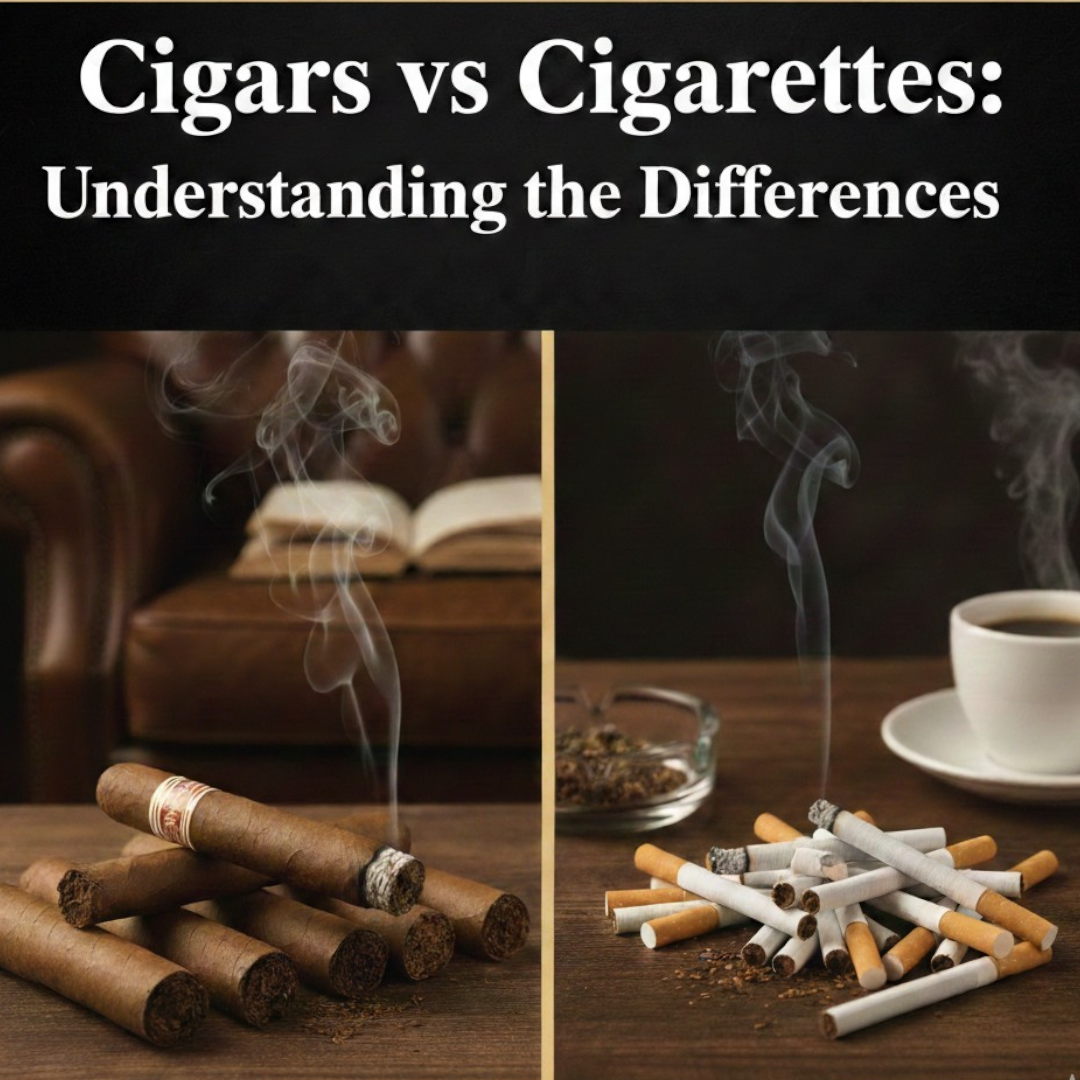
Cigars and cigarettes both involve tobacco, but that’s about where the similarities end. The difference between smoking a premium cigar and grabbing a quick cigarette? Night and day. Cigarettes are engineered for one thing—fast nicotine delivery. Cigars? They’re a whole different animal. We’re talking handcrafted tobacco, complex flavors, and an experience that demands your time and attention.
This guide breaks down what actually separates these two—from how they’re built to why they taste so different.
Quick Answer: Cigars vs Cigarettes
Here’s what you need to know upfront:
- Construction: Cigars use whole tobacco leaves. Nothing else. Cigarettes? Shredded tobacco mixed with chemicals, wrapped in treated paper.
- How you smoke them: With cigars, the smoke stays in your mouth—you’re tasting it. Cigarettes get inhaled straight into your lungs.
- Time: A good cigar takes 45-90 minutes, maybe longer. Cigarettes are done in 5-7 minutes.
- The point: Cigars are about flavor and ritual. Cigarettes are about nicotine delivery.
- When you smoke: Cigars mark occasions—celebrations, milestones, relaxation. Cigarettes become a daily habit.
Still with me? Let’s dig deeper.
Table of Contents
- Quick Answer: Key Differences
- Construction Comparison
- Tobacco Quality
- Time & Technique
- Flavor Profiles
- Sensory Experience
- Premium Brands
- Storage & Longevity
- FAQs
Why Cigars Feel Different
Smoking a cigar versus lighting up a cigarette—these aren’t even in the same category. Cigarettes are quick hits. You light one, you’re done in minutes, then you move on with your day. Premium cigars? They’re something else entirely.
A cigar asks for your time. It rewards your attention with layers of flavor, craftsmanship you can actually taste, and a ritual that makes you slow down. It’s the difference between grabbing fast food and sitting down for a proper meal.
Ever walked into a real cigar lounge? Notice what’s missing? Cigarettes. These places exist for one reason—the cigar experience. Climate-controlled humidors keeping hundreds of cigars at perfect conditions, comfortable leather chairs, people settling in for the long haul. It’s built around appreciation, not addiction.
How They’re Built: Cigars vs Cigarettes
The construction differences tell you everything about what each product is trying to be. When you understand how cigars and cigarettes get made, the gap between them becomes obvious.
What’s Actually Inside a Cigarette
Cigarettes pack shredded tobacco into chemically-treated paper. Most people don’t realize the “tobacco” is often reconstituted sheet. Manufacturers take tobacco dust, stems, whatever’s left over, and bind it all together into something usable. Then come the chemical additives, the burn accelerants in the paper, the filters. It’s engineering, not agriculture. Built for consistency, speed, and one purpose: nicotine delivery.
What Makes Up a Premium Cigar
Open up a premium cigar and you’ll find… tobacco. That’s it. Three different types of whole tobacco leaves, each with a job:
- Filler: The core that gives you body and primary flavors
- Binder: Holds everything together structurally
- Wrapper: The outer leaf responsible for 60-70% of what you taste
That wrapper alone often costs more than a whole pack of cigarettes. Premium wrappers—Connecticut Shade, Ecuadorian Habano—get grown under shade cloth, hand-selected for perfect color and minimal veins, then aged. Every step matters.
Machines vs Master Craftsmen
Watch how these get made and you’ll see two completely different worlds.
Cigarettes: Automated from start to finish. Machines pump out 20,000+ per minute. Zero human involvement. Just industrial efficiency doing its thing—fast, identical, endless.
Cigars: Human hands, human judgment, human skill. Master rollers (called torcedores) spend 2-5 years learning their craft.
- Feeling the tobacco moisture by hand
- Picking the right filler leaves for balance
- Rolling with just enough firmness for a perfect draw
- Wrapping without tears or imperfections
That’s the difference. One’s a factory product. The other’s handmade by someone who’s dedicated years to getting it right.
The Tobacco Makes All the Difference
Cigars and cigarettes really split paths when it comes to tobacco. It starts at the farm and keeps going through every step of production.
What Goes Into Each
Cigarette tobacco: Usually a blend of Virginia, Burley, and Oriental varieties picked mainly for nicotine content and how fast they burn. Function over flavor, every time.
Cigar tobacco: Dozens of varieties, each bringing something unique to the table. This is why handmade cigars taste so much better:
- Criollo: Spicy and complex, classic Cuban genetics
- Corojo: Bold pepper with natural richness
- Connecticut Shade: Smooth and creamy, gentle character
- Ligero: Top-priming leaves, full-bodied intensity
- Seco: Middle leaves, balanced medium body
- Volado: Bottom leaves that help with burn quality
And location? Massive factor. Cuban tobacco doesn’t taste anything like Nicaraguan or Dominican leaf. Same plant, different soil, completely different flavor—just like wine from different regions.
Time Changes Everything
Cigarette tobacco gets processed fast. Speed to market wins, quality comes second.
Premium cigar tobacco? That’s a years-long journey. After harvesting, the leaves go into pilones—large fermentation stacks where temperatures climb to 110-130°F. This isn’t a quick process:
- 30-90 days per fermentation round
- Usually 2-3 separate rounds
- Natural reduction of ammonia and harshness
- Development of complex flavors
- Sometimes 1-3 years before rolling even starts
Then after rolling, cigars age another 3-6 months minimum. Some age for years. Good flavor takes time, and there’s no shortcut around it.
Time and Technique: Completely Different Approaches
When comparing cigars vs cigarettes, how long they take and how you smoke them shows you everything about what each is designed for.
How Long It Takes
- Cigarettes: 5-7 minutes while you’re doing something else
- Petit Corona: 20-30 minutes
- Robusto: 45-60 minutes
- Churchill: 60-90 minutes
- Double Corona: 90+ minutes, sometimes pushing two hours
You can’t rush a cigar. Try it and you’ll overheat the tobacco, turn everything bitter. The time commitment isn’t negotiable—it’s the whole point.
How You Actually Smoke Them
Cigarettes: Deep inhale straight to the lungs. Quick nicotine absorption, uniform experience start to finish. It’s delivery, not enjoyment.
Cigars: Retrohaling—drawing smoke into your mouth, tasting it across your palate, sometimes exhaling through your nose to catch the aromatics. Never inhaling into your lungs. The whole point is flavor, and that flavor keeps changing as you smoke. Where cigarettes stay flat, cigars evolve.
Flavor: Why the Cigar Experience Surpasses Cigarettes
One of the most striking elements of the cigar smoking experience vs cigarettes is the profound difference in flavor complexity. When comparing cigars vs cigarettes, flavor separates them more than any other factor. While cigarette smoking offers monotone consistency, the cigar experience delivers a symphony of evolving tastes.
Cigarette Experience: One-Dimensional
Cigarettes offer consistency with minor brand variations. The taste remains largely static from start to finish, with characteristics primarily determined by additives and tobacco blend ratios. When people wonder why the cigar smoking experience is superior, understanding this flavor limitation in cigarettes is essential.
The Cigar Flavor Experience: Multi-Layered Complexity
Premium cigars deliver the layered, evolving flavor experiences that define the cigar smoking experience. Based on wrapper type and tobacco blend, each cigar offers a unique journey:
Connecticut Shade cigars (Escobar Connecticut, Perdomo Connecticut):
- Cream, almonds, cedar
- Mild to medium body
- Smooth, approachable
Habano wrapper cigars (Escobar Habano, PDR blends):
- Leather, earth, coffee
- Medium to full body
- Spicy, complex
Maduro cigars (Escobar Maduro, Drew Estate Blackened):
- Dark chocolate, espresso, molasses
- Full body with natural sweetness
- Rich, robust
Corojo cigars (Stallone Alazan):
- Black pepper, spice, tobacco
- Medium to full body
- Bold, distinctive
The Three Thirds Experience
A well-constructed cigar changes character as you smoke. This evolution is a defining feature of cigars vs cigarettes—where cigarettes remain static, handmade cigars transform:
First third: Introduction of primary flavors—often milder, with cream, nuts, or light spice
Second third: Core flavors develop—leather, cedar, coffee, earth emerge
Final third: Intensity peaks—pepper, espresso, concentrated tobacco notes
This evolution makes cigar smoking a journey rather than a static experience.
The Multi-Sensory Cigar Experience vs Cigarette Smoking
What truly separates the cigar smoking experience from cigarettes is the multi-sensory engagement. The debate of cigars vs cigarettes becomes clear when examining sensory depth. While cigarette smoking offers a one-dimensional nicotine delivery mechanism, the cigar experience involves all five senses in a rich, contemplative ritual. This is why many enthusiasts describe the premium cigar experience as incomparable to cigarette smoking.
What the Cigar Experience Engages
Visual inspection: Examining wrapper color (Claro, Colorado, Maduro, Oscuro), oil content, vein structure, and construction quality. Cigarette smoking offers no visual appreciation.
Touch and feel: Assessing firmness, wrapper texture (silky vs toothy), weight distribution. The tactile dimension is absent from the cigarette experience.
Pre-light aroma: Detecting barnyard, hay, cocoa, dried fruit, cedar notes from the foot and wrapper. Cigarettes smell of chemicals and paper.
Retrohale technique: Experiencing aromatic compounds through nasal passages—a sophisticated element unique to the cigar smoking experience.
Smoke character: Observing volume, density, and aroma of the smoke itself. Cigar smoke is aromatic and complex; cigarette smoke is acrid.
Draw resistance: Feeling the airflow—ideal draw should offer slight resistance without being tight. This subtle element of the cigar experience has no equivalent in cigarette smoking.
The Cigar Ritual
Unlike the quick cigarette break, cigar smoking involves preparation and ritual:
- Selection: Choosing from the humidor based on mood, time available, and flavor preference
- Inspection: Examining construction and checking for soft spots
- Cutting: Using a guillotine cutter, V-cut, or punch to create the opening
- Toasting: Gently warming the foot before lighting
- Lighting: Achieving even combustion with a torch lighter or cedar spill
- Savoring: Smoking slowly (1 puff per minute) to avoid overheating
Premium Brands Worth Exploring
The cigar smoking experience changes dramatically depending on the brand. Based on our extensive reviews, these brands consistently deliver exceptional quality:
Escobar Cigars
Exceptional construction across Connecticut, Habano, and Maduro wrappers. Reviews highlight firm, evenly rolled cigars with silky, oily wrappers and surprising flavor complexity.


Stallone Cigars
Master blender Tony Barrios creates blends known for remarkable construction and slow burn times. Reviewed cigars show full-bodied complexity with exceptional craftsmanship.


El Septimo
Known for remarkably “clean” flavor profiles and multi-layered complexity. The artist series—Da Vinci, Michelangelo, Salvador Dali—delivers evolving flavors with balanced construction throughout. Discover what makes their tobacco special.


Drew Estate
Innovative American manufacturer offering diverse experiences across price points, from value-focused blends to premium maduro complexity.


PDR Cigars
Dominican blends offering exceptional value with wonderful balance and smooth, fresh flavors across multiple lines.


Perdomo Cigars
Nicaraguan excellence with incredible value and luxurious everyday smoking options across Connecticut, Sungrown, and Anniversary blends.


Explore our detailed reviews and brand interviews to discover which premium cigar experience matches your palate.
Cigar Value vs Cigarette Cost
Cigarettes are designed for daily, repeated consumption with pricing to match that frequency.
Premium cigars range from accessible entry-level options to super-premium and limited edition releases. Learn more about what makes cigars worth their price.
The value of a cigar reflects:
- Years of tobacco growing and fermentation
- Skilled hand-rolling labor
- Wrapper leaf quality and rarity
- Brand prestige and aging
- 45-90+ minutes of experience
Culture and Community: The Social Cigar Experience
The social and cultural aspects of the cigar smoking experience versus cigarette smoking differ dramatically. Cigar culture emphasizes community, celebration, and shared ritual, while cigarette smoking tends to be solitary, rushed, and habit-driven.
The Social Element of Cigar Smoking
Cigar lounges function as gathering spaces where the cigar smoking experience unfolds over hours of conversation. The extended smoking time naturally facilitates:
- Business discussions
- Social bonding
- Celebration of milestones
- Relaxation and contemplation
Many lounges offer leather chairs, televisions, full bars, and membership programs creating community among regular patrons.
Occasions That Define the Cigar Experience
The cigar smoking experience marks life’s significant moments—something cigarettes never achieve:
- Weddings and anniversaries
- Bachelor parties
- Birth of a child
- Business success
- Golf outings
- Whiskey and cigar pairings
- Coffee pairings
- Holiday celebrations
This occasional, celebratory use defines the premium cigar experience and contrasts sharply with the habitual, frequent nature of cigarette smoking.
Storage and Longevity: Part of the Cigar Experience
How cigars and cigarettes are stored reflects their fundamental difference in philosophy and experience.
Cigarettes stay fresh in the pack for months due to sealed packaging and additives.
Premium cigars require proper storage:
- In a humidor: Years or decades (improve with age)
- Without humidification: Days to weeks before drying out
- Over-humidified: Risk of mold and beetles
Properly aged cigars (5-10+ years in controlled conditions) can increase in value and flavor complexity, similar to fine wine.
Understanding the Distinction: The Cigar Experience vs Cigarette Smoking
When evaluating the cigar smoking experience versus cigarettes, the fundamental difference becomes unmistakable:
Cigarette smoking is manufactured for efficient, consistent nicotine delivery through rapid consumption. Cigarettes are designed as daily-use products optimized for convenience and habit formation. The cigarette experience prioritizes speed and delivery.
The cigar smoking experience emphasizes agriculture, craftsmanship, and extended sensory enjoyment. Premium cigars offer flavor complexity, ritual, and the luxury of dedicated time. The handmade cigar represents a philosophy of appreciation and contemplation.
These represent two fundamentally different philosophies in tobacco—one engineered for efficiency and habit, the other cultivated for experience and appreciation. Understanding this core distinction between the cigar smoking experience and cigarette smoking explains why the two shouldn’t be directly compared as simple alternatives. They’re entirely different categories of tobacco enjoyment, serving completely different purposes and appealing to fundamentally different values.
Ready to explore the premium cigar experience? Visit a local cigar lounge with a proper walk-in humidor where knowledgeable staff can guide you through wrapper types, flavor profiles, and finding the right cigar for your palate and available time. The cigar smoking experience awaits—a world apart from cigarettes.
FAQs: The Cigar Smoking Experience vs Cigarettes
Short answer: Cigars contain more tobacco but deliver nicotine differently than cigarettes.
The cigar smoking experience and cigarette smoking deliver nicotine differently. Cigarettes provide quick nicotine hits through lung inhalation. Cigars offer a slower, mouth-absorbed experience with different alkaloid absorption. “Strength” in the cigar experience refers to flavor intensity, not just nicotine. Learn about body vs strength in cigars.
Short answer: Cigars are smoked for flavor through the mouth, not inhaled into lungs like cigarettes.
The cigar smoking experience emphasizes flavor appreciation through mouth and palate, not lung inhalation. Cigar smoke is too alkaline for lung inhalation—it’s designed for tasting, not rapid nicotine absorption. This fundamental technique difference is why the cigar experience focuses on sensory enjoyment while cigarette smoking focuses on delivery.
Short answer: Most cigar enthusiasts smoke occasionally (1-2 times weekly), not daily like cigarettes.
While possible, most cigar enthusiasts enjoy cigars occasionally—once or twice weekly. The time commitment (45-90+ minutes) and contemplative nature of the cigar smoking experience make daily smoking impractical for many. The cigar experience is about quality over quantity, unlike the habitual daily cigarette routine.
Rare cigars can reach premium price points. Limited edition releases and vintage cigars at auction command significant value.
Short answer: Yes. Cigars offer vastly more flavor complexity than cigarettes.
Yes, the cigar smoking experience offers dramatically more flavor complexity than cigarette smoking. When evaluating cigars vs cigarettes on taste alone, handmade cigars deliver evolving flavor profiles with notes ranging from cream and nuts to leather, chocolate, coffee, and spice due to whole-leaf tobacco, extended fermentation, and careful blending. Cigarettes offer one-note consistency. The difference in taste experience between cigars and cigarettes is comparable to comparing aged wine with mass-produced beverages.
Short answer: Start with our beginner’s guide, then try mild Connecticut-wrapped cigars.
Begin with our complete beginner’s guide to understand the cigar smoking experience. Then explore recommended cigars for beginners to find the right starting point for your journey.
Related Articles
For Beginners
- Cigar 101: Everything You Need to Know About Smoking Cigars (2026)
- Best Cigars for Beginners: Top 30 Picks to Start Your Journey
- How to Smoke a Cigar Properly: The Right Way for Beginners
- After Your First Cigar: What to Try Next
Understanding Cigars
- What Makes a Premium Cigar Premium?
- Are Cigars Expensive? The Truth About Premium Cigar Prices
- Understanding Cigar Anatomy: A Complete Breakdown
- The Essential Guide to Cigar Wrappers
- Maduro vs Connecticut Wrapper: Key Differences
Choosing Your Cigar
- Understanding Cigar Vitolas: How Size Shapes Your Experience
- Mild vs Medium vs Full-Bodied Cigars: What’s the Real Difference?
- What Do Cigars Taste Like? Complete Flavor Guide
- How to Inspect a Cigar Before Buying It
Cigar Storage & Care
- How to Store Cigars: The Complete Humidity Guide
- How to Choose the Right Humidor
- When Are Cigars Ready to Smoke After Purchase?
- Electronic Humidors: Are They Worth It?
Top Lists & Reviews
- Top 20 Cigars of 2025
- Best 15 Premium Cigars Under $15
- Top 16 Maduro Cigars of 2025
- Top 13 Connecticut Cigars of 2025
- Browse All Cigar Reviews
Pairing & Occasions
- How to Pair Cigars with Whiskey: Beginners Guide
- 10 Cigars That Pair Perfectly with Coffee
- How to Choose Wedding Cigars Your Guests Will Actually Enjoy
- How to Choose the Perfect Cigar for a Bachelor Party
Subscribe to our newsletter and find out about all new posts
Check out our latest posts
- The 20 Best Cigars for the Money
 The best cigars for the money are not the lowest-priced cigars on the shelf. They’re the ones where the price and the quality don’t match.… Read more: The 20 Best Cigars for the Money
 - How to Put Out a Cigar Properly: The Complete Guide
 Most guides online skip this entirely. They’ll walk you through cutting, lighting, draw technique — then nothing. The session just ends and you’re left staring… Read more: How to Put Out a Cigar Properly: The Complete Guide
 - Interview Escobar Cigars: Two Markets, One Brand, Zero Compromises
 Escobar Cigars has been carving out its place in some of the world’s most demanding markets — navigating strict European regulations, building a brand without… Read more: Interview Escobar Cigars: Two Markets, One Brand, Zero Compromises
 - Swecigars: Premium Cigar Distribution in Sweden Explained
 Most people pick up a premium cigar and never think twice about what it took to get there. Behind every cigar on a Swedish shelf… Read more: Swecigars: Premium Cigar Distribution in Sweden Explained
 - Do you inhale cigar smoke?
 Do you inhale cigar smoke? No. The smoke stays in your mouth, you taste it, then blow it out. Cigarettes get inhaled into the lungs.… Read more: Do you inhale cigar smoke?
 - El Septimo Cigars: The Complete Guide — cigar Reviews, Interviews & the Story Behind the Brand
 El Septimo cigars are a Swiss-founded luxury cigar brand owned by Zaya Younan. Tobacco is grown without pesticides at high altitude, fermented for 12 months… Read more: El Septimo Cigars: The Complete Guide — cigar Reviews, Interviews & the Story Behind the Brand
 - Cigars vs Cigarettes: What’s the Difference?
 Cigars and cigarettes both involve tobacco, but that’s about where the similarities end. The difference between smoking a premium cigar and grabbing a quick cigarette?… Read more: Cigars vs Cigarettes: What’s the Difference?
 - Sex and Cigars Trigger the Same Parts of Your Brain
 It’s that hour. The one you’ve been quietly looking forward to all day. You settle into your chair — the leather cool for just a… Read more: Sex and Cigars Trigger the Same Parts of Your Brain